Artwork
Little Girl in a Blue Armchair
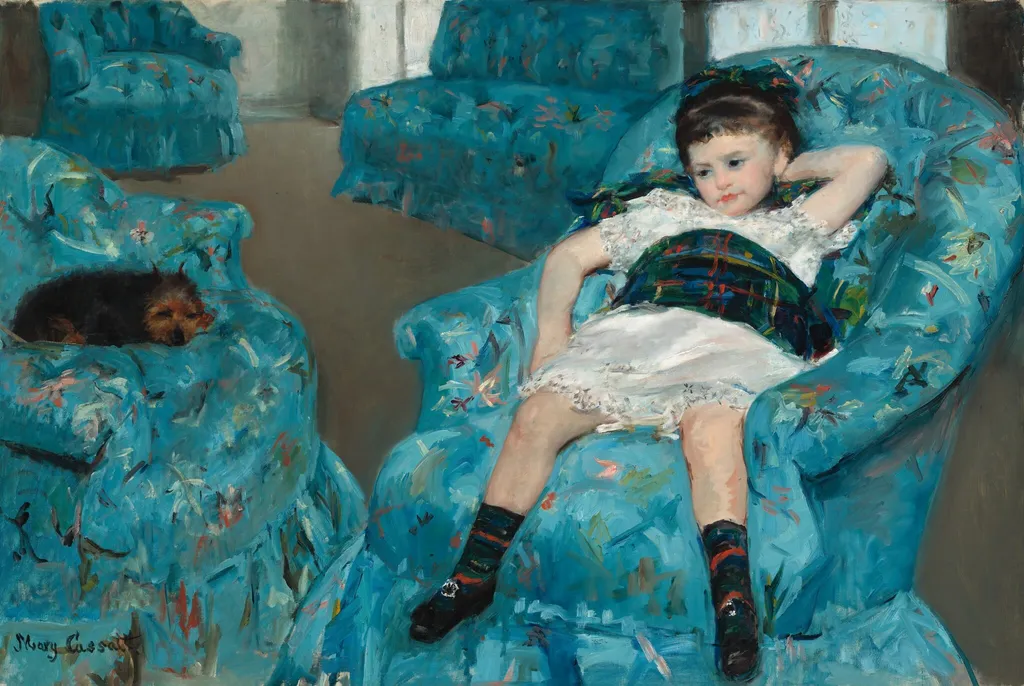
Little Girl in a Blue Armchair is an oil painting by the Impressionist artist Mary Cassatt. It dates from 1878 and is held in the collection of the National Gallery of Art.
- Inscription
- Inscribed:lower left: Mary Cassatt; on stretcher crossbar in pencil: M. Vollard / 6 Rue Lafitte
About this work
Painted by Mary Cassatt in 1878, the canvas captures the restlessness of childhood with a candid, asymmetrical composition that broke with formal portraiture.
A small girl sprawls across an overstuffed blue armchair in a Parisian drawing room, her tartan sash and polished shoes at odds with her exhausted, unposed slump. Beside her, a lapdog sleeps in a matching chair. Painted by Mary Cassatt in 1878, the canvas captures the restlessness of childhood with a candid, asymmetrical composition that broke with formal portraiture. It now hangs in the National Gallery of Art, Washington.
History & Provenance
Painted in 1878, the work was not commissioned; the model was a daughter of friends of Edgar Degas. Degas advised on the background and worked on the canvas, a contribution later confirmed by infrared photography. Cassatt submitted the painting to the American Pavilion of the 1878 World's Fair, where it was rejected; she expressed her frustration in a 1903 letter to dealer Ambroise Vollard.
It was likely shown at the Fourth Impressionist Exhibition in 1879 as Portrait de petite fille. Provenance: purchased from the artist by Ambroise Vollard (Paris, c. 1903), then Hector Brame (Paris); sold in November 1963 to Mr. and Mrs. Paul Mellon (Upperville, Virginia); gifted in 1983 to the National Gallery of Art, Washington, D.C.
The painting is held in the collection of the National Gallery of Art, Washington, D.C., to which it was gifted in 1983 by Mr. and Mrs. Paul Mellon. Its exhibition history includes the Fourth Impressionist Exhibition in Paris in 1879, where it was likely shown as Portrait de petite fille. It was also submitted to the American pavilion of the 1878 World's Fair but rejected.
Prior to its gift, the work was lent by the Mellons to the National Gallery of Art for exhibitions. The painting was earlier owned by dealer Ambroise Vollard (purchased from the artist around 1903) and then by Hector Brame before its acquisition by the Mellons in 1963.
Context
Debuted at the Fourth Impressionist Exhibition in 1879 after rejection by the American pavilion at the 1878 World's Fair, the painting is often cited as a radical image of childhood. Griselda Pollock and Petra Chu see it as challenging adult constraints, while Germaine Greer calls it Cassatt's first stunning icon of childlike boredom. Feminist scholarship explores its subjectivity: Pollock reads the child as subject, Harriett Chessman links the pose to Manet’s Olympia, suggesting encoded female sexuality.
The asymmetrical composition and cropping reflect Degas’ influence and Japanese prints; infrared photography confirmed Degas worked on the background. Judith Barter compares Cassatt’s nuanced psychologism to a conventional contemporary portrait by Cluysenaar. The painting thus stands as a pivotal early Impressionist statement on childhood.
Legacy
The painting has been celebrated as a groundbreaking and radical depiction of childhood. Art historian Griselda Pollock has described it as one of the most radical images of childhood of its time, while Germaine Greer called it Cassatt's first real stunner, an icon of the child's experience of being controlled yet ignored by adults. The work is frequently analyzed in feminist art history, notably in Harriett Chessman's influential 1993 essay Mary Cassatt and the Maternal Body, which reads the child's body as a site for encoding female subjectivity.
Its unconventional, child's-eye perspective and languid pose have made it an enduring symbol of bourgeois childhood boredom and nascent independence. The painting's initial rejection from the 1878 World's Fair is often cited as a testament to its avant-garde nature, now firmly recognized as a masterpiece.
Overview
Little Girl in a Blue Armchair, an oil on canvas by American artist Mary Cassatt, was completed in 1878. This painting is held in the collection of the National Gallery of Art in Washington D.C. It exemplifies Cassatt's distinctive approach to depicting children, capturing a moment of unposed relaxation that challenged the formal conventions of portraiture prevalent in her era, reflecting her engagement with Impressionist principles.
Subject & Meaning
The artwork portrays a young girl sprawled across an oversized blue armchair within what appears to be a Parisian drawing room. Her formal attire, including a tartan sash and polished shoes, contrasts with her languid, almost exhausted posture, suggesting a candid moment rather than a posed sitting. A small dog sleeps peacefully in a matching armchair beside her, reinforcing the scene's intimate and relaxed atmosphere. Cassatt effectively conveys the natural, often uninhibited, spirit of childhood.
Technique & Style
Cassatt employed an asymmetrical composition that departed from traditional portraiture, positioning the child off-center and capturing her in an unconventional, sprawling pose. This candid approach emphasizes the girl's individuality and natural behavior, moving away from the idealized or stiff portrayals common in the period. The loose brushwork and the vibrant blue hues of the armchairs contribute to the painting's fresh, modern sensibility, characteristic of the Impressionist movement with which Cassatt was associated.
Own this work as a print
Artist & collection
Artist
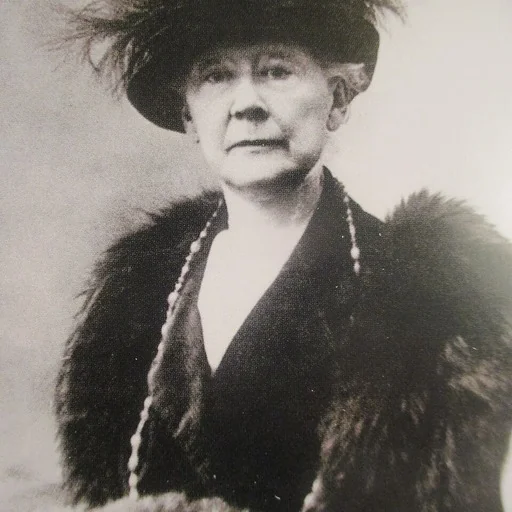
Mary Stevenson Cassatt (; May 22, 1844 – June 14, 1926) was an American painter and printmaker.

 Compared in the Impressionism course