Artwork
The Cup of Tea
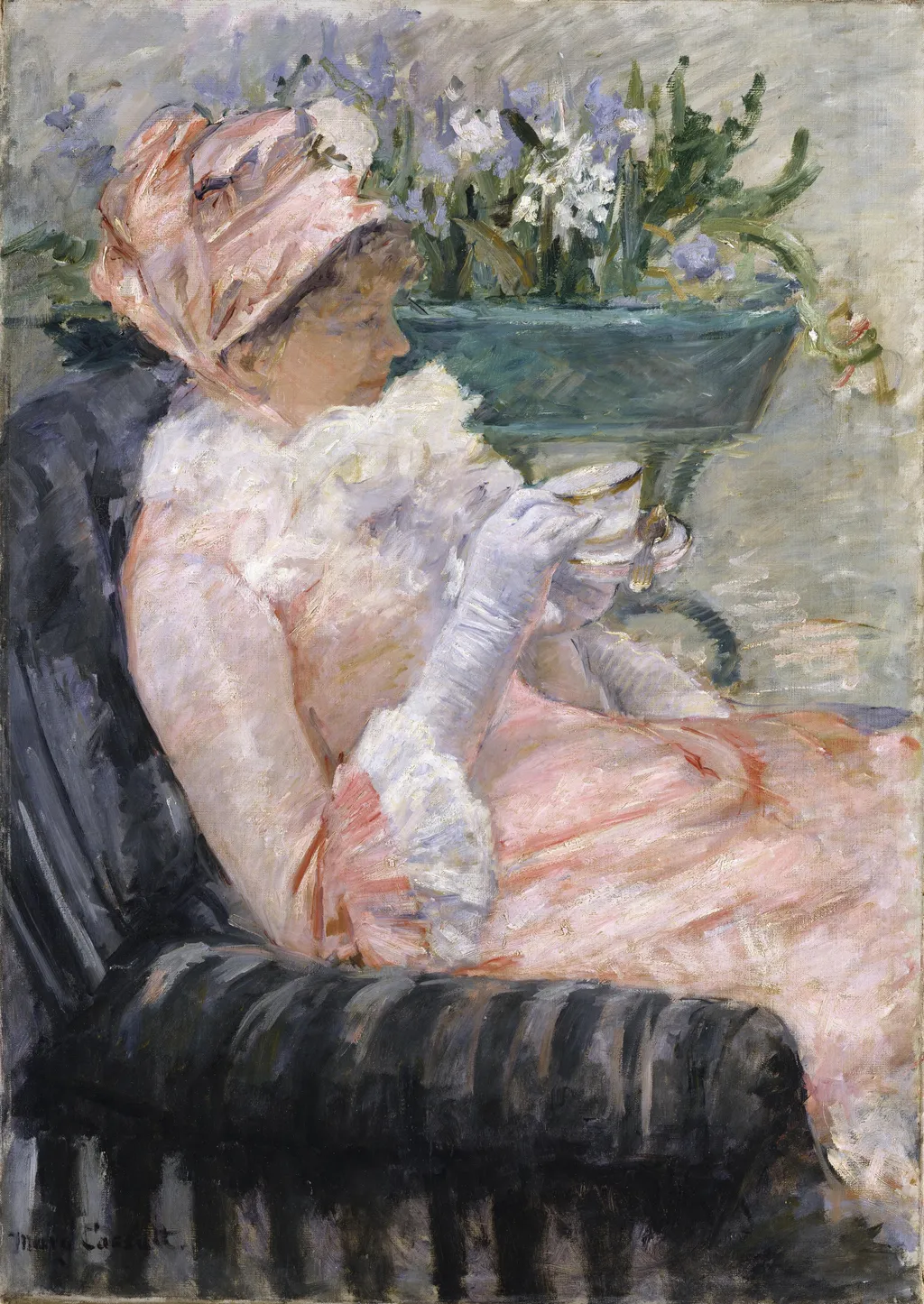
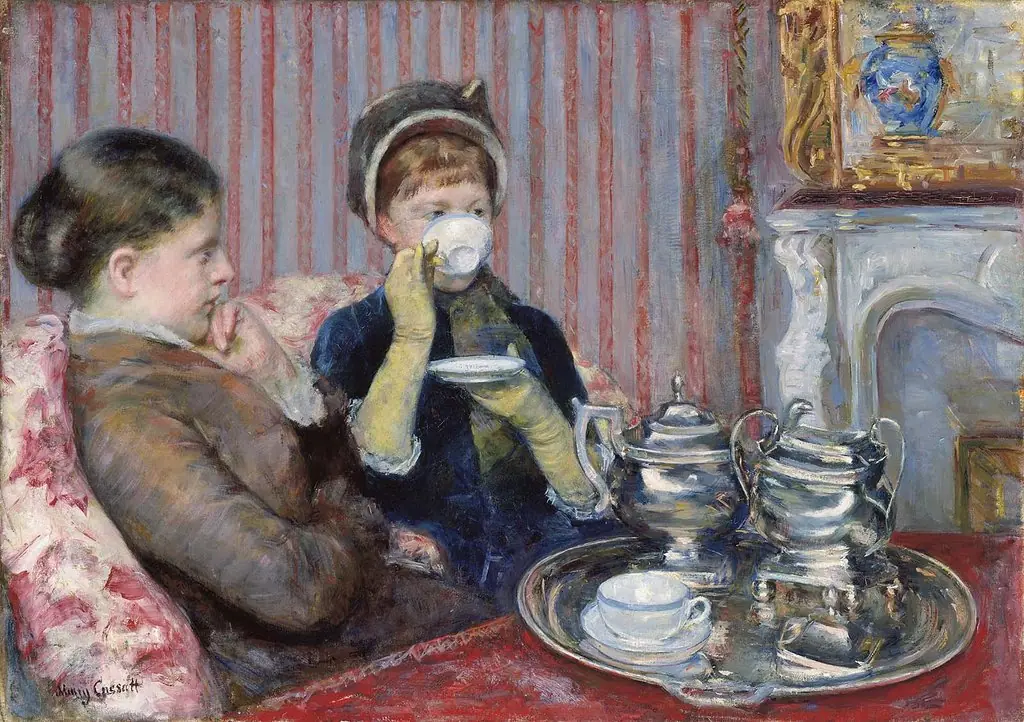
The Cup of Tea is an oil painting by the Impressionist artist Mary Cassatt. It dates from 1890 and is held in the collection of the Metropolitan Museum of Art.
About this work
The Cup of Tea, an oil by Mary Cassatt from 1890, shows a quiet afternoon moment over tea. Cassatt painted her sister Lydia in Paris, where the two lived. The everyday scene gains energy from bright color and quick brushstrokes, never stiff or formal.
Subject & Meaning
Scholars interpret the work as a representation of the domestic sphere accessible to bourgeois women, who were often restricted from public spaces.
The Cup of Tea depicts Mary Cassatt's sister, Lydia, engaged in the upper-class Parisian ritual of afternoon tea. The subject is identified by specific iconography: a gold-edged teacup, silver spoon, bonnet, lace, and gloves, which collectively signify high social status and the formality of a guest visiting a home. A green wicker planter containing white hyacinths sits behind the figure; these flowers traditionally symbolize beauty and pride, reinforcing the scene's elegance.
Scholars interpret the work as a representation of the domestic sphere accessible to bourgeois women, who were often restricted from public spaces. The composition avoids traditional portraiture, instead emphasizing an anecdotal moment of daily life. The recurring use of pink tones unites the dress, gloves, face, and flowers, while the undefined spatial boundaries create a sense of intimacy, capturing the specific social identity and constraints of the artist's milieu.
Technique & Style
The Cup of Tea is an oil on canvas painting measuring 92.4 × 65.4 cm, created by Mary Cassatt in Paris around 1880. The work is executed in oil paint on a canvas support, a medium noted in the artist’s records and confirmed by the Metropolitan Museum of Art’s catalogue. Cassatt’s technique employs loose, measured brushstrokes that dissolve outlines and integrate figure with background, a hallmark of Impressionist practice documented in contemporary analyses.
Vivid, contrasting colors, particularly varied pinks, unify the composition, while selective detail, such as the blue‑tinged highlights on the gloves, accentuates form. The painting’s spatial ambiguity, described as undefined by critics, contributes to a sense of immediacy, and its overall conception emphasizes anecdotal daily life rather than formal portraiture.
History & Provenance
Mary Cassatt painted The Cup of Tea in Paris between 1879 and 1881, using her sister Lydia Cassatt as the model; the work is an oil on canvas measuring 92.4 × 65.4 cm. The painting was first noted in Edgar Degas’s 1879 exhibition list and subsequently shown at the Sixth Impressionist Exhibition of 1881. It was later purchased by James Stillman, a retired American banker and associate of the Cassatt family, before entering the collection of the Metropolitan Museum of Art, where it remains today. The dating of 1880 is recorded in the artist’s catalogue entry and corroborated by the work’s documented inception on 1880‑01‑01.
According to the Metropolitan Museum of Art’s catalog, The Cup of Tea is part of the museum’s collection and is housed in New York. The work was first listed in Edgar Degas’s provisional inventory for the 1879 Impressionist exhibition, though it did not appear in the subsequent exhibition catalogue; it was later shown at the Sixth Impressionist Exhibition in 1881, where it attracted both praise and criticism. The painting remained in private hands until it entered the Met’s holdings, where it has been displayed as part of the museum’s permanent collection of Impressionist works. No specific accession number is recorded in the available sources.
Context
Painted in Paris between 1879 and 1881, The Cup of Tea is recognized as a quintessentially Impressionist work due to its vivid colors, loose brushwork, and novel perspective. Although excluded from the 1879 exhibition catalog, it appeared in the Sixth Impressionist Exhibition of 1881, where it garnered both praise and criticism. Contemporary critic Gustave Geffroy lauded the piece for its "exquisitely Parisian" depiction of femininity and light.
Art historical scholarship interprets the painting through the lens of Cassatt's gendered constraints; while some view it as a natural extension of her bourgeois milieu, others argue that social restrictions on women limited her subject matter to domestic rituals. Critics note the work's "undefined" spatial boundaries and deliberate cropping, which prioritize the overall scene over traditional portraiture. Today, the painting's status within the Metropolitan Museum of Art underscores its significance in documenting the intersection of Impressionist technique and the specific social realities of upper-class Parisian women.
Legacy
The Cup of Tea helped solidify Mary Cassatt’s reputation as a leading chronicler of women’s private social rituals, a role that defined her later legacy. After its debut at the Sixth Impressionist Exhibition of 1881, the work was praised by critics such as Geffroy and later acquired by James Stillman, eventually entering the Metropolitan Museum of Art. Contemporary scholarship highlights its Impressionist brushwork, use of color, and depiction of upper‑class Parisian domesticity, noting how Cassatt transforms an everyday tea ceremony into a study of gendered space.
Its inclusion in a major museum collection and repeated scholarly discussion have made the painting a reference point for studies of gender, class, and Impressionism, reinforcing Cassatt’s enduring influence on the representation of women’s interior lives.
Overview
Mary Cassatt, an American artist working in Paris, created The Cup of Tea around 1879–1881. This oil painting captures a quiet, intimate moment, portraying her sister Lydia Cassatt engaged in the everyday ritual of afternoon tea. The work exemplifies Cassatt's distinctive approach to depicting domestic life, blending a sense of personal observation with the innovative stylistic elements of her time.
Own this work as a print
Artist & collection
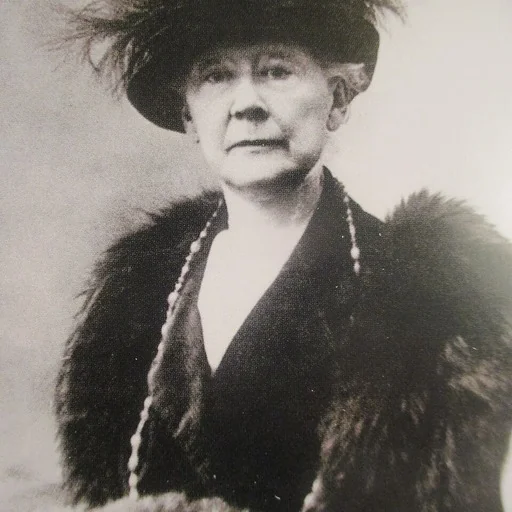
Artist
Mary Stevenson Cassatt (; May 22, 1844 – June 14, 1926) was an American painter and printmaker.