Artwork
Calvary
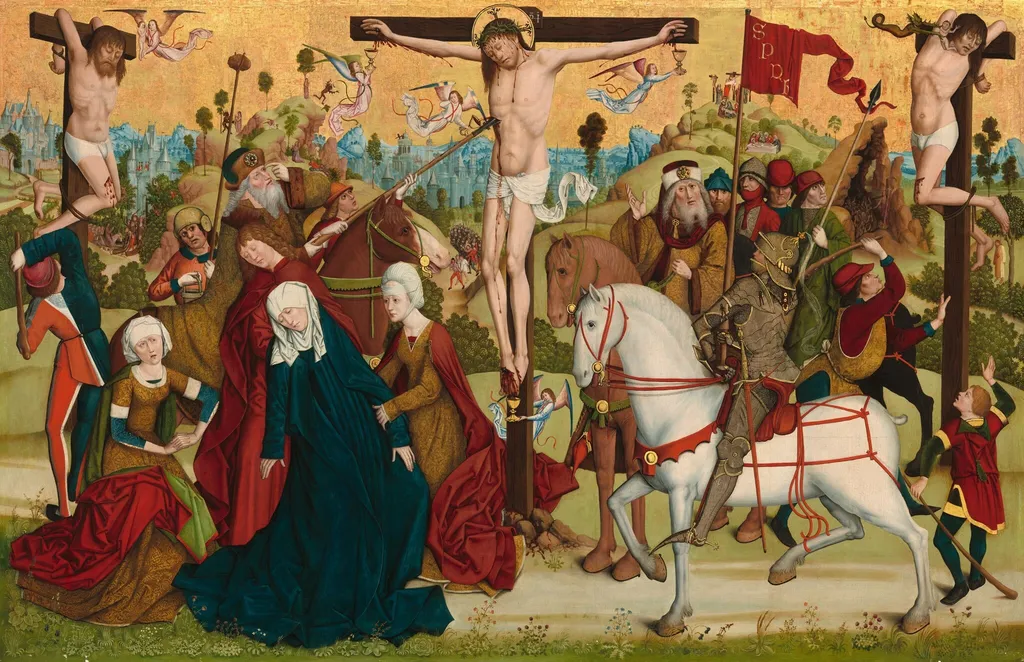
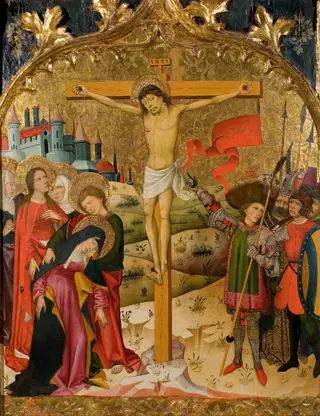
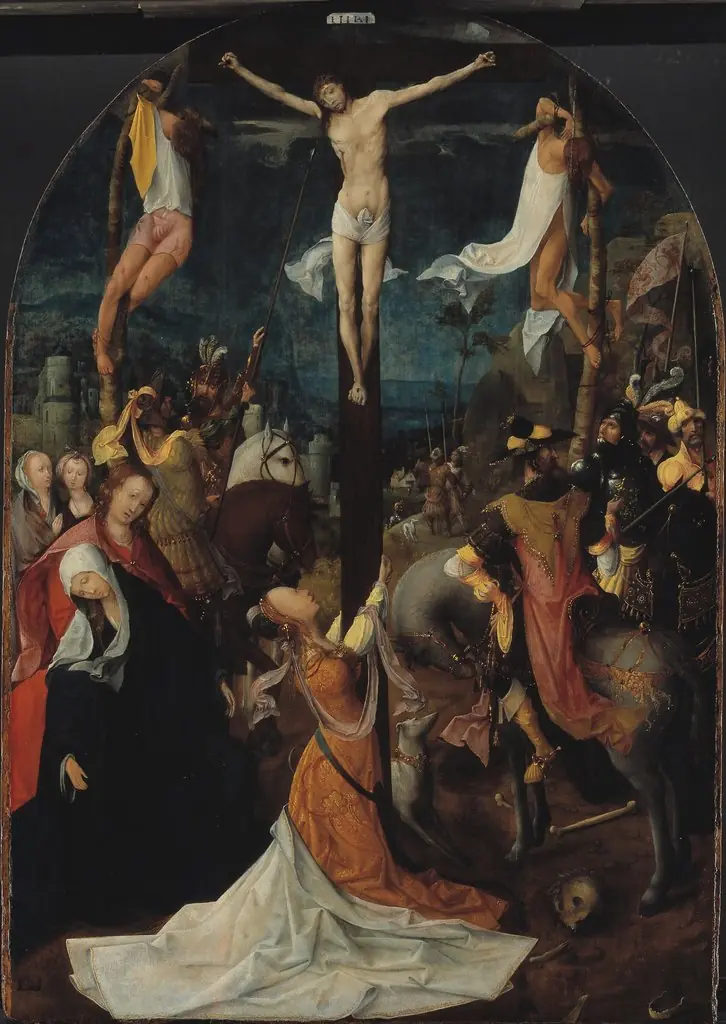
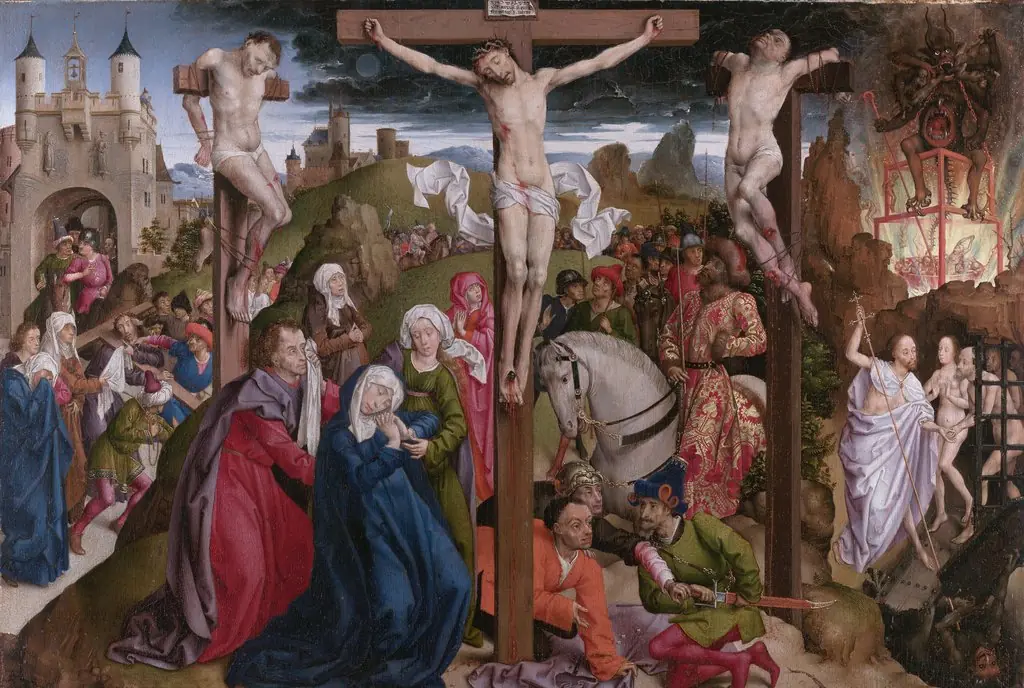
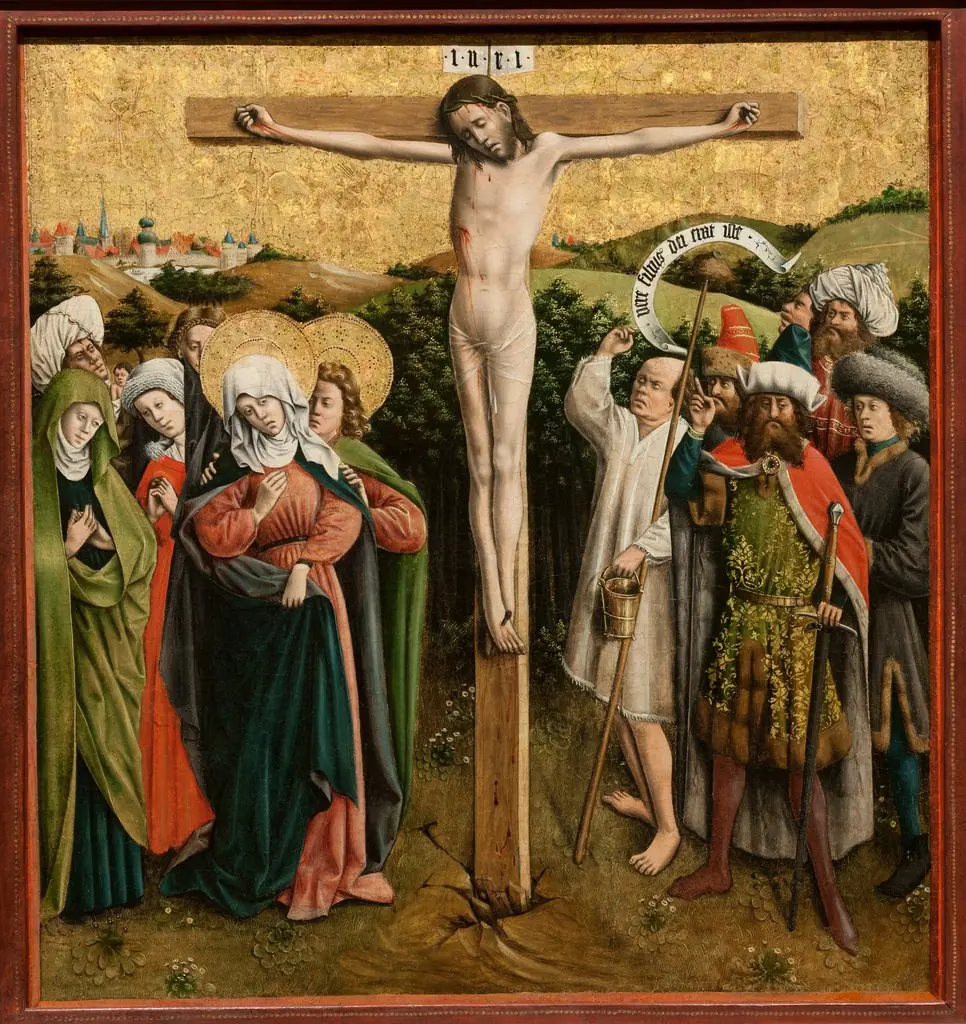
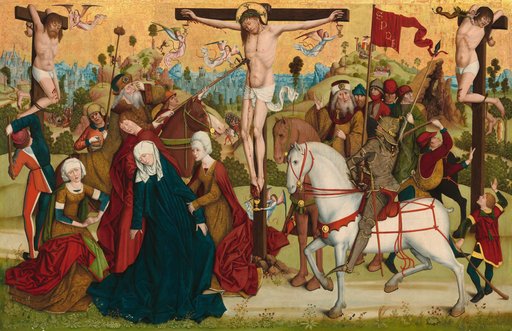
Calvary is an oil painting by the Northern Renaissance artist Master of the Death of Saint Nicholas of Münster. It dates from 1475 and is held in the collection of the National Gallery of Art.
- Inscription
- Inscribed:on the leg of the figure in lower right: N V S
About this work
Subject & Meaning
Created circa 1475, this oil panel by the Master of the Death of Saint Nicholas of Münster depicts the Crucifixion of Jesus Christ as its primary subject.
Created circa 1475, this oil panel by the Master of the Death of Saint Nicholas of Münster depicts the Crucifixion of Jesus Christ as its primary subject. Classified as a religious work, the painting's title, Calvary, directly references the biblical site of the execution, known as Golgotha. The iconography centers on the figure of Jesus Christ, representing the pivotal moment of sacrifice in Christian theology.
While specific details regarding surrounding figures or landscape elements are not explicitly enumerated in the available records, the work's classification and designated main subject confirm its function as a devotional image focused on the Passion narrative. The composition serves as a visual meditation on the death of Christ, adhering to the traditional iconographic conventions of Northern European religious art from the second half of the fifteenth century.
Technique & Style
The work is an oil painting on a wooden panel, created circa 1475 by the Master of the Death of Saint Nicholas of Münster. Its support is a panel, and the paint medium consists of oil pigments applied to achieve a richly layered surface typical of late‑Gothic religious art. The composition centers on the crucifixion of Jesus, reflecting a devotional genre common in Central European painting of the period.
Provenance records document handling through several owners, Nazi confiscation in 1940, and subsequent restitution, indicating careful archival tracking. While specific conservation details are not provided, the documented chain of custody and material description confirm its panel support and oil technique.
History & Provenance
The Calvary by the Master of the Death of Saint Nicholas of Münster is dated to circa 1475 based on stylistic and technical analysis. The painting’s early provenance traces to Léon Tabourier, whose estate sale in Paris in June 1898 included it as a work by a German school artist. It subsequently passed through Durand-Ruel et Cie and F. Kleinberger Galleries in Paris before entering the collection of André J. Seligmann by 1938.
During World War II, the painting was confiscated by Nazi forces from Seligmann in July 1940 and transferred to the Jeu de Paume, later removed by Hermann Göring in November 1940. Recovered post-war at the Munich Central Collecting Point, it was restituted and later acquired jointly by Bernheimer, Otto Naumann, and Alfred Bader in 2001 before entering the National Gallery of Art, Washington, D.C.
The painting is currently held by the National Gallery of Art in Washington, D.C., having been acquired on June 6, 2001, through a joint purchase involving Bernheimer of Munich, Otto Nauman of New York, and Alfred Bader of Milwaukee. Prior to this acquisition, the work appeared at a Christie's auction in New York on January 27, 2000. The object's modern history includes its confiscation by Nazi forces in July 1940 from the Paris collection of André J. Seligmann and subsequent transfer to the Jeu de Paume, where it was selected for Hermann Göring's personal collection in November 1940.
Following recovery in Berchtesgaden, the panel passed through the Munich Central Collecting Point and the Musées Nationaux Récupération before entering the American museum's holdings.
Context
The panel, attributed to the Master of the Death of Saint Nicholas of Münster and dated to circa 1475, is an oil painting on panel that depicts the Crucifixion, a common devotional subject in late‑15th‑century German religious art. Its provenance records a confiscation by Nazi authorities in 1940, inclusion in Hermann Göring’s collection, and post‑war restitution, illustrating the impact of World War II on European art. The work is presently in the National Gallery of Art, Washington, D.C., where it is studied alongside other pieces from the Master’s oeuvre.
Legacy
Following its post-war recovery and restitution, Calvary eventually entered the National Gallery of Art, Washington, which acquired it in 2001, where it became a focal point in studies of late-medieval German painting. Its association with the Nazi-era Göring collection later shaped provenance research, influencing discussions on restitution and the displacement of cultural property during World War II. The work’s stylistic influence remains limited in broader art-historical narratives, confined largely to specialized examinations of Westphalian panel painting from the late fifteenth century.
Overview
This painting, titled Calvary, is an oil on panel work created around 1475 by an artist known only as the Master of the Death of Saint Nicholas of Münster. It portrays the crucifixion of Jesus Christ, a central event in Christian theology. The composition employs a restrained palette and understated emotional expressions, contributing to a solemn and contemplative atmosphere characteristic of the period's devotional art.
Own this work as a print
Artist & collection
Artist
Master of the Death of Saint Nicholas of Münster
Master of the Death of Saint Nicholas of Münster (1470–1480) was an artist.