Artwork
Charles I de Crequi, Duke of Lesdiguières
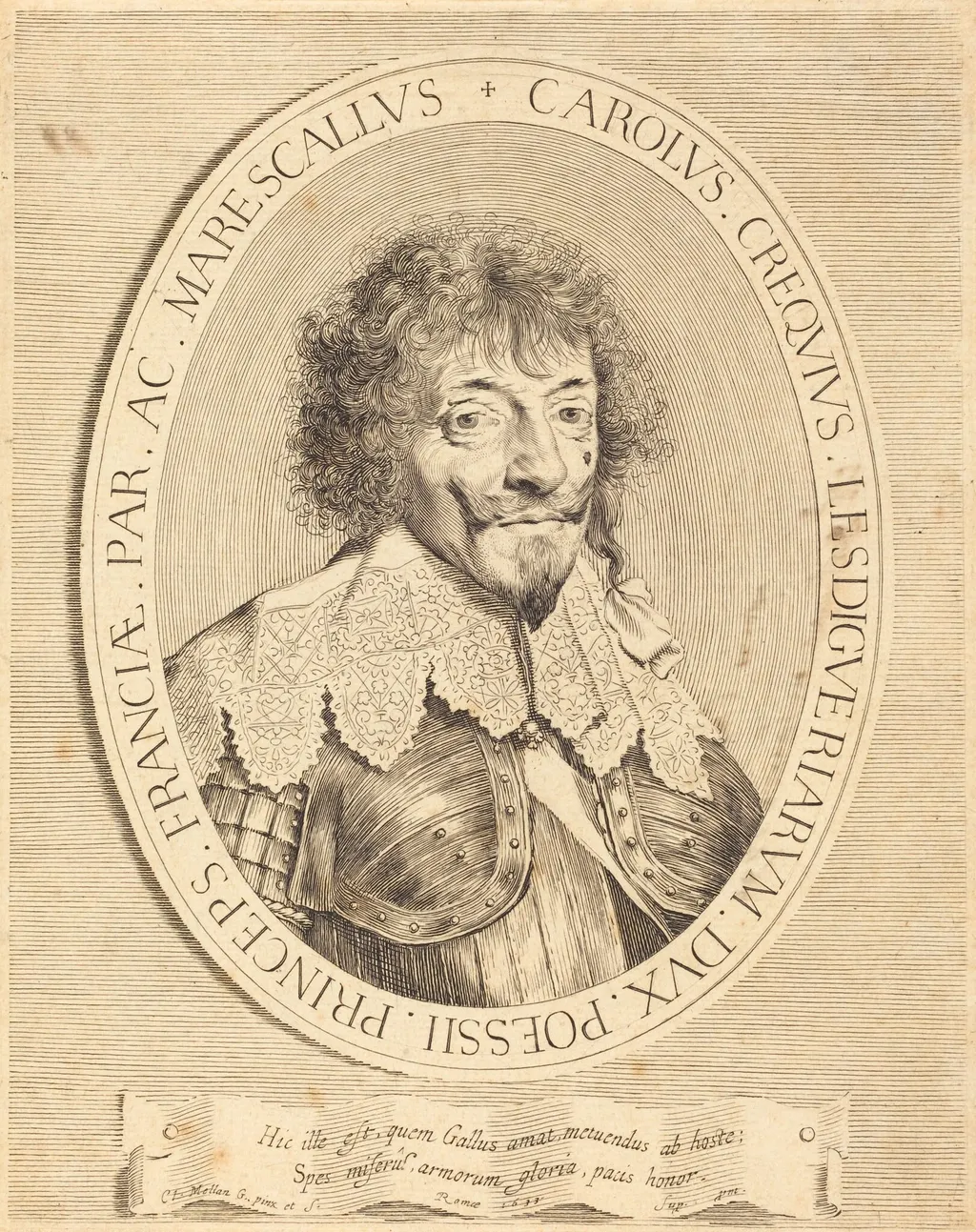
Charles I de Crequi, Duke of Lesdiguières is an ink print by the Baroque artist Claude Mellan. It dates from 1633 and is held in the collection of the National Gallery of Art.
- Inscription
- Inscribed:around circumference in plate: CAROLVS. CREQVIVS. LESDIGVERIARVM. DVX. POESSII. PRINCEPS. FRANCIAE. PAR. AC. MARESCALLVS; across bottom in plate: Hic ille est. quem Gallus amat, metuendus ab hoste; / Spes miferus, armorum gloria, pacis honor. / Cl. Mellan G. pinx et S. Romae 1633 Sup. pnt. ; by later hands, cLv//in brown ink: a paris Chez Naudet / M Destemps au louvre 1792; uRv//in brown ink: 28
About this work
The artist signed it in 1633, and the lines are made by etching into the paper.
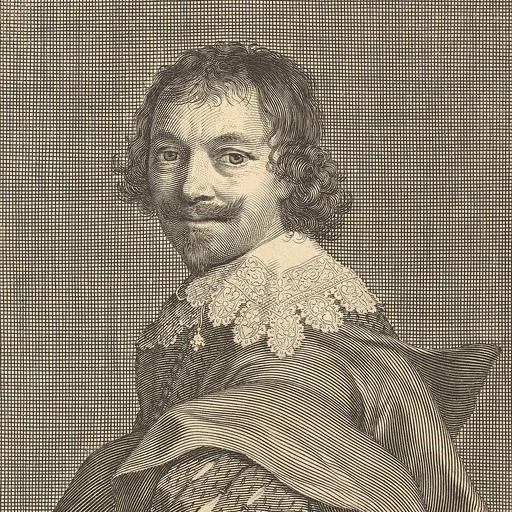
This is a black-and-white portrait of a man with curly hair and a beard. He’s wearing a fancy lace collar and a dark jacket with buttons. The background is plain, and his face looks serious.
The name around the oval reads Charles I de Crequi, Duke of Lesdiguières. The artist signed it in 1633, and the lines are made by etching into the paper.
Check out how the artist used engraving to create all those tiny details.
Overview
Created in 1633 by the French Baroque engraver Claude Mellan, this portrait depicts Charles I de Créquy, Duke of Lesdiguières. The work is an engraving on laid paper, presenting a bust-length view of the sitter within an oval frame. Mellan captures the Duke with a serious expression, characterized by curly hair and a beard, dressed in a dark jacket with visible buttons and a prominent, intricate lace collar.
The composition relies on a plain background to focus attention entirely on the subject's face and attire. The artist's signature and the date 1633 appear alongside the inscription identifying the Duke. This piece exemplifies Mellan's technical mastery in the early 17th century, utilizing fine line work to render texture and volume without the aid of color.
As a formal state portrait, it serves to document the status and appearance of a significant French nobleman during the reign of Louis XIII, reflecting the period's preference for dignified, realistic representation in print.
Subject & Meaning
The portrait records the identity and status of Charles I de Crequi, a prominent French duke and military leader of the early 17th century. The sober expression and restrained attire convey authority and dignity, typical of aristocratic portraiture intended to affirm lineage and social rank.
Technique & Style
Mellan employed a fine engraving technique, incising lines directly into the paper surface. The delicate hatching creates subtle tonal variations that model the facial features, hair, and lace collar. The precision of the line work demonstrates the artist’s mastery of chiaroscuro through linear means rather than tonal washes.
History & Provenance
Signed and dated 1633 by Mellan, the print likely originated as a commemorative image for the duke’s contemporaries. While specific ownership records are scarce, such portraits were commonly circulated among noble families and collected by connoisseurs of French printmaking in the 17th and 18th centuries.
Context
The engraving belongs to a period when French aristocracy commissioned portrait prints to disseminate their image beyond painted portraits. Mellan, known for his precise line work, contributed to this tradition, providing a reproducible likeness that could reach a broader audience while reinforcing the duke’s public persona.
Own this work as a print
Artist & collection