Artwork
白鶏図|Rooster, Hen, and Chicks
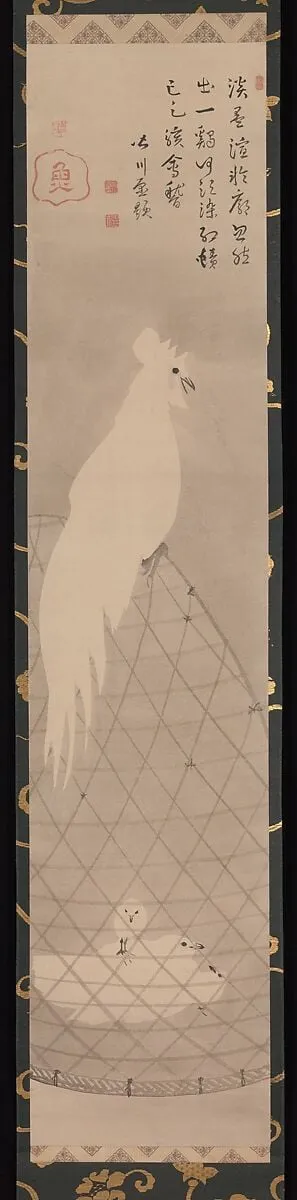
白鶏図|Rooster, Hen, and Chicks is an ink painting by the Nihonga artist Nagasawa Rosetsu. It dates from 1784 and is held in the collection of the Metropolitan Museum of Art.
About this work
Subject & Meaning
Painted in 1787 by Nagasawa Rosetsu, this hanging scroll in ink on paper presents a domestic scene of fowl, depicting a rooster, a hen, and their chicks.
Painted in 1787 by Nagasawa Rosetsu, this hanging scroll in ink on paper presents a domestic scene of fowl, depicting a rooster, a hen, and their chicks. The composition belongs to the genre of still life, a category in which Rosetsu occasionally worked despite the prominence of figure and landscape subjects in late-eighteenth-century Japanese painting.
In East Asian visual tradition, groupings of a rooster with hens and chicks carried auspicious associations. The rooster was linked to the dawn, to vigilance, and to the Five Virtues (civic courage, parental devotion, martial valor, benevolence, and trustworthiness), while the surrounding brood evoked familial harmony, fertility, and the continuity of the household. Such imagery appealed to patrons as a blessing for domestic prosperity and protection.
History & Provenance
The hanging scroll Rooster, Hen, and Chicks was painted by Nagasawa Rosetsu in 1787, as indicated by the artist’s inscription on the work. The painting entered the collection of the Metropolitan Museum of Art, where it is currently held. The piece was created in Japan during the Edo period, aligning with Rosetsu’s active years (1754–1799).
No documented commission or patronage history is recorded in the available sources, and the work does not bear evidence of a specific patron or original ownership beyond its eventual acquisition by the museum.
The painting is held by the Metropolitan Museum of Art, New York, where it is accessioned as 2015.503.1. It was first recorded in a Japanese context in 1787, the year of its creation by Nagasawa Rosetsu.
The work has not been recorded in any subsequent public exhibitions in the sources consulted.
Overview
Nagasawa Rosetsu's "Rooster, Hen, and Chicks," created around 1784, is an ink painting on a hanging scroll. This work presents a domestic scene featuring a rooster, a hen, and three chicks. The composition is notable for its minimalist approach, employing significant areas of unpainted paper to define the space around the birds, a technique that distinguishes it within the artistic practices of its period.
Technique & Style
Rosetsu utilized ink on paper with a distinctive approach to brushwork. The birds are formed through quick, assured strokes, creating a dynamic yet refined texture. A notable contrast emerges between the perceived softness of the rooster's plumage and the precise, dry application of ink.
The absence of a background and the intentional use of expansive white space are central to the work's aesthetic, highlighting the subjects with clarity.
Context
Executed in the 1780s, this painting deviates from the common artistic conventions of its era, when many artists favored compositions that filled the entire picture plane. Rosetsu's decision to leave large portions of the paper blank was a deliberate stylistic choice. This innovative use of negative space lends the work a striking and almost contemporary sensibility, setting it apart from much of the period's output and showcasing an advanced compositional awareness.
Artist & collection

Artist
Nagasawa Rosetsu (長沢芦雪; 1754–1799) was a Japanese painter during the Edo period. A disciple of the Maruyama School, he was known for his versatile artistic style. He was born to the family of a low-ranking samurai. He…