Artwork
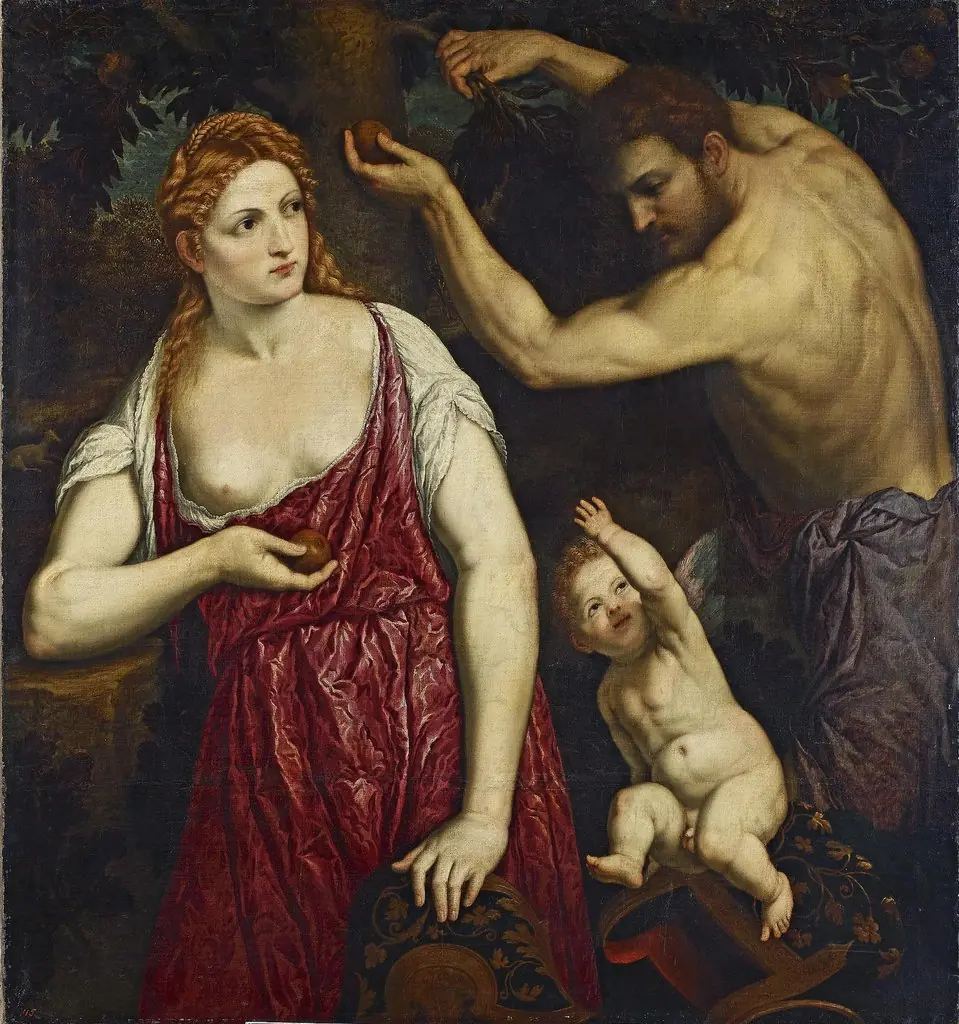
Allegory (Mars, Venus, Victoria and Cupido)
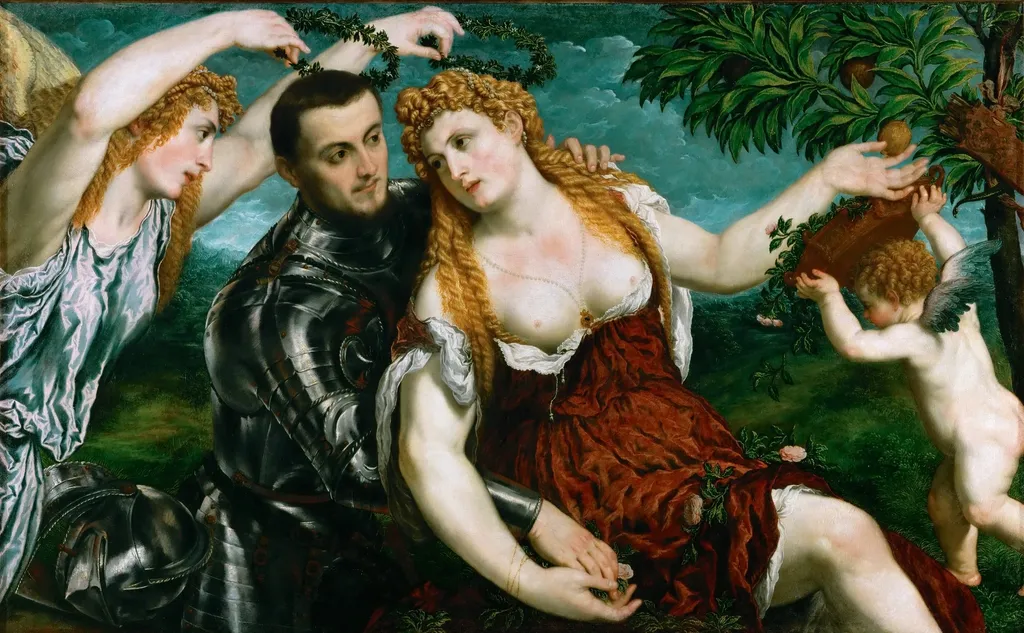
Allegory (Mars, Venus, Victoria and Cupido) is an oil painting by the Mannerist artist Paris Bordone. It dates from 1560 and is held in the collection of the Kunsthistorisches Museum.
About this work
Subject & Meaning
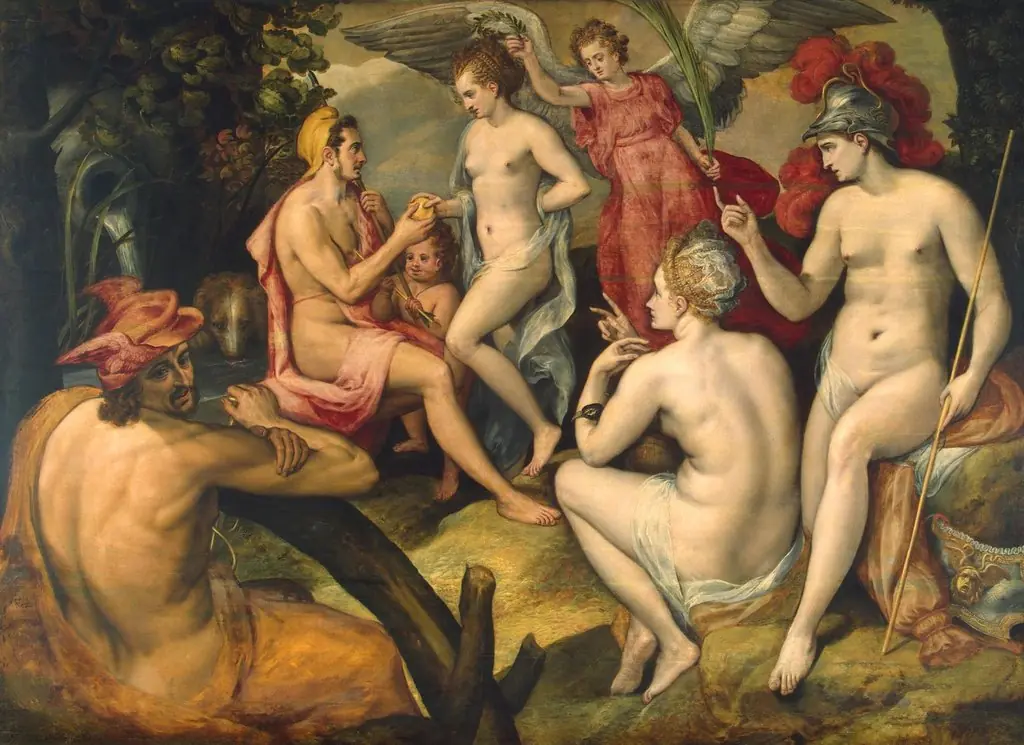
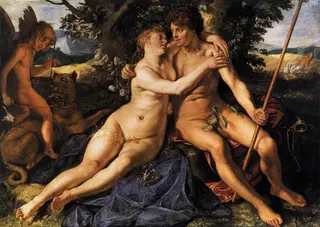
The painting is a mythological allegory centred on the divine lovers Mars and Venus, flanked by two further figures: a winged deity on the left, likely the goddess Victoria or Hebe, and Cupid on the right. The flanking figures present the central couple with roses and wreaths of myrtle, a plant sacred in Greek myth to Aphrodite, the deity later syncretised with the Roman Venus. Through this arrangement, the work functions as an allegory of marriage, using the union of the war god and the love goddess together with the bridal attributes of myrtle crowns and roses to evoke marital harmony and love triumphant over conflict.
The iconographic programme draws on classical sources filtered through Renaissance humanist interpretation, as reflected in Erwin Panofsky's study of humanistic themes in Renaissance art, which is cited in the scholarly literature on the painting.
Technique & Style
The composition arranges Mars and Venus centrally, with Victoria and Cupido positioned to frame the couple, creating a balanced and harmonious arrangement.
The work is an oil painting executed on canvas, measuring 174.5 cm in width and 111.5 cm in height. Paris Bordone applied oil paint in a technique characteristic of Venetian Renaissance art, emphasizing rich coloration and delicate modeling of forms. The composition arranges Mars and Venus centrally, with Victoria and Cupido positioned to frame the couple, creating a balanced and harmonious arrangement.
The handling of brushwork conveys a soft, almost atmospheric quality, while the stylistic treatment reflects the influence of Titian, particularly in the rendering of drapery and the subtle interplay of light and shadow. The painting’s condition is stable, retaining its original surface without significant degradation, and it remains displayed in its original support, the canvas, within the Kunsthistorisches Museum’s collection.
History & Provenance
The work was created around 1560 by Paris Bordone, a Venetian painter active in the 16th century and a pupil of Titian, placing it within the mature phase of his career. It was first documented in 1643 as part of the collection of Archduke Leopold Wilhelm of Austria, who inherited it from his stepmother Eleonora Gonzaga. The painting entered the imperial collection in Vienna by 1781 and remains in the Kunsthistorisches Museum, where it is recorded as part of the museum's holdings.
The work measures 111.5 cm in height and 174.5 cm in width, executed in oil paint on canvas, depicting the mythological allegory of Mars, Venus, Victoria, and Cupid.
The painting is held in the collection of the Kunsthistorisches Museum in Vienna, where it remains today.
Its earliest documented appearance is in 1643, when it was recorded as part of the collection of Archduke Leopold Wilhelm of Austria (1614–1662), a military commander, Catholic bishop, and art collector who inherited his passion for Italian and Flemish art from his stepmother, Eleonora Gonzaga of Mantua. By 1781 the work had been transferred to the imperial collection in Vienna.
Context
The painting entered the Habsburg collections in the mid‑17th century, first appearing in the 1643 inventory of Archduke Leopold Wilhelm and later recorded in the imperial Viennese collection in 1781. Modern scholarship cites it in Erwin Panofsky’s Studies in Iconology (2018) as an example of Renaissance humanistic themes. Bordone, a pupil of Titian and representative of the Venetian school, executed the work around 1560, during his artistic maturity, employing a mythological allegory of marriage that combines Mars, Venus, Victory and Cupid with myrtle and roses.
As a mid‑cento Venetian allegory, it situates Bordone within the broader mannerist tendency to fuse classical myth with contemporary emblematic meaning, securing its place in art history as a notable example of Venetian allegorical painting.
Overview
Created in 1560 by the Venetian artist Paris Bordone, this oil painting assembles four mythological figures within a densely wooded setting. The work belongs to the Mannerist period, displaying the compositional intricacy and stylized elegance characteristic of the movement. It is part of the permanent collection of the Kunsthistorisches Museum in Vienna.
Own this work as a print
Artist & collection

Artist
Paris Bordone (Paris Paschalinus Bordone; 5 July 1500 – 19 January 1571) was an Italian painter of the Venetian Renaissance who, despite training with Titian, maintained a strand of Mannerist complexity and provincial vigor.