Artwork
Venus with an Organist and Cupid
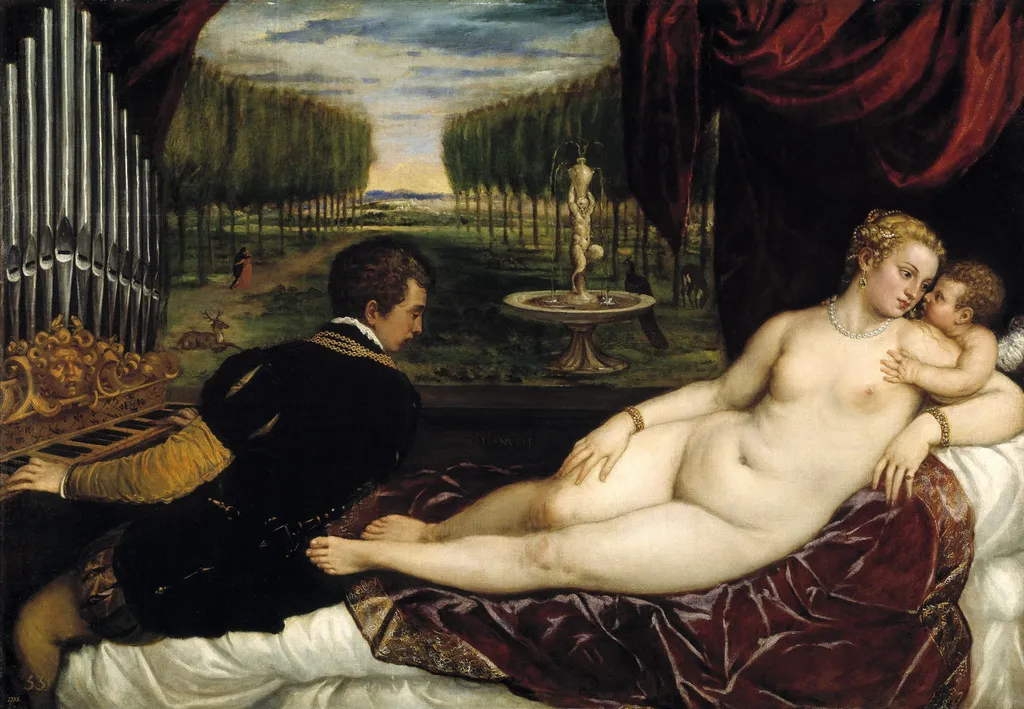
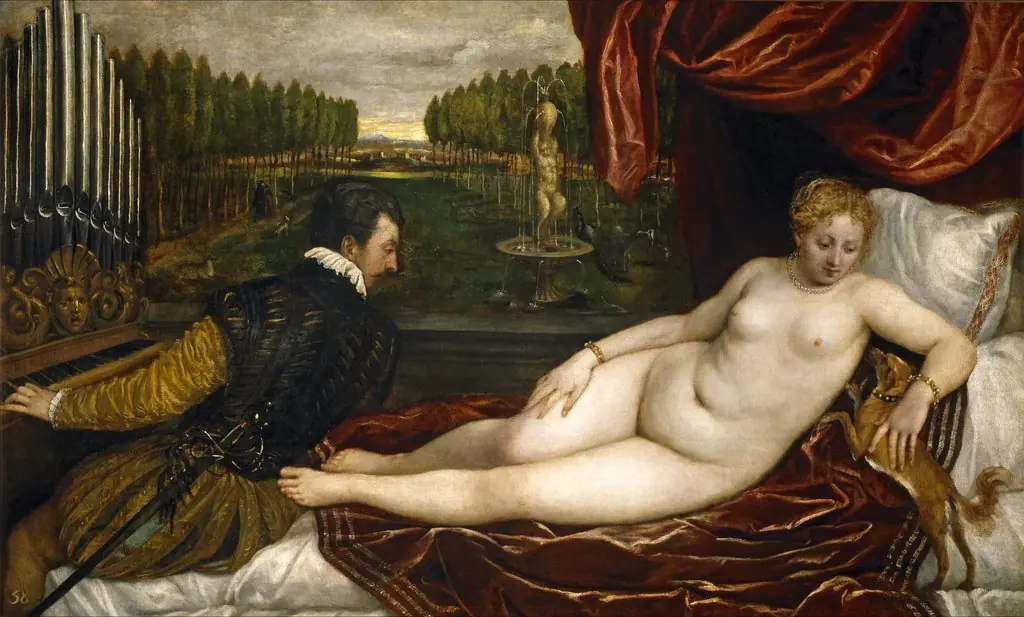
Venus with an Organist and Cupid is an oil painting by the Mannerist artist Titian. It dates from 1555 and is held in the collection of the Museo del Prado.
About this work
Subject & Meaning
At the foot of the bed, a lavishly dressed young man plays a portative organ while fixating on the nude goddess.
The painting depicts Venus reclining on a bed covered with rich, gold-embroidered dark red velvet, gazing toward Cupid, who embraces her and appears to whisper in her ear. At the foot of the bed, a lavishly dressed young man plays a portative organ while fixating on the nude goddess. The setting is an aristocratic villa interior opening onto a lush garden featuring a central fountain where the god Pan pours water, alongside a peacock symbolizing beauty.
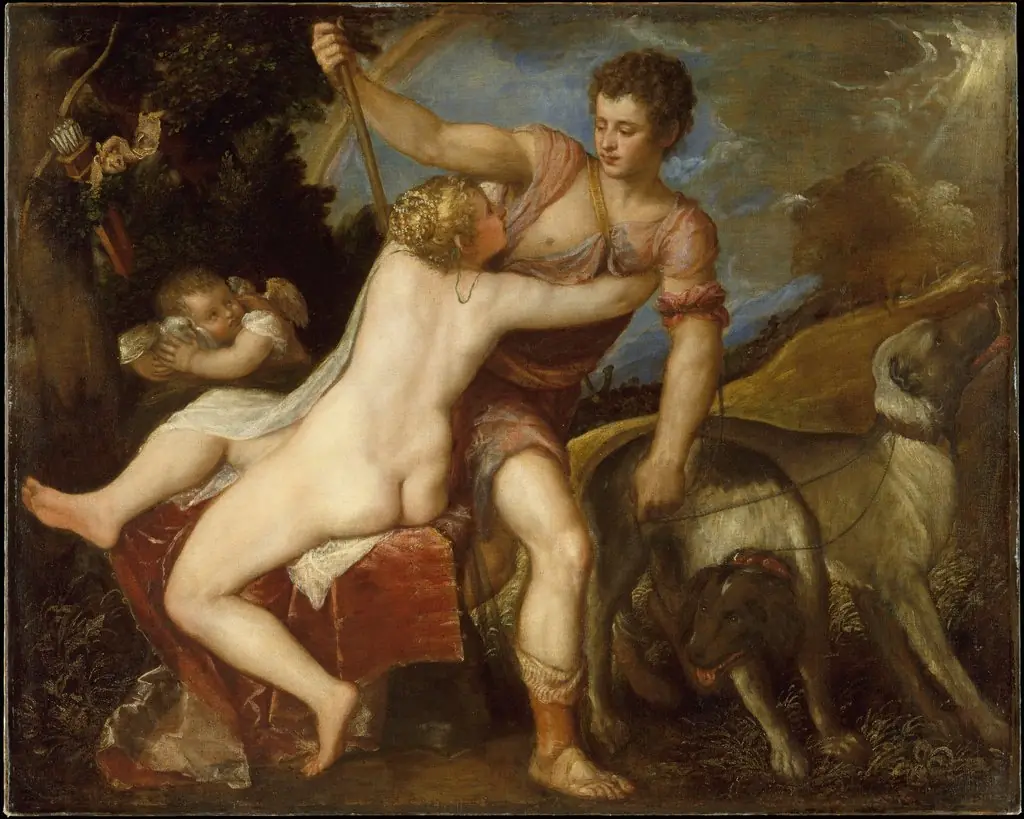
While some interpretations have viewed these variations merely as erotic scenes devoid of moral intent, the specific inclusion of Cupid rather than a dog suggests a broader symbolic meaning intended for a wider audience. Unlike versions possibly commissioned for specific marriages depicting noblewomen as Venus, this composition likely represents a more generic allegory of love and music, diverging from earlier iterations that focused on particular patrons.
Technique & Style
Executed in oil on canvas, the work measures 150.2 cm in height and 218.2 cm in width. Titian employs a fluid handling of oil paint to build up the composition in luminous glazes, especially in the depiction of Venus’s flesh and the shimmering drapery, while the organist’s brocade and chain are rendered with crisp, decorative detail.
The scene unfolds in a sumptuous interior opening onto a verdant garden under a sunset sky. Venus reclines on a crimson velvet bed adorned with gold embroidery; her languid pose and direct gaze engage the viewer. Cupid nestles beside her, whispering, while the organist, richly attired and chained in gold, plays and gazes intently at the goddess.
Beyond, a fountain with a goat-legged Pan and a peacock animates the landscape, which teems with grazing animals and amorous couples, all suffused with Titian’s characteristic chromatic harmony.
History & Provenance
Venus with an Organist and Cupid is an oil on canvas by Titian dated to around 1550–1555, with 1555 cited as the inception date. The work is thought to derive from a lost composition of 1545 that Titian referenced in a letter, and it exists in several related variants held at the Museo del Prado, the Fitzwilliam Museum in Cambridge, and the Uffizi. Some scholars, including Cavalcaselle and Joseph Archer Crowe, initially attributed the painting to an anonymous imitator because of an apocryphal signature, but Georg Gronau argued that it originated in the Venetian workshop with Titian's own participation, particularly in the landscape, and it is now accepted as a fully autograph work by the master.
The painting is first documented in 1626 among the works held by the Spanish monarchs in the Real Alcázar in Madrid. After the palace fire of 25 December 1734, it was transferred to the new Royal Palace, then kept in a residence near the Palacio de Rebeque. In 1796 it entered the Sala Riservata of the Academy of San Fernando, where it remained until 1827, when it was delivered to the Museo del Prado, where it is still housed.
Titian's Venus with an Organist and Cupid is held in the collection of the Museo del Prado in Madrid, where it has been conserved since 1827. The work was first documented in 1626 within the Spanish royal collections at the Real Alcázar of Madrid. Following the catastrophic fire of December 25, 1734, the painting was relocated to the new Royal Palace and subsequently housed in the residence at the de Rebeque palace before moving to the Reserved Hall of the Academy of San Fernando in 1796.
It remained there until its transfer to the Prado Museum. The source material does not provide a specific inventory or accession number for the work.
Context
The painting Venus with an Organist and Cupid was created by Titian around 1555 and is housed in the Museo del Prado in Madrid. It entered Spanish royal collections by 1626 and survived the 1734 fire at the Real Alcázar, later moving to the Palacio Real and then to various museum spaces before its 1827 placement in the Prado. Early scholarship, including work by Georg Gronau, questioned initial attributions to an anonymous imitator but ultimately affirmed Titian’s authorship, particularly in the landscape elements.
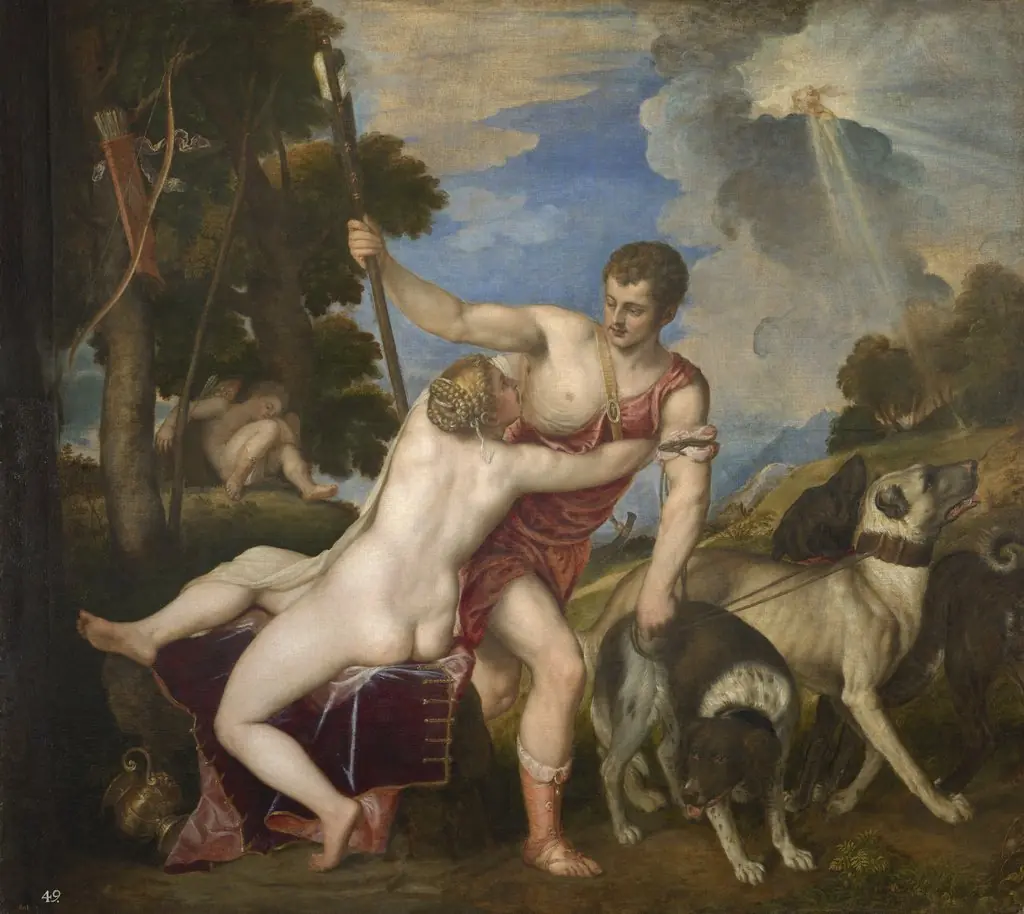
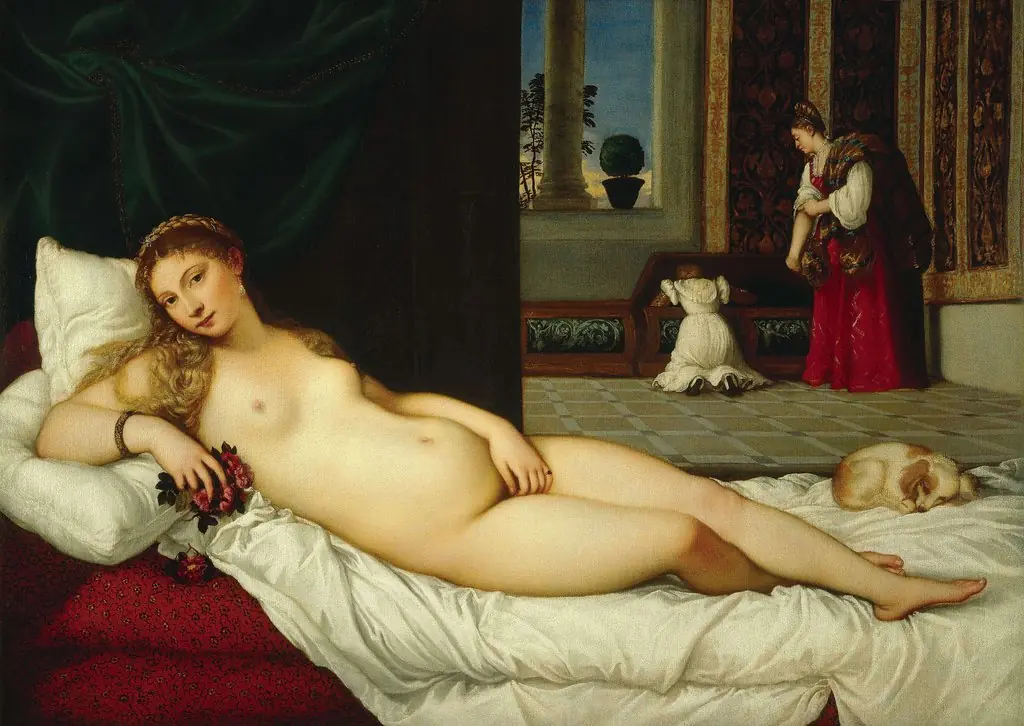
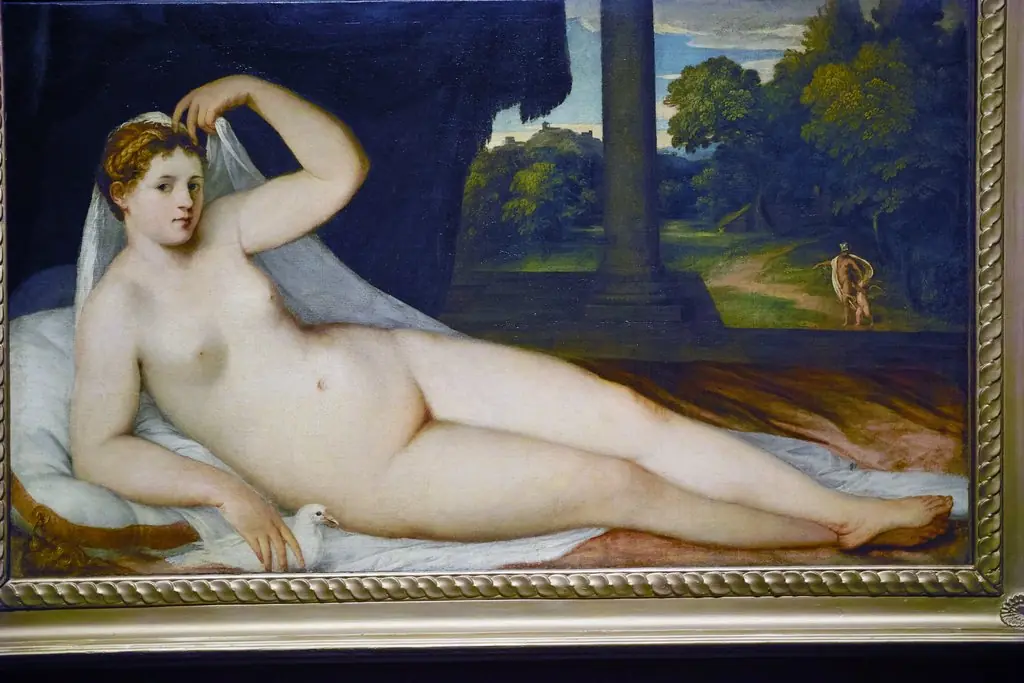
The work has been studied in relation to other versions, such as the one in the Fitzwilliam Museum and the Uffizi’s Venus with a Dog, and has been interpreted both as an erotic subject and as a piece with broader symbolic and commemorative significance tied to possible marital commissions.
Legacy
The work's later influence, reputation, and legacy are evident in its continued presence in major museum collections and its role in scholarly discourse. It remains part of the Museo del Prado's holdings and has inspired related paintings, such as another version in the same museum and a variant in the Fitzwilliam Museum, Cambridge. The painting's attribution evolved from being considered anonymous to recognized as by Titian, reflecting changing interpretations of style and authorship.
Its thematic variations, including depictions of Venus with a dog or a lute, have contributed to discussions of its symbolic meaning, with scholars like Ulrich Middeldorf interpreting it as an erotic work while others emphasize its broader cultural significance. The painting's provenance, including its transfer to the Royal Palace after the 1734 fire and eventual placement in the Museo del Prado, underscores its historical journey.
Overview
Created in 1555, this oil on canvas work portrays a reclining nude figure identified as Venus, accompanied by a small child, interpreted as Cupid, while an organist performs beside her. The scene unfolds within an interior that opens onto a garden featuring a fountain and distant trees, combining mythological narrative with a domestic setting.
Own this work as a print
Artist & collection

Artist
Tiziano Vecellio (Italian:; c. 1488/1490 – 27 August 1576), Latinized as Titianus, hence known in English as Titian ( TISH-ən), was an Italian Renaissance painter. The most important artist of Renaissance Venetian…