Artwork
James I of England
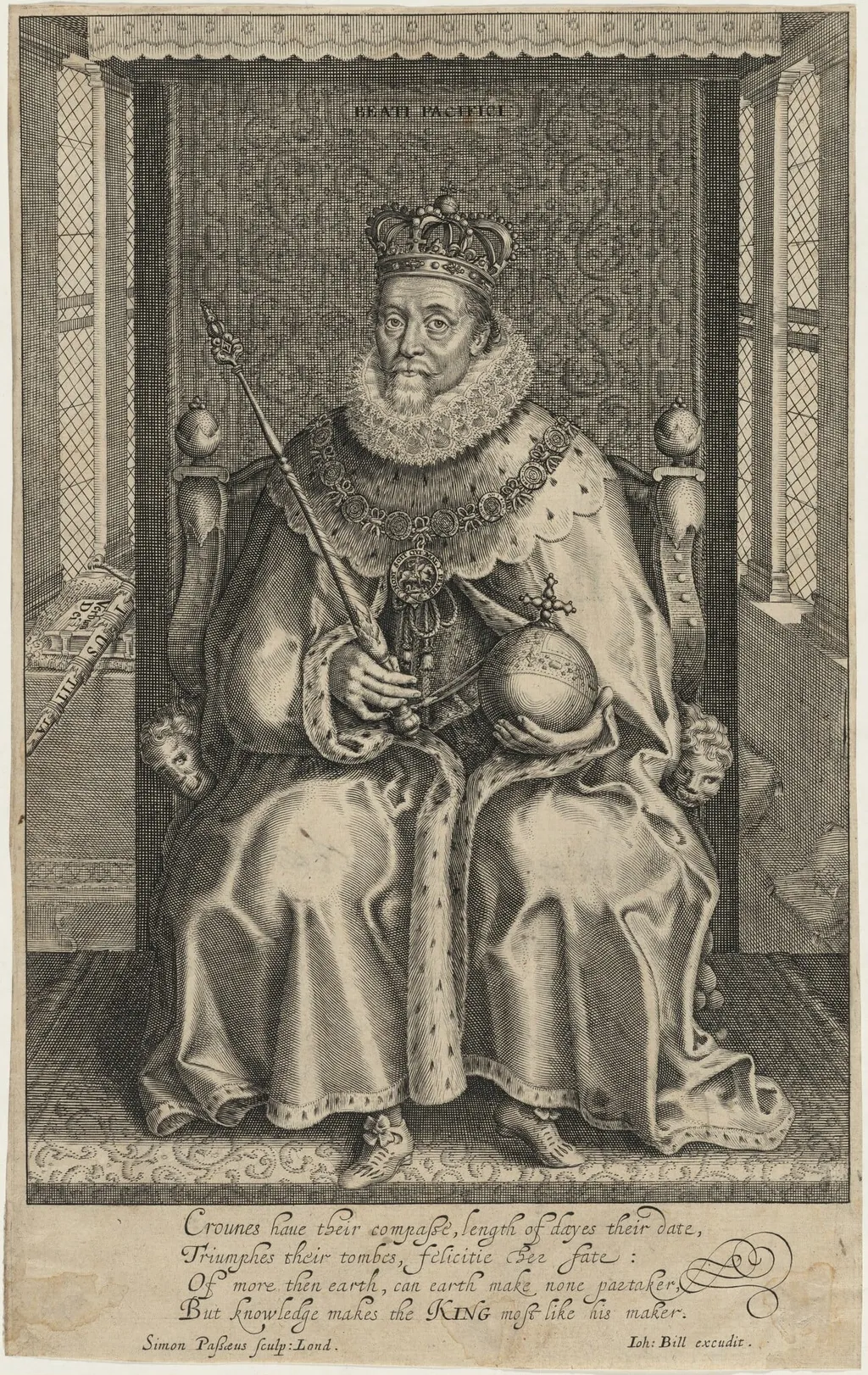
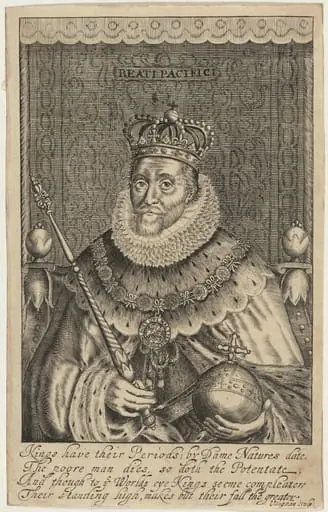
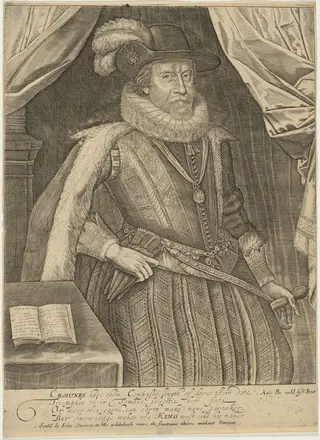
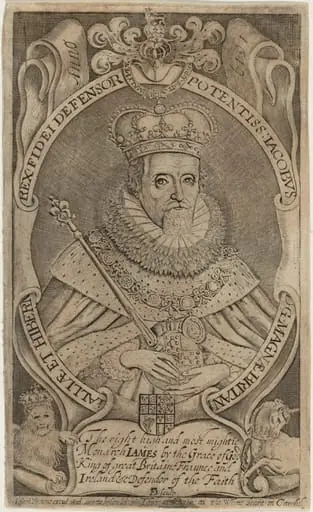
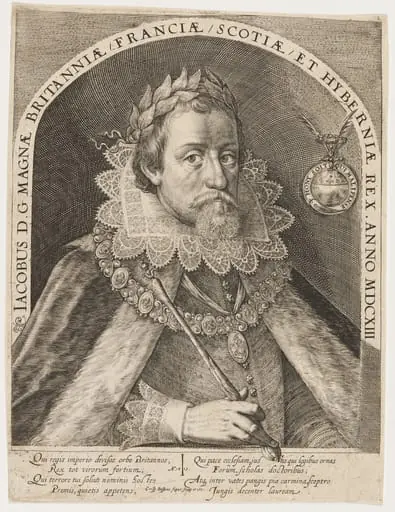
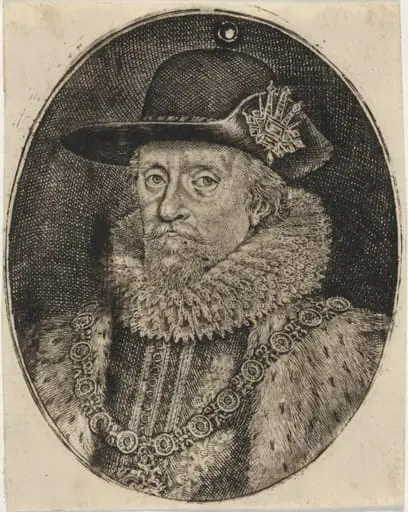
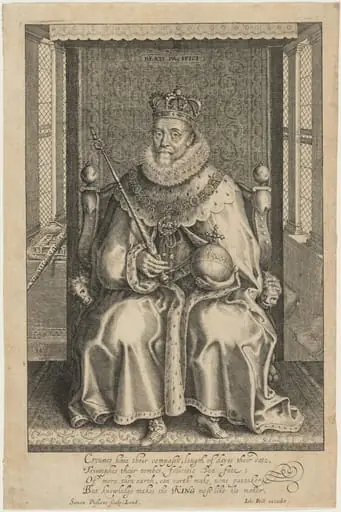
James I of England is an ink print by the Baroque artist Simon van de Passe. It dates from 1616 and is held in the collection of the National Gallery of Art.
About this work
Overview
In his left hand, he grasps a globus cruciger, while his right hand holds a scepter topped with a cross, traditional symbols of Christian sovereignty.
Created in 1616 by the Dutch engraver Simon van de Passe, this portrait depicts James I of England and VI of Scotland in a formal, regal pose. The work is a black-and-white engraving characterized by fine, precise lines that render the texture of the monarch's heavy fur-lined robe and the intricate details of his attire. James is shown wearing a crown and a sash adorned with a cross, signifying his royal authority and religious affiliation.
In his left hand, he grasps a globus cruciger, while his right hand holds a scepter topped with a cross, traditional symbols of Christian sovereignty. His long beard and serious expression convey the gravity of his office. The composition places the king against a background featuring a throne, emphasizing his status.
This engraving is a significant example of early 17th-century portraiture, capturing the image of the Stuart monarch during a period of consolidation for the British crown. Van de Passe, known for his work in the Netherlands and England, produced this piece early in his career, contributing to the visual dissemination of royal imagery across Europe.
Subject & Meaning
The portrait emphasizes James I’s authority and global reach, symbolized by the globe and scepter, while the crown and royal robes affirm his sovereign status. The inclusion of a patterned curtain behind the throne suggests the ceremonial setting of the court, and the accompanying inscription in archaic English alludes to the monarch’s role as both political ruler and patron of knowledge.
Technique & Style
Van de Passe employed fine line work characteristic of early 17th‑century engraving, using cross‑hatching to model the textures of fur, fabric, and metal. The contrast between deep shadows and delicate highlights creates a three‑dimensional effect within the limited monochrome palette. The composition balances detailed portraiture with ornamental background elements, reflecting the period’s blend of realism and symbolic ornamentation.
History & Provenance
Created in 1616, the print was likely intended for distribution among courtiers and collectors as a visual affirmation of James I’s reign. Simon van de Passe, a Dutch engraver active in England, produced several royal portraits, and this work forms part of his series of state images. Copies of the engraving have survived in several European libraries and museum collections.
Context
The engraving emerges during a time when printed portraiture served both political propaganda and personal commemoration. James I, who united the English and Scottish crowns, sought to project a unified image of his rule across the British Isles and abroad. Van de Passe’s work aligns with contemporary efforts to disseminate royal iconography through affordable prints.
Own this work as a print
Artist & collection