Artwork
Landscape with windmill at Abcoude
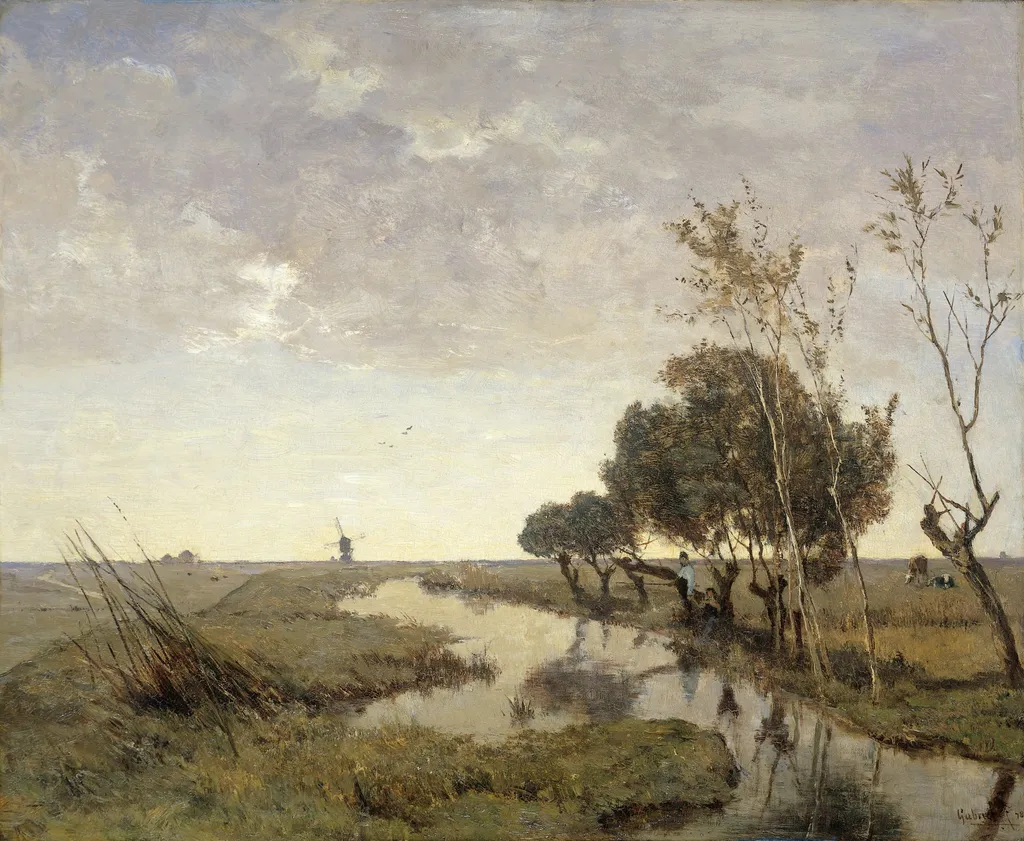
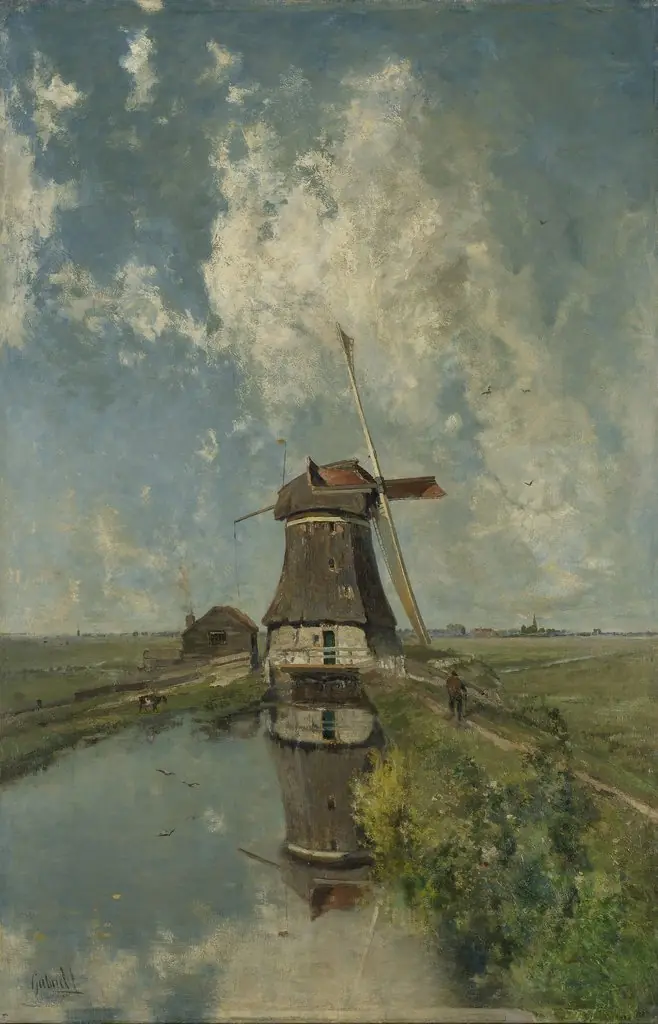
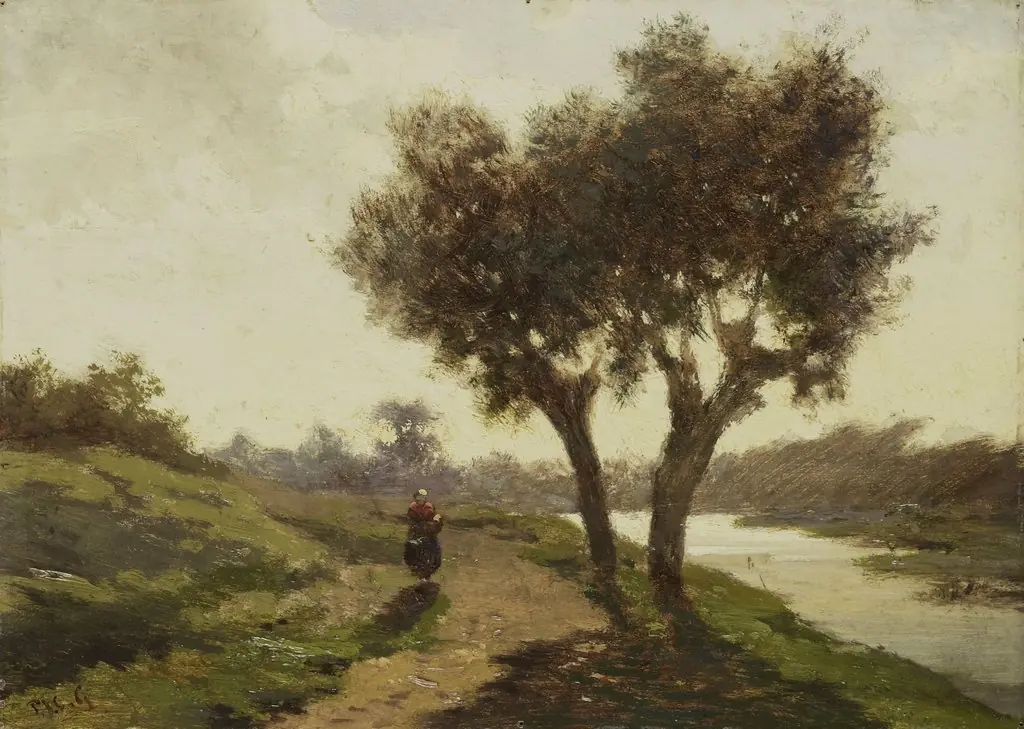
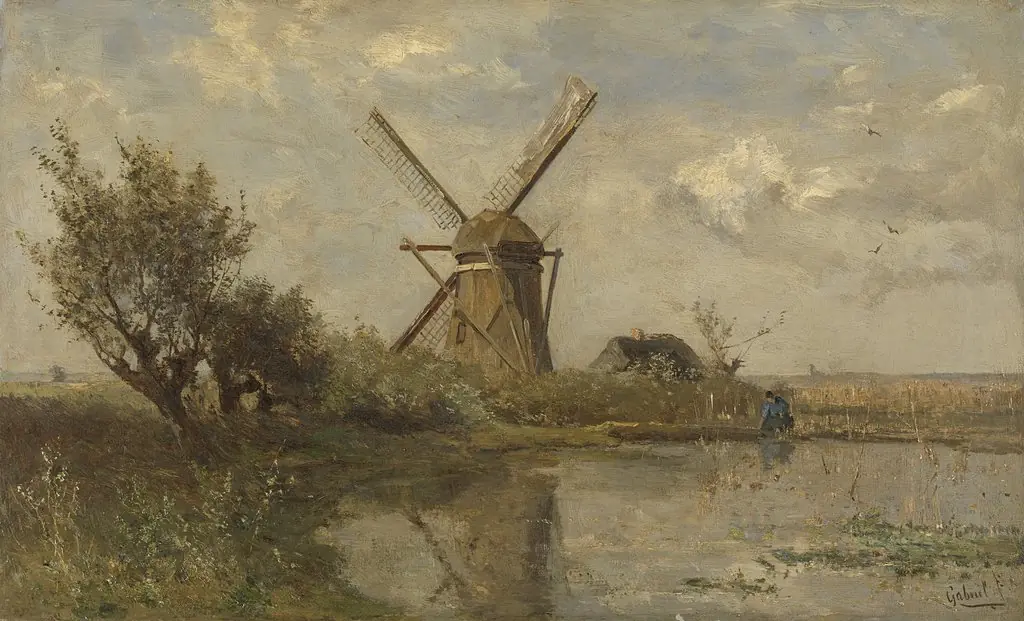
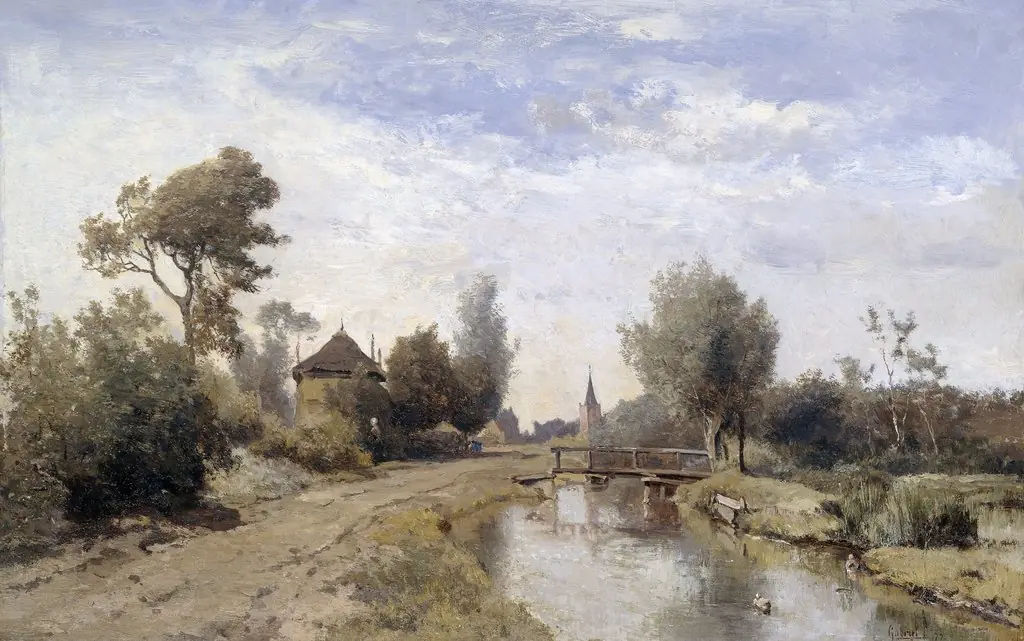
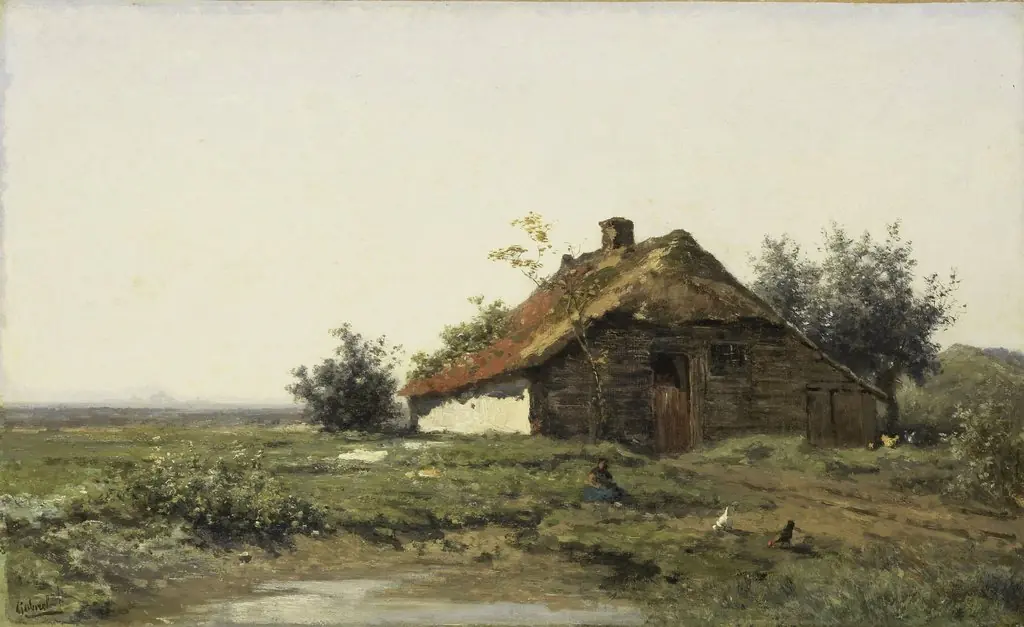
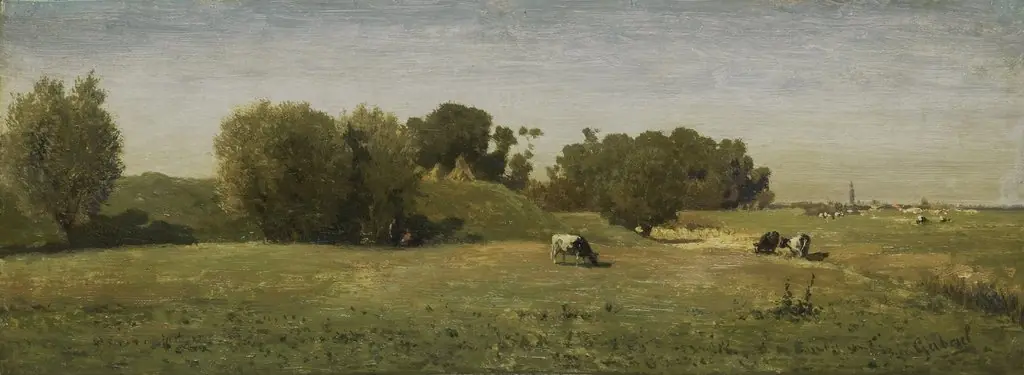
Landscape with windmill at Abcoude is an oil painting by the Impressionist artist Paul Joseph Constantin Gabriël. It dates from 1890 and is held in the collection of the Rijksmuseum. Created in 1890 by Dutch painter Paul Gabriël, this oil on canvas depicts a tranquil Dutch countryside scene.
About this work
Subject & Meaning
Small human figures, specifically a fisherman and his wife beside willow trees on the right, serve as minor accents within the dominant natural environment.
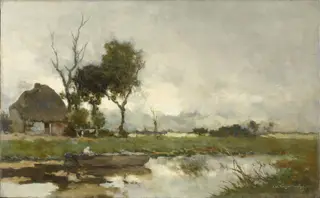
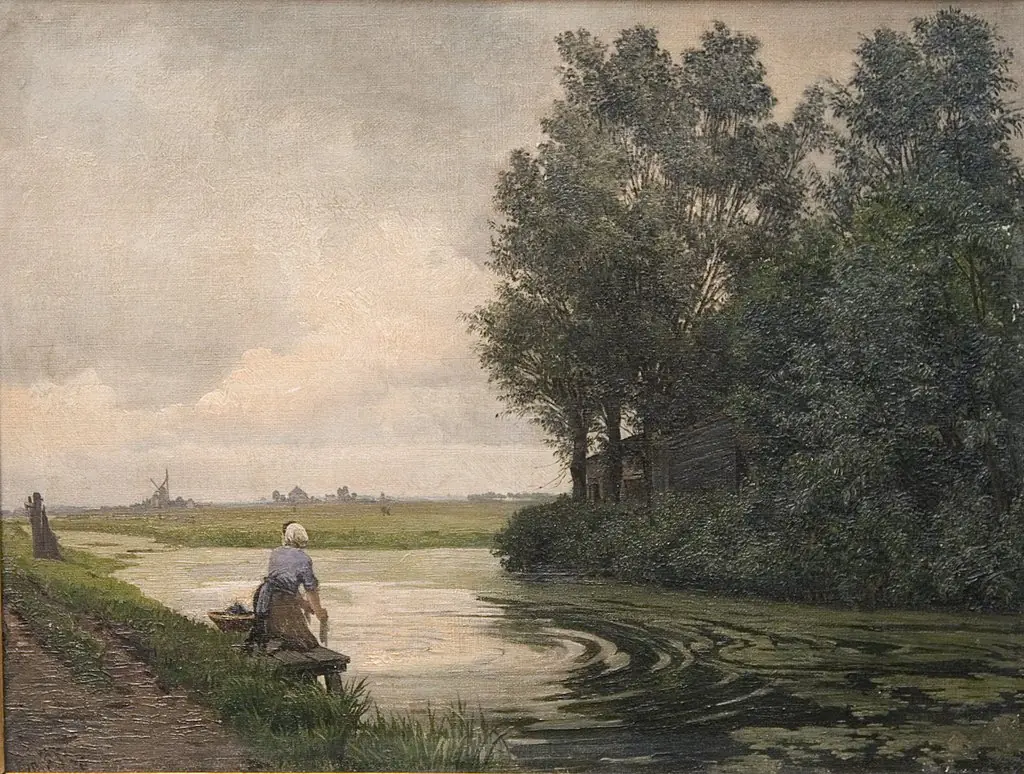
The work depicts a characteristic Dutch landscape featuring a waterway near Abcoude, with a windmill visible in the distance. Small human figures, specifically a fisherman and his wife beside willow trees on the right, serve as minor accents within the dominant natural environment. The composition employs a central perspective where all lines converge on a vanishing point at the horizon's center, a technique that emphasizes the expansive, low horizon and the impressive cloud-filled sky above.
This arrangement creates a sense of depth and highlights the atmospheric quality of the scene. The painting reflects the artist's developed style of the 1870s, characterized by a balanced, almost geometric structure and a restrained palette of muted ochres, greens, and browns. The overall mood and atmospheric rendering are interpreted as a reflection of the artist's own state of mind.
Technique & Style
Landscape with windmill at Abcoude is executed in oil paint on a wooden panel measuring 41 × 50 cm. Gabriël began with on‑site sketches made en plein air during visits to Abcoude and later completed the work in his Brussels studio, a process evident in the alternation of fine, drawing‑like lines and broad, sweeping brushstrokes. The painting shows a typical Hague School landscape: a low horizon, central perspective converging on a vanishing point at the horizon’s centre, and a restrained palette of muted ochres, greens and browns that conveys atmospheric light and depth.
History & Provenance
Landscape with windmill at Abcoude was painted in 1878 by Paul Joseph Constantin Gabriël, executed in oil on panel and measuring 41 × 50 centimeters. Gabriël, who was based in Brussels during this period, repeatedly traveled back to the Netherlands to gather material for his polder landscapes, frequently visiting the area around Abcoude. He typically made a series of plein-air sketches on site and then quickly worked them up into finished paintings in his Brussels studio, producing several related works from 1878 that share the same Abcoude setting and compositional approach.
The painting entered the collection of Joannes Barnardus Antonius Maria Westerwoudt (1849–1908), a painter and collector. In 1888, ten years after its creation, Westerwoudt donated the work to the Rijksmuseum, where it has remained in the collection ever since.
The painting is held in the collection of the Rijksmuseum in Amsterdam. It entered the museum’s holdings in 1888 as a gift from the first owner, the painter-collector Joannes Barnardus Antonius Maria Westerwoudt (1849–1908).
No exhibition history beyond its permanent presence in the Rijksmuseum’s collection is documented in the provided sources.
Context
Created in 1878, this work exemplifies Paul Joseph Constantin Gabriël's mature style within the Hague School, marking a deliberate shift from his earlier Romantic training toward a distinct realism. Although Gabriël resided in Brussels from 1860 to 1884, he frequently returned to the Netherlands, specifically the Abcoude region, often accompanied by Willem Roelofs. While his landscapes of the 1860s were so heavily influenced by Roelofs that they were often confused with them, this painting demonstrates the artist's successful pursuit of an independent artistic identity during the 1870s.
Scholars characterize the composition by its balanced plane construction and geometric clarity, utilizing central perspective to guide the eye toward a low horizon that emphasizes the atmospheric Dutch sky. The piece is recognized as a poetic reflection of reality, where a muted palette of ochres and browns conveys a specific mood rather than mere topographical accuracy. This approach aligns Gabriël with the broader nineteenth-century Dutch movement that prioritized atmosphere and the artist's internal state over detailed narration.
Overview
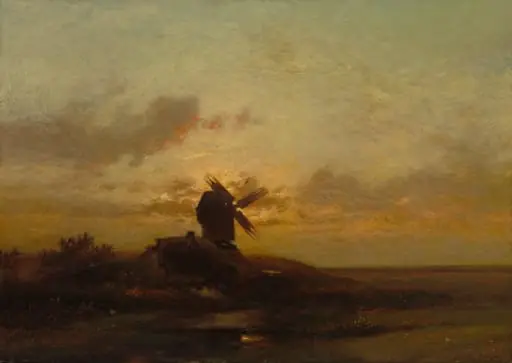
Created in 1890 by Dutch painter Paul Gabriël, this oil on canvas depicts a tranquil Dutch countryside scene. The composition centers on a low hill crowned by a windmill, set against a pale sky dotted with soft clouds. In the foreground, flat grassy fields lead to a small water body flanked by a few leaf‑stripped trees, conveying a sense of open, quiet space.
Own this work as a print
Artist & collection
Artist
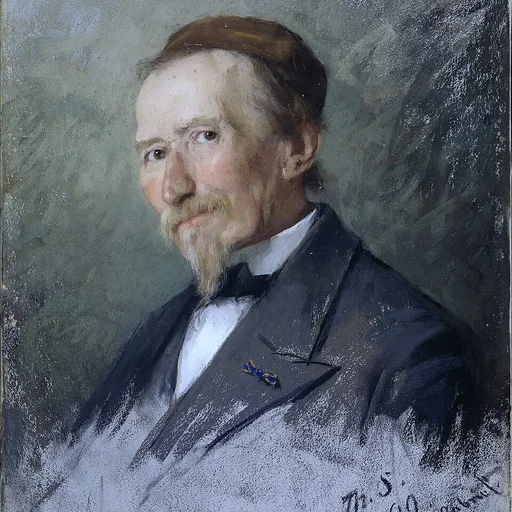
Paul Joseph Constantin Gabriël
Paul Joseph Constantin Gabriël or Paul Gabriël (5 July 1828 – 23 August 1903) was a painter, draftsman, watercolorist, and etcher who belonged to the Hague School.