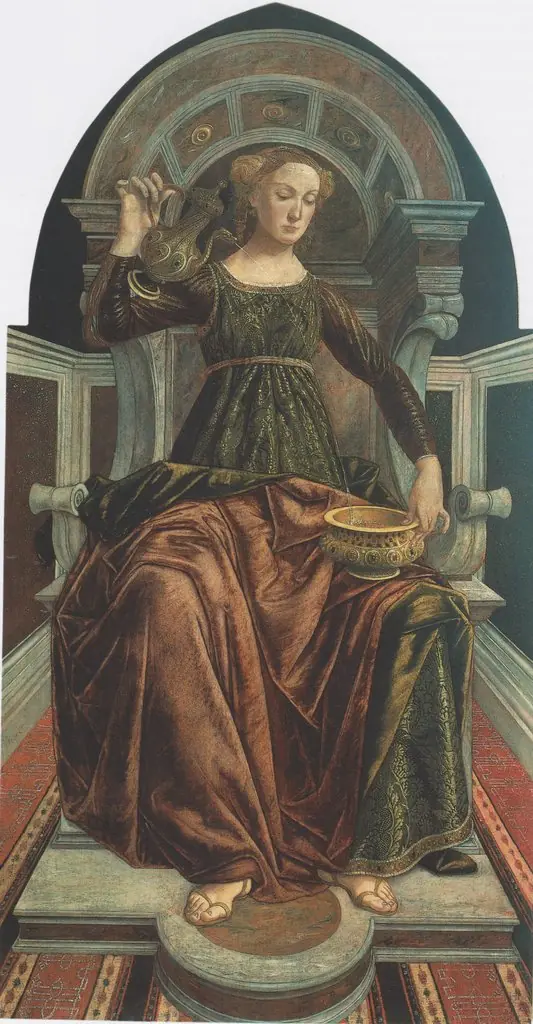
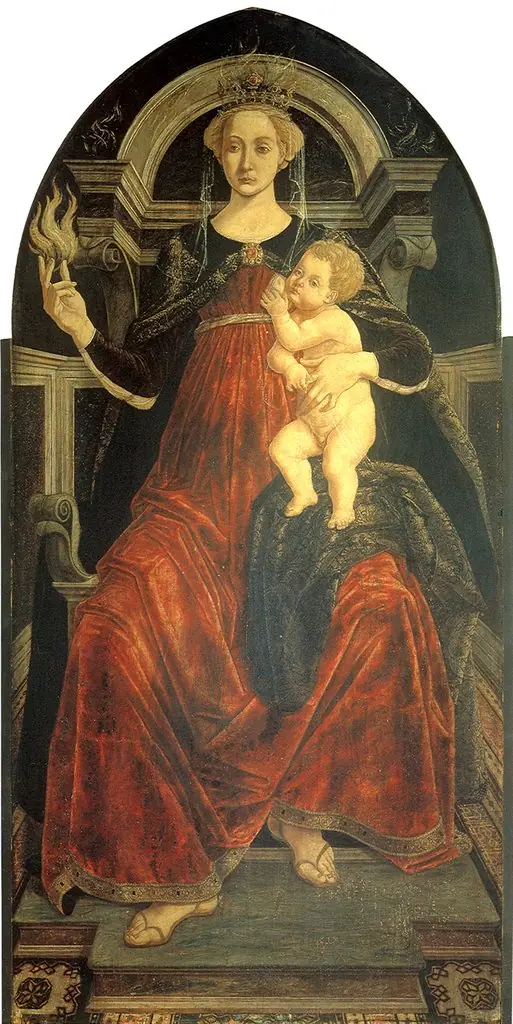
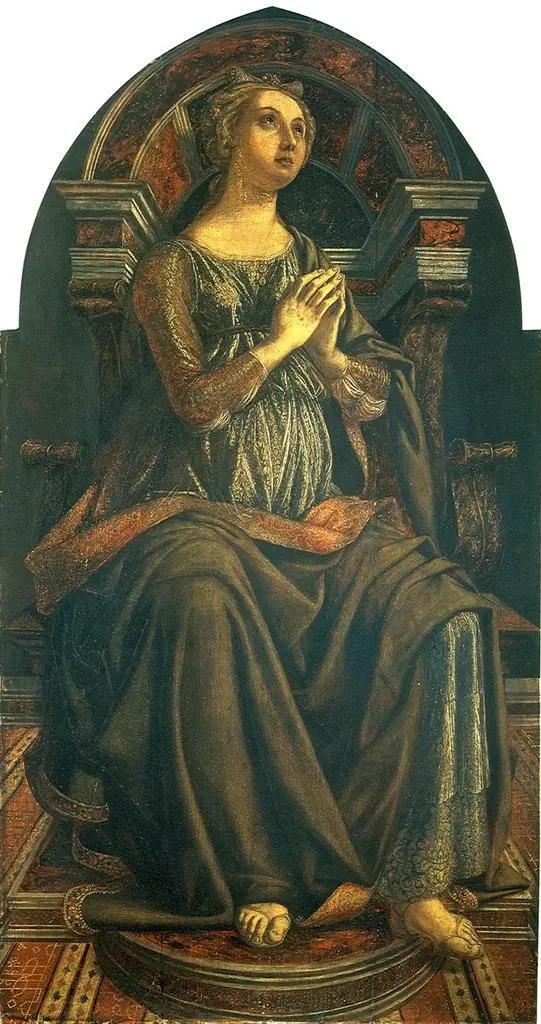
Artwork
Justice
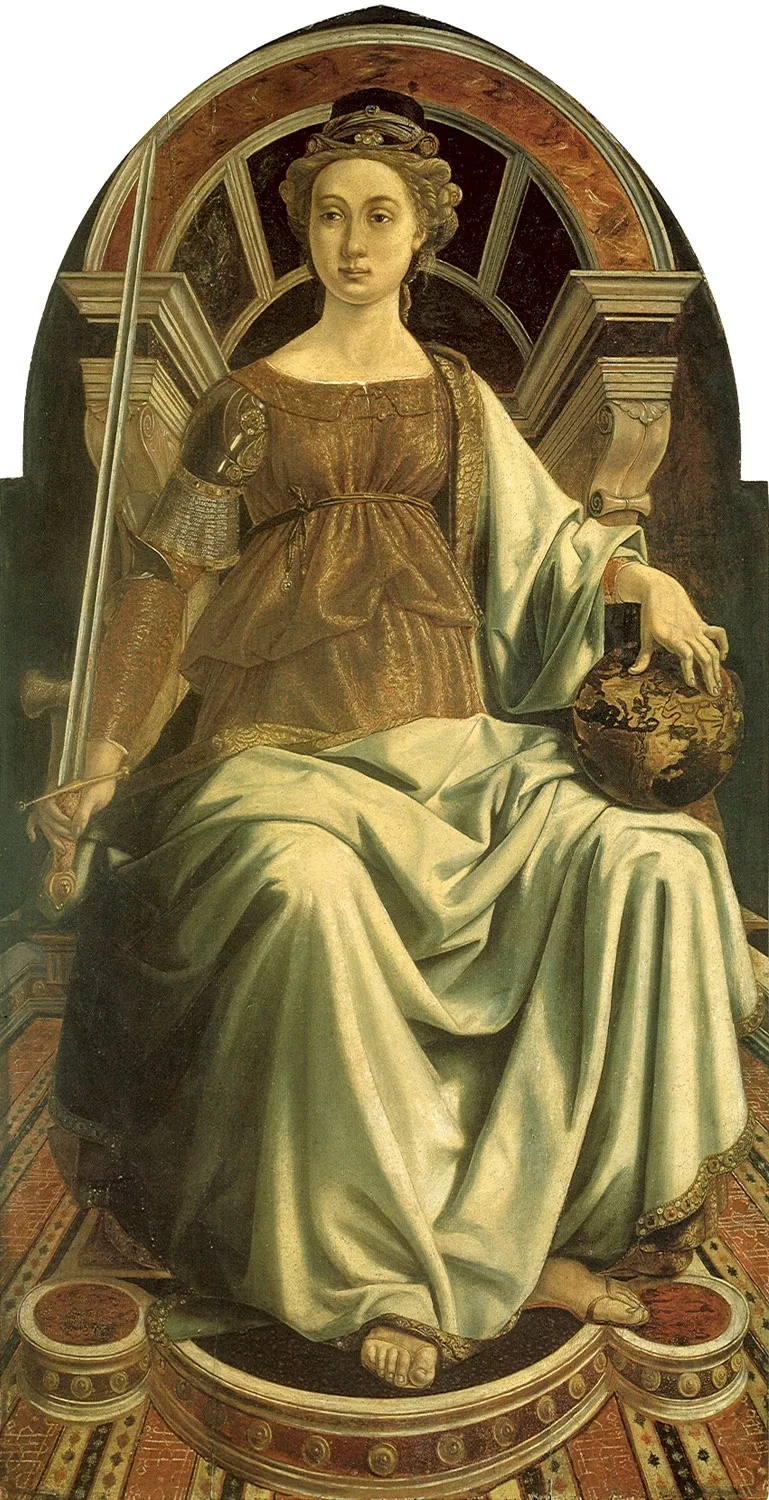
Justice is an oil painting by the Early Renaissance artist Piero del Pollaiuolo. It dates from 1470 and is held in the collection of the Uffizi Gallery.
About this work
This painting shows Justice as a woman holding symbols of fairness. It’s a tempera work by Piero del Pollaiuolo from around 1470. The artist used bright colors and sharp details to make the scene clear.
The Uffizi owns this piece now. It was painted in Florence during a time when art often included moral lessons.
Look up the Uffizi Gallery next.
Subject & Meaning
Unlike the traditional scales of justice, the globe serves as the primary symbol, representing the augury of a world destined to be dominated by this virtue.
The work is an allegorical personification of Justice, depicted as a seated woman holding a sword in her right hand and resting her left hand on a terrestrial globe placed upon her knee. Unlike the traditional scales of justice, the globe serves as the primary symbol, representing the augury of a world destined to be dominated by this virtue. The figure's gesture of rotating the globe from right to left alludes to the actual movement of the Earth, reflecting a contemporary cosmographic vision. As the most significant virtue in the series for a tribunal setting, the painting emphasizes a monumental presence through distorted proportions designed for viewing from below. The composition also incorporates Flemish influences in its detailed rendering of decorative elements, such as the oriental-style floor and the jeweled trim of the throne and dress.
Technique & Style
Piero del Pollaiuolo executed Justice in 1470 using oil and tempera on a wooden panel support, measuring 167 cm in height and 88 cm in width. The work depicts a seated female figure holding a sword in her right hand and resting her left on a terrestrial globe, replacing the traditional scales. Stylistically, the figure is elongated with a disproportionately powerful lower body and slender upper torso, a distortion designed to optimize the visual impact when viewed from the elevated position of the Tribunale della Mercanzia's audience hall. The drapery on the legs is rendered with smooth, sculptural folds and deep chiaroscuro, creating a soft fabric texture against a dark background that lacks the railings seen in other works of the series. The composition employs an extreme foreshortening perspective to display the throne's dimensions, while decorative details like the oriental-style floor and gem-encrusted throne edges reflect Flemish painting influences.
History & Provenance
The work was commissioned by Florence's Tribunale della Mercanzia in a contract dated 18 August 1469 to depict the cardinal virtue of justice among seven paintings intended for the seat-backs of its audience hall on piazza della Signoria. The contract was initially transferred to Botticelli due to delays by Pollaiuolo, but was later reinstated to Piero and his studio after protests from both brothers. The painting, dated 1470 in the canonical record, shows a female personification of Justice holding a sword and a globe, seated on a richly decorated throne, with detailed drapery and a perspectival composition that emphasizes grandeur. After the magistracy moved to the Uffizi, the work was exhibited there from 1717 onward, though 19th-century conservation issues limited public display to the virtue of Prudence.
Justice is held in the Uffizi Gallery in Florence, where it has been since 1717, when the panels arrived after the suppression of the Tribunale della Mercanzia and the transfer of the magistracy into the gallery.
Originally commissioned by the Tribunale della Mercanzia under a contract dated 18 August 1469, the painting was one of seven works depicting the virtues intended to decorate the seat-backs of the audience hall on the Piazza della Signoria. The cycle was exhibited in the Uffizi from 1717 onward. By the 19th century the works had deteriorated so badly that only Prudence was displayed, with Justice among those withdrawn from view due to its poor state of conservation.
No specific accession number is recorded in the available sources.
Context
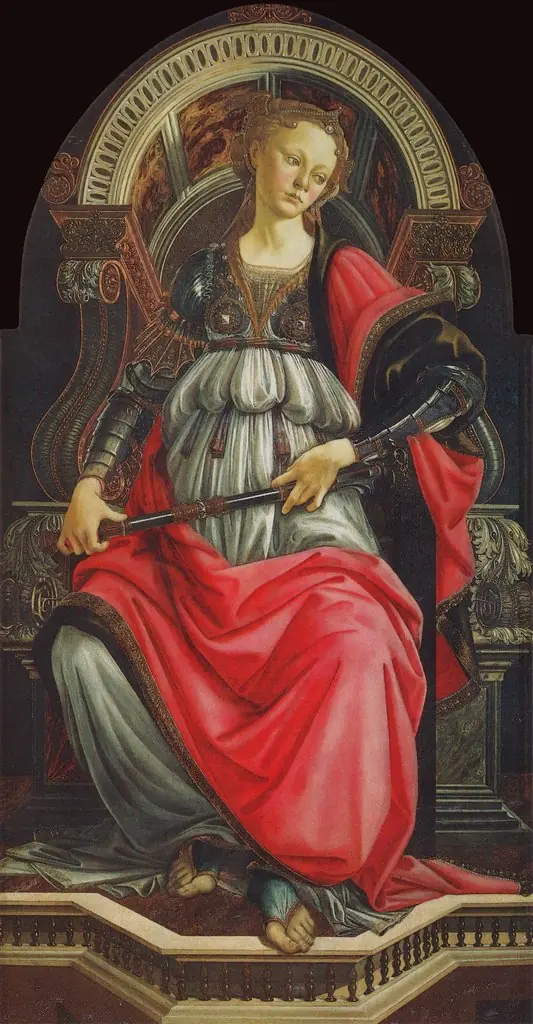
Commissioned by Florence's Tribunale della Mercanzia in 1469, this work forms part of a seminal cycle depicting the cardinal virtues, originally intended to decorate the audience hall's seat-backs. The series is historically significant for the temporary involvement of Sandro Botticelli, whose execution of Fortitude sparked a contentious attribution debate that persists in scholarship. While documentary evidence led early critics like Billi and Albertini to assign the cycle to Piero del Pollaiuolo, later analysts such as Ullman argued for Antonio's authorship based on stylistic comparisons with his signed prints. A prevailing compromise suggests Antonio designed the compositions while Piero handled the painting.
Art historically, the panel exemplifies Early Renaissance innovations in perspective and cross-cultural exchange. The figure is distorted with powerful legs and a slender upper body to optimize viewing from below, utilizing a wide-angle perspective to exaggerate the throne's depth. Furthermore, the meticulous rendering of decorative details, including an Oriental carpet pattern and jeweled hems, demonstrates the profound influence of Flemish painting on Florentine art during this period.
Legacy
The painting was installed in the audience hall of the Tribunale della Mercanzia by December 1469 and remained in civic service until transferred to the Uffizi in 1717 after the tribunal’s suppression.
By the nineteenth century the seven virtue panels were so deteriorated that only Prudence was exhibited, yet the cycle’s iconography and allegorical program continued to inform later representations of Justice in Florentine art. The attribution debates between Piero and Antonio Pollaiuolo have persisted, shaping scholarly discussions of Early Renaissance workshop practice and authorship across the series.
Artist & collection
Artist
Piero del Pollaiuolo (UK: POL-eye-WOH-loh, US: POHL-, Italian:; also spelled Pollaiolo; c.