Artwork
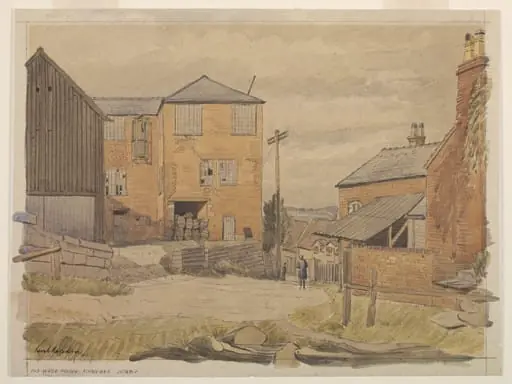
An old part of the Ship Canal, Quay Street, Manchester
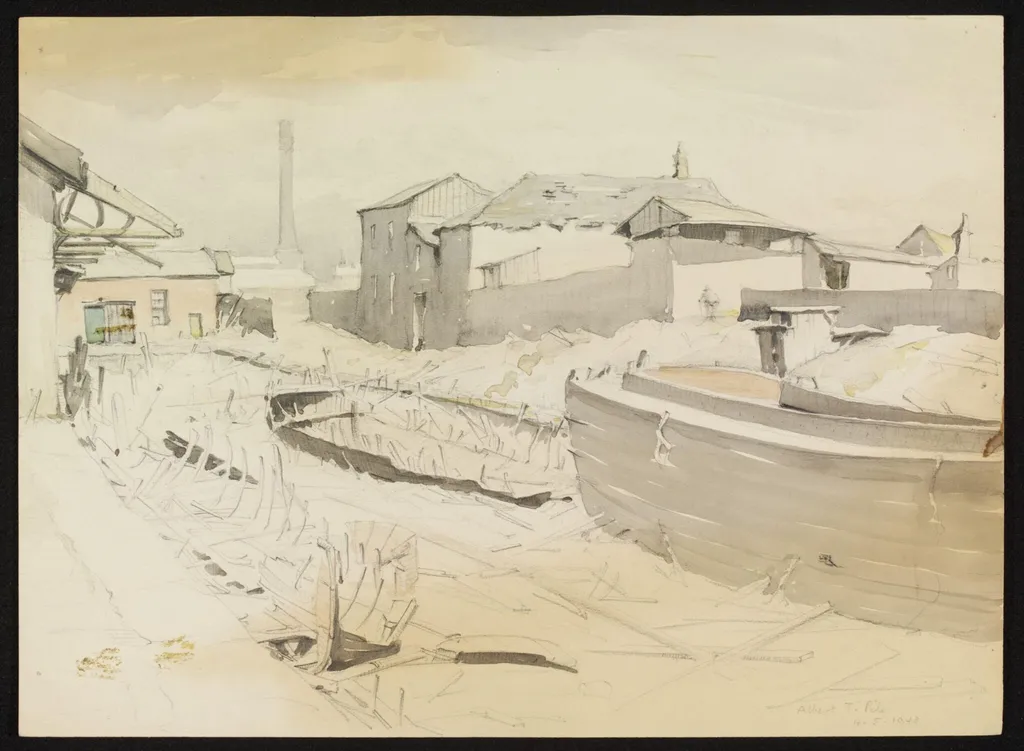
An old part of the Ship Canal, Quay Street, Manchester is a watercolor work on paper by the Social Realist artist Pile. It dates from 4 and is held in the collection of the Victoria and Albert Museum.
About this work
Overview
The work is one of many produced under the Pilgrim Trust’s sponsorship, directed by Sir Kenneth Clark, to document landscapes at risk of loss or transformation.
This watercolour, signed and dated by artist Pile, captures a quiet stretch of the Manchester Ship Canal along Quay Street in the early 1940s. Created as part of the 'Recording Britain' project, it reflects a deliberate effort to preserve visual records of industrial sites during wartime. The work is one of many produced under the Pilgrim Trust’s sponsorship, directed by Sir Kenneth Clark, to document landscapes at risk of loss or transformation.
Subject & Meaning
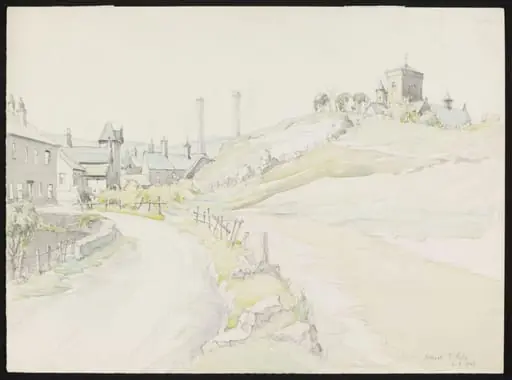
The scene depicts abandoned barges overturned on a frozen dockside, surrounded by shuttered buildings under a leaden sky. A single window glows faintly, hinting at residual human presence amid widespread neglect. The stillness and decay suggest a pause in industrial activity, evoking the quiet tension between wartime disruption and the enduring, if diminished, presence of working-class infrastructure.
Technique & Style
Pile employed rapid, unrefined watercolour strokes, likely executed en plein air in cold conditions. The pigment is applied loosely, with washes suggesting snow-covered ground and slushy ice without detailed rendering. The palette is muted, grays, browns, and pale blues, enhancing the sense of chill and isolation. The unfinished quality conveys immediacy, as if the scene was captured in a single, brief observation.
History & Provenance
The work was produced under the 'Recording Britain' initiative, launched in 1939 by the Pilgrim Trust and the Ministry of Labour and National Service. Artists were commissioned to record sites deemed vulnerable to wartime damage or urban change. Pile’s piece entered the national collection, later held by the Victoria and Albert Museum, where it remains as part of a broader archive of British topographical studies from the period.
Context
During the early 1940s, Britain’s industrial regions faced uncertainty due to bombing, labor shifts, and economic reorganization. The Manchester Ship Canal, once a vital artery of trade, saw reduced activity. This watercolour reflects not only physical decay but also the cultural anxiety of a nation preserving its identity through art amid upheaval and impending change.
Legacy
Pile’s watercolour contributes to a significant wartime archive that prioritized documentation over aesthetic perfection. Alongside hundreds of similar works, it offers a sober record of Britain’s industrial margins during a time of national crisis. Today, these pieces serve as historical evidence of places and ways of life that faded with postwar modernization.
Own this work as a print
Artist & collection

 Workmen's House at Troyes, France
 Old Wharves, Portmadoc, Caernarvonshire.
 Shipyard at Padstow
 Bărci cu pânze la cherhanaua de la Sarichioi
 Old Cottages on the Marshes, Winchelsea
 Bărci în port la Tulcea
 Industrial Section, Troyes
 The Abandoned Village
 Six Marines: Couverture, Une Grève
 Old Warehouse, Ashbourne
 Cottages at Norton, No.3