Artwork
Bianca Maria Sforza
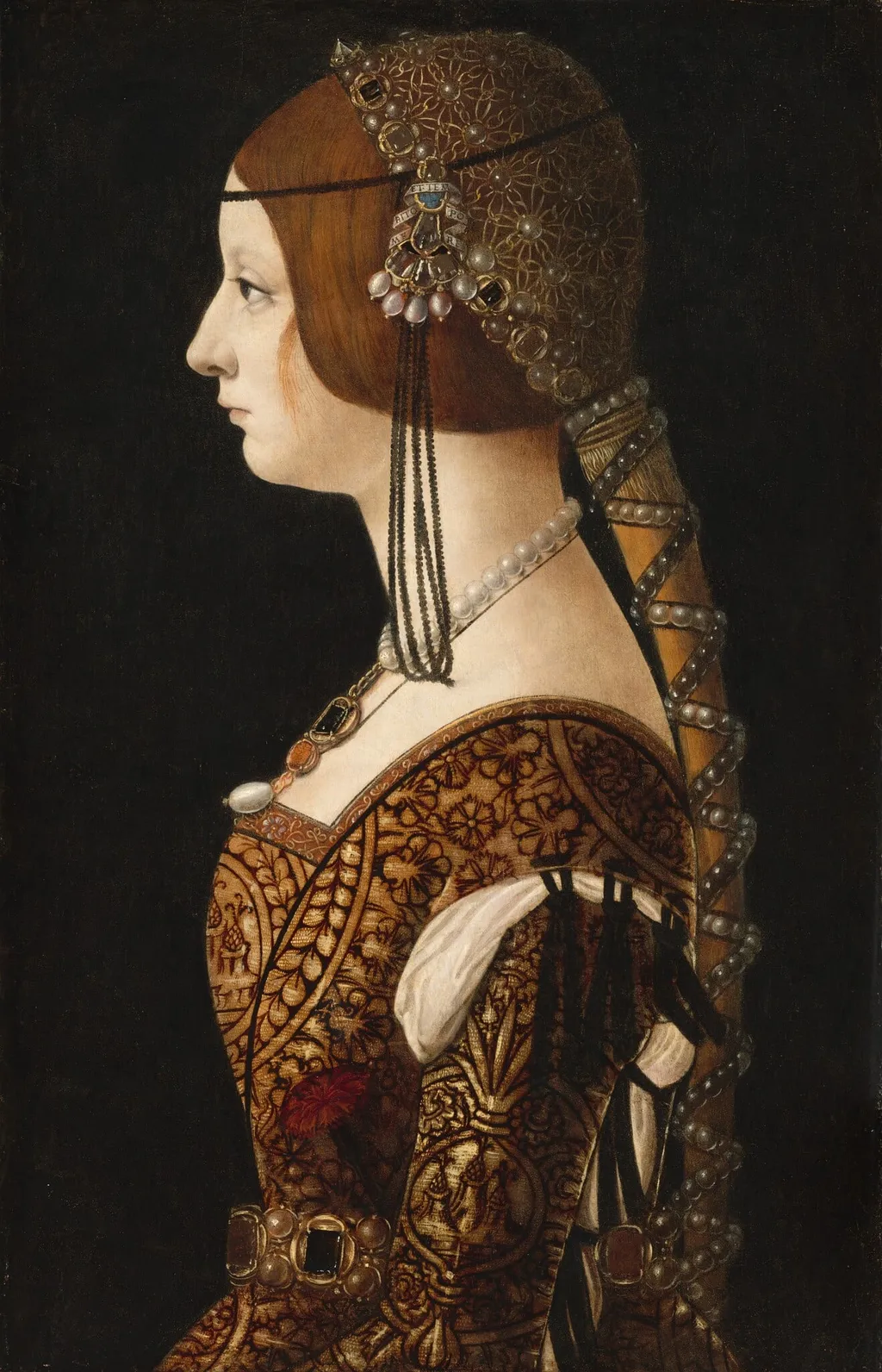
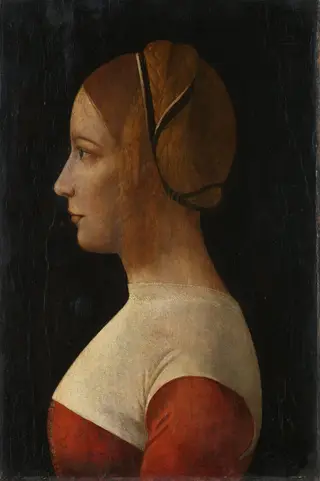
Bianca Maria Sforza is an oil painting by the Early Renaissance artist Giovanni Ambrogio de Predis. It dates from 1493 and is held in the collection of the National Gallery of Art.
- Inscription
- Inscribed:upper center on headdress is the Sforza motto: MERITO ET TEMPORE (With merit and time)
About this work
Bianca Maria Sforza sits in a formal setting, richly dressed and serious in expression. Ambrogio de Predis set down her jewelry and clothing in fine detail, marking her place in a wealthy family. Oil on poplar panel, 1493.
Technique & Style
As a product of the late fifteenth-century Italian tradition, the piece employs oil medium on wood, a standard technique for portraiture of this period.
Executed in 1493, this portrait utilizes oil paint applied to a poplar panel support. The work measures 51 cm in height and 32.5 cm in width, classifying it as a small-scale panel painting. As a product of the late fifteenth-century Italian tradition, the piece employs oil medium on wood, a standard technique for portraiture of this period.
The surviving physical object allows for the identification of these specific material components, distinguishing it from canvas or fresco works. The combination of oil and poplar provides a rigid, smooth surface conducive to the detailed rendering characteristic of the artist's approach to courtly likenesses.
History & Provenance
The portrait of Bianca Maria Sforza was painted by Giovanni Ambrogio de Predis in 1493, executed in oil on a poplar panel. Its early history is uncertain, though Fern Rusk Shapley speculated that it may have been among the Sforza portraits confiscated in Milan by King Louis XII of France in 1499 and recorded in an inventory of Italian portraits belonging to his queen, Anne de Bretagne. By the late nineteenth century the painting was in a private English collection.
Dr. Friedrich Lippmann, director of the Kupferstichkabinett in Berlin, purchased it in England during the summer of 1888, as documented by Fritz Harck in 1889. The work passed by inheritance to his son, also named Friedrich Lippmann, and was acquired in 1904 on joint account by Durlacher Brothers and P & D Colnaghi's, who sold it the same year to Eugène Fischhof. Peter A.B. Widener of Lynnewood Hall, Elkins Park, Pennsylvania, acquired the painting from Fischhof in 1904.
It descended through the Widener family by gift and power of appointment to Joseph E. Widener, who donated it to the National Gallery of Art in 1942.
The portrait of Bianca Maria Sforza by Ambrogio de Predis is held in the collection of the National Gallery of Art in Washington, D.C., where it is accessioned as a gift from Joseph E. Widener to the museum in 1942. Prior to this donation, the work was part of the estate of Peter A.B. Widener at Lynnewood Hall in Elkins Park, Pennsylvania. The painting's provenance traces back to its acquisition in 1904 by the Widener family from art dealers Eugène Fischhof, following earlier ownership by the Durlacher Brothers and P & D Colnaghi.
Before entering the American market, the panel was purchased in England in the summer of 1888 by Dr. Friedrich Lippmann of Berlin and subsequently inherited by his son. Currently, the work is displayed in Gallery 18 of the National Gallery of Art's West Building.
Context
The portrait of Bianca Maria Sforza, painted by Ambrogio de Predis in 1493, exemplifies early Lombard court portraiture and reflects the cultural milieu of the Sforza dynasty in Milan. Executed in oil on poplar panel (51 × 32.5 cm), the work entered the National Gallery of Art in 1942 after a documented chain of ownership that began with its acquisition by Peter A. B. Widener in 1904. Scholars have noted its possible link to Italian portraits seized by King Louis XII of France in 1499, suggesting a provenance tied to the family's displaced collection.
Its presence in the West Building’s Gallery 18 underscores its significance within the narrative of Renaissance portraiture in the United States.
Overview
This oil painting, titled Bianca Maria Sforza, was created by Ambrogio de Predis around 1493. Executed on a poplar panel, it presents a formal portrait of its namesake subject, Bianca Maria Sforza. The work serves as a significant example of Renaissance portraiture, capturing the likeness and social standing of a prominent figure from a wealthy family, reflecting the artistic trends of the period.
Subject & Meaning
The portrait depicts Bianca Maria Sforza in a formal pose, her expression composed and serious. Her attire, characterized by elaborate clothing and intricate jewelry, underscores her elevated social status and the wealth of her family. The meticulous rendering of these details provides insight into the sartorial customs and personal adornment favored by the aristocracy of the late 15th century, emphasizing her position.
Own this work as a print
Artist & collection
Artist
Giovanni Ambrogio de Predis (c. 1455 – c. 1508) was an Italian Renaissance painter, illuminator and designer of coins active in Milan. Ambrogio gained a reputation as a portraitist, including as a painter of miniatures,…