Artwork
Wandering Musician
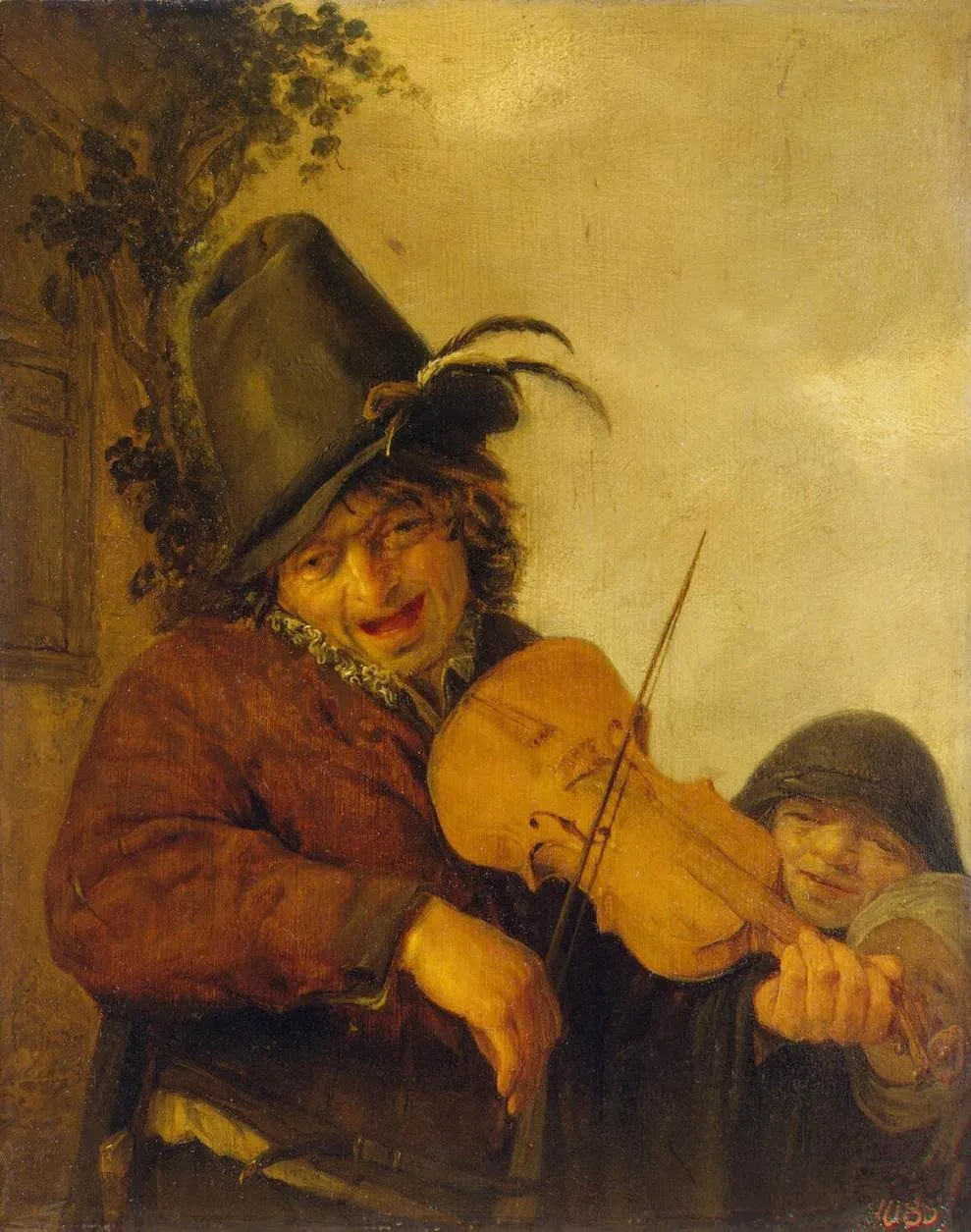
Wandering Musician is an oil painting by Adriaen van Ostade. It dates from 1648 and is held in the collection of the Hermitage Museum.
About this work
Overview
Wandering Musician is an oil painting on panel created in 1648 by the Dutch Golden Age genre painter Adriaen van Ostade.
Wandering Musician is an oil painting on panel created in 1648 by the Dutch Golden Age genre painter Adriaen van Ostade. Measuring 26.5 by 21.5 cm, the work depicts a seated violinist accompanied by a secondary figure, rendered in the earthy tonalities and dramatic lighting characteristic of Van Ostade's mid-career period. The painting is currently held in the collection of the Hermitage Museum in Saint Petersburg, Russia, where it entered through the provenance of the Dutch collector Gerrit Braamcamp. As a compact, meticulously observed genre scene produced in Haarlem during the height of the Dutch Republic's cultural flourishing, the painting exemplifies Van Ostade's ability to elevate everyday subjects through technical refinement and psychological immediacy.
Subject & Meaning
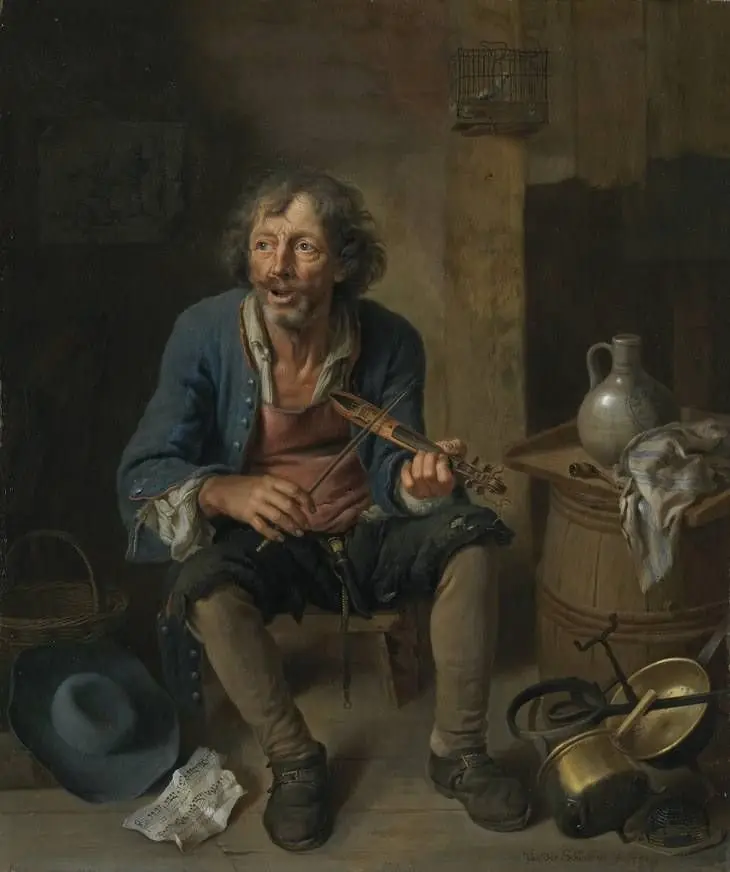
The painting presents a musician seated in the foreground, his body angled slightly to the right while his face turns toward the viewer. He wears a tall dark feathered hat, a reddish-brown jacket, and a ruffled collar, with his left hand gripping the violin's neck and his right hand holding the bow. Behind him to the right, a smaller second figure wearing a dark cap leans forward, partially obscured, suggesting an accompanist or companion who adds depth and a social dimension to the scene. The background features a pale warm sky and a vine-covered structure to the left. The iconography of the wandering musician taps into a well-established theme in Dutch genre painting, representing the itinerant performer as a figure of both entertainment and social marginality. The musician's animated expression, with eyes alert and mouth partially open, conveys jovial engagement with his art, perhaps even singing as he plays. The feathered hat, while ostensibly part of his costume, also signals a degree of performative self-presentation that distinguishes the professional musician from the peasants Van Ostade typically depicted. The secondary figure's partial concealment creates a subtle hierarchy of attention while reinforcing the communal aspect of musical performance.
Technique & Style
The work is executed in oil on panel, a support that allowed Van Ostade the smooth surface necessary for his refined handling. Light falls strongly from the left, illuminating the musician's face, hands, and instrument while casting deep shadows beneath his hat brim and in the folds of his clothing, a chiaroscuro effect that recalls the influence of Rembrandt on Van Ostade's development around 1638-1640. The palette consists of earthy browns, warm ochres, and muted greens, with the vibrant reds of the jacket providing focal emphasis. The brushwork varies across the surface, appearing smooth in the flesh tones and more textured in the fabrics and foliage, demonstrating Van Ostade's controlled modulation of paint handling to differentiate materials and spatial planes. The small red inscription in the lower right corner, noted in direct observation, likely constitutes the artist's signature and date, a conventional placement in Dutch panel painting of this period. The compact dimensions, 26.5 by 21.5 cm, indicate a cabinet picture intended for close viewing, where the subtle tonal transitions and detailed rendering of costume and expression could be fully appreciated.
History & Provenance
The painting was created in 1648 in Haarlem, where Van Ostade had established his studio after training in Frans Hals's workshop and returning from a brief period in Utrecht. The work's provenance includes ownership by Gerrit Braamcamp, a notable Dutch collector whose name is associated with the painting's transfer to the Hermitage Museum collection in Saint Petersburg. The Hermitage accession represents part of the broader pattern by which Dutch Golden Age paintings entered Russian imperial collections during the eighteenth and nineteenth centuries, often through the agency of collectors like Braamcamp who operated within an international art market. A small red inscription in the lower right corner, visible on the panel, records the artist's authorship and the date of execution. The painting's modest scale and intimate character suggest it was conceived for a private collector rather than a public or institutional setting, consistent with the domestic function of much Dutch genre painting.
Context
Adriaen van Ostade, baptized in Haarlem in 1610 and buried there in 1685, was a central figure in Dutch genre painting, with a career spanning the height of the Dutch Golden Age. According to Arnold Houbraken, he trained in Frans Hals's Haarlem workshop, where the subject matter of fellow student Adriaen Brouwer, known for delicately painted scenes of carousing peasants, shaped Van Ostade's own thematic preoccupations. In his early work, Van Ostade depicted peasants engaged in debauchery using forceful chiaroscuro derived from Rembrandt; later, as both he and the Netherlands grew more prosperous, he portrayed calmer, more respectable figures in carefully structured interiors. The 1648 date of Wandering Musician places it in a transitional phase, after the Rembrandtesque influence had modified his palette and lighting but before the fully domesticated respectability of his late manner. Van Ostade was an extremely prolific artist, with over 800 paintings surviving, and he also maintained a significant practice as a printmaker, producing 50 recorded etchings that ranked him as the major Dutch printmaker after Rembrandt. His students included his younger brother Isaack and Jan Steen, ensuring the dissemination of his approach to subsequent generations of Dutch genre painters.
Legacy
Wandering Musician occupies a significant position within Van Ostade's oeuvre as a representative example of his mid-career synthesis of Rembrandtesque lighting with genre subject matter. The painting's presence in the Hermitage Museum ensures its continued visibility within one of the world's major collections of Dutch art, where it contributes to the institutional narrative of Dutch Golden Age painting for international audiences. The work's compact scale and focused subject have made it an accessible entry point for understanding Van Ostade's artistic evolution, from the boisterous peasant scenes of his early years toward the more refined and contemplative character studies of his mature period. The figure of the wandering musician itself became a recurrent type in European art, with Van Ostade's treatment influencing subsequent depictions of itinerant performers through its combination of sympathetic observation and technical polish. The painting's provenance through Gerrit Braamcamp and its eventual acquisition by the Hermitage also illustrate the long history of Dutch art collecting and the international dispersal of Golden Age paintings that has shaped museum collections worldwide.
Artist & collection

Artist
Adriaen van Ostade (baptized as Adriaen Jansz Hendricx 10 December 1610 – buried 2 May 1685) was a Dutch Golden Age painter of genre works, showing the everyday life of ordinary men and women.