Artwork
Black Iris
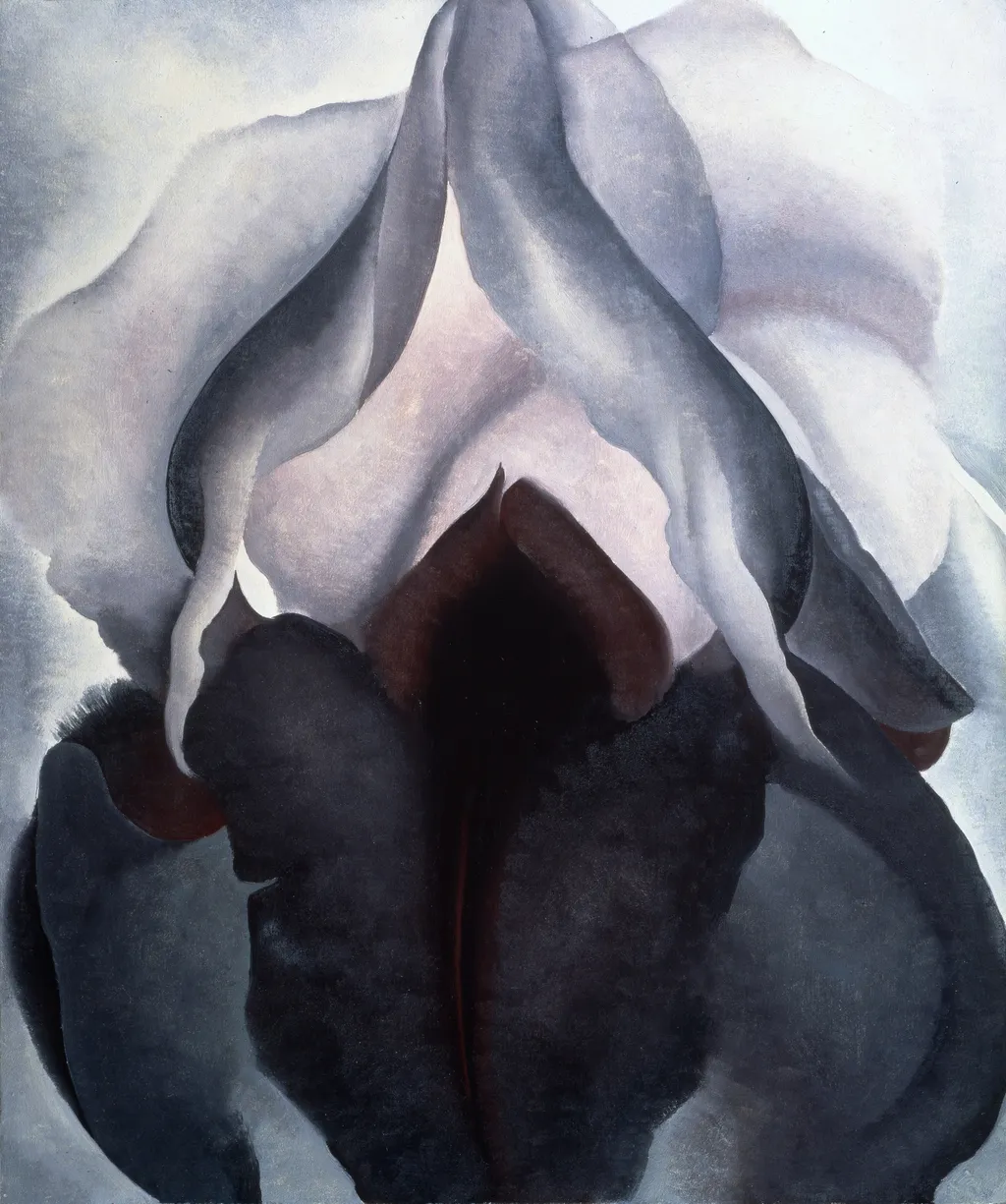
Black Iris is an oil painting by Georgia O'Keeffe. It dates from 1926 and is held in the collection of the Metropolitan Museum of Art.
About this work
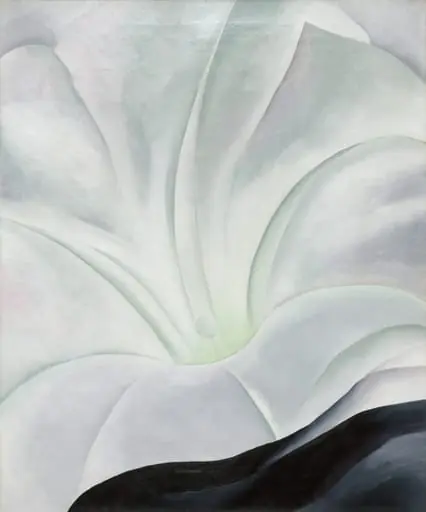
Georgia O’Keeffe painted Black Iris in oil paint in 1926. It shows a close-up view of a dark flower. The medium is oil on canvas.
Art historian Linda Nochlin read the painting as a metaphor for female anatomy. O’Keeffe later pushed back on that idea. She wanted people to see the flower itself, not their own ideas.
Look up the artist Q46408 next.
Technique & Style
The composition employs a palette dominated by dark tones, specifically black, purple, and maroon, to render the flower's center and lower petals.
Executed in 1926, Black Iris is an oil painting on canvas measuring 91.4 by 75.9 cm. The work exemplifies O'Keeffe's mid-1920s series of enlarged floral subjects, utilizing a close-up perspective to intensify visual presence through detailed observation. The composition employs a palette dominated by dark tones, specifically black, purple, and maroon, to render the flower's center and lower petals. In contrast, the upper petals are articulated using lighter shades of pink, gray, and white.
O'Keeffe applied these pigments with a blending technique that softens the outer edges, creating a sense of depth and focusing attention inward. This handling of light and form allows brightness to emerge within the image despite the absence of a defined external light source, emphasizing the organic vitality of the subject.
History & Provenance
Georgia O'Keeffe created Black Iris in 1926 as an oil painting on canvas. The work remained in the artist's personal collection from its completion until 1969. Between 1949 and 1969, the painting was held on extended loan by the Metropolitan Museum of Art.
In 1969, O'Keeffe donated the piece to the museum as part of the Alfred Stieglitz Collection. Originally exhibited in 1927 under the title Dark Iris No. 3, the work was later known as Black Iris III before being officially renamed Black Iris in 1991 following a revision of the artist's catalog.
Black Iris is held by the Metropolitan Museum of Art in New York, where it entered the collection in 1969 as part of the Alfred Stieglitz Collection. The painting had been on extended loan to the Metropolitan Museum from 1949 to 1969, having remained in the artist's own possession from 1926 until that donation. It is catalogued under dimensions of 91.4 × 75.9 cm and is identified in the artist's catalogue raisonné as CR 557.
The work was first exhibited at the Intimate Gallery in New York from January 11 to February 27, 1927, where it was catalogued as Dark Iris No. 3. It was subsequently shown at An American Place in 1933, at the Amon Carter Museum of Western Art in Fort Worth in 1966 as part of Georgia O'Keeffe: An Exhibition of the Work of the Artist from 1915 to 1966, and at the Whitney Museum of American Art in New York in 1970.
Context
Black Iris (1926), an oil painting by Georgia O'Keeffe, is housed in the Metropolitan Museum of Art and was first exhibited at the Intimate Gallery in New York in January 1927 as Dark Iris No. III. The work entered the artist's collection in 1926 and remained until 1969, when it was donated to the Met as part of the Alfred Stieglitz Collection. Its title was officially changed from Black Iris III to Black Iris in 1991.
O'Keeffe began focusing on flower centers in 1924, producing a series of large-scale works that intensified their visual presence through detailed rendering and soft blending of edges. She employed dark tones such as black, purple, and maroon in the lower petals and lighter hues like pink and white in the upper petals, using diffusion to create depth and emphasize organic form. Art historian Linda Nochlin interpreted the painting as a morphological metaphor for female genitalia, a reading O'Keeffe explicitly rejected in a 1939 statement defending her intent against sexualized readings.
The painting has been included in major retrospectives at institutions including the Amon Carter Museum of Western Art (1966) and the Whitney Museum of American Art (1970).
Legacy
The painting Black Iris (1926) has become a focal point in discussions of O'Keeffe’s role in modernist abstraction and feminist interpretation. Art historian Linda Nochlin interpreted the work as a morphological metaphor for female genitalia, a reading O'Keeffe explicitly rejected, stating that critics imposed personal associations onto her flowers. Despite this, the piece has been repeatedly exhibited, including its first showing at the Intimate Gallery in 1927 under the title Dark Iris No. III and later in major retrospectives at the Amon Carter Museum (1966) and the Whitney Museum (1970).
Its title was formally changed from Black Iris III to Black Iris in 1991 following a revision of O'Keeffe’s catalogue raisonné. The work was donated to the Metropolitan Museum of Art in 1969 as part of the Alfred Stieglitz Collection and has remained in their collection since. Its influence persists in art historical discourse on gender, abstraction, and the visual language of flowers in modernism.
Overview
Black Iris is an oil painting completed in 1926 by American artist Georgia O’Keeffe. Executed on canvas, the work presents an enlarged, close‑up view of a dark iris flower, rendered in a limited palette that emphasizes its form and texture.
Subject & Meaning
The composition isolates the iris, inviting prolonged observation of its structure. Early critics, notably art historian Linda Nochlin, read the image as a visual metaphor for female genitalia, a reading O’Keeffe herself rejected. In a 1939 statement she emphasized that the painting should be seen on its own terms, not as a projection of the viewer’s associations.
Artist & collection

Artist
Georgia Totto O'Keeffe (November 15, 1887 – March 6, 1986) was an American modernist painter and draftswoman whose career spanned seven decades and whose work remained largely independent of major art movements.