Artwork
Ravana’s sister Shurpanakha complains that Lakshmana cut off her nose and ears, from Chapter 31 of the Aranya Kanda (Book of the Forest) of a “Shangri” Ramayana (Rama’s Journey)
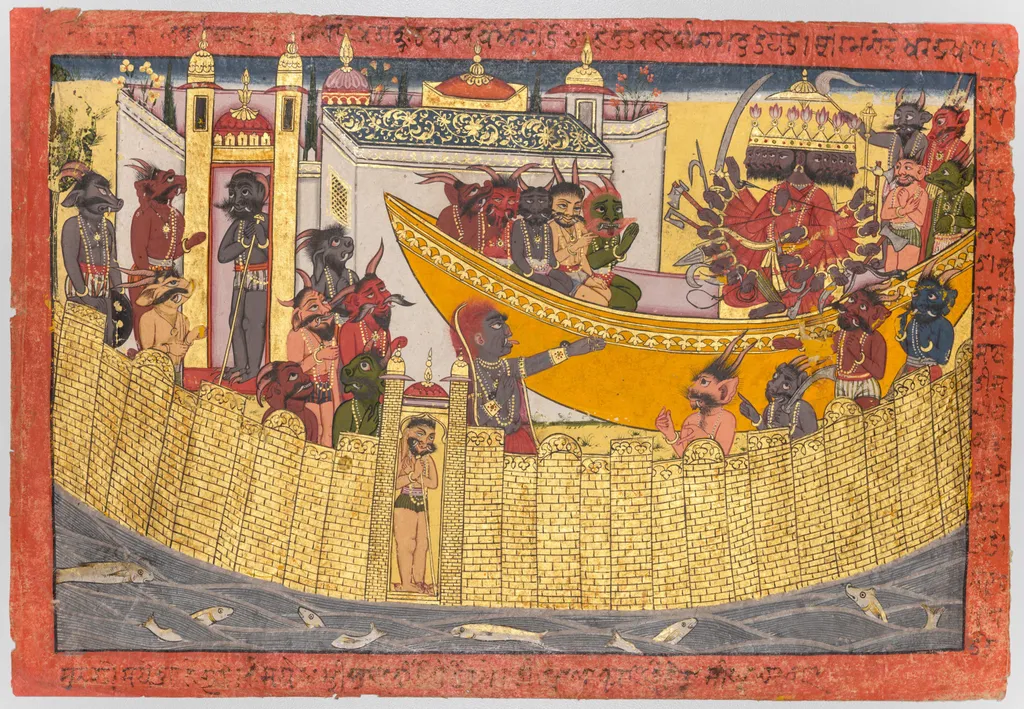
Ravana’s sister Shurpanakha complains that Lakshmana cut off her nose and ears, from Chapter 31 of the Aranya Kanda (Book of the Forest) of a “Shangri” Ramayana (Rama’s Journey) is an unspecified painting. It dates from 1696 and is held in the collection of the Cleveland Museum of Art. The work depicts a bustling, multicolored tableau drawn from Chapter 31 of the Aranya Kanda, the forest book of a regional Ramayana version.
About this work
Subject & Meaning
The painting illustrates Shurpanakha, the rakshasi sister of the demon king Ravana, after Lakshmana disfigures her by cutting off her nose and ears as recounted in Chapter 31 of the Aranya Kanda of the Shangri Ramayana. In Hindu epic tradition this episode symbolizes the transgression of social boundaries and the consequences of desire and aggression, with Shurpanakha's disfigurement serving as a catalyst for the ensuing conflict between Rama's forces and Ravana's kingdom.
Technique & Style
The composition emphasizes narrative clarity with expressive facial features and decorative borders that frame the scene.
The painting portrays Shurpanakha, Ravana's sister, mourning the loss of her nose and ears after Lakshmana's violent act, as described in Chapter 31 of the Aranya Kanda of the Shangri Ramayana. Rendered in a traditional Indian miniature style, the work employs fine brushwork and flat planes of color on a paper support, characteristic of late 17th-century manuscript illustration. The composition emphasizes narrative clarity with expressive facial features and decorative borders that frame the scene.
History & Provenance
The painting is dated to 1696. It is held in the collection of the Cleveland Museum of Art, where it is catalogued under the accession number 2018.107. No information regarding the original commissioner, earlier ownership, or chain of custody prior to the museum's acquisition is documented in the available records.
Overview
The work depicts a bustling, multicolored tableau drawn from Chapter 31 of the Aranya Kanda, the forest book of a regional Ramayana version. Central to the composition is a woman without a nose or ears, positioned on a yellow‑tiled platform and gesturing in anger. Around her, a crowd of figures, some with animal heads, others in red skin, brandish weapons, scale a boat, or stand amid a crowded vessel laden with swords.
Context
This scene is taken from a localized “Shangri” version of the Ramayana, a textual tradition that adapts the Indian epic for regional audiences. The episode appears in the forest chapter, where the protagonists encounter Shurpanakha’s assault on Lakshmana, leading to her disfigurement. The painting thus reflects a narrative moment that has been repeatedly illustrated in South Asian visual culture.
Legacy
Illustrations of Shurpanakha’s mutilation have long served as moral exemplars in devotional art, reinforcing themes of dharma and the perils of unchecked desire. By employing a lively, almost theatrical visual language, the work continues the tradition of making mythic episodes accessible and emotionally resonant for viewers across generations.
Artist & collection

 Vishnu as Kurma
 Vishnu as Matsya
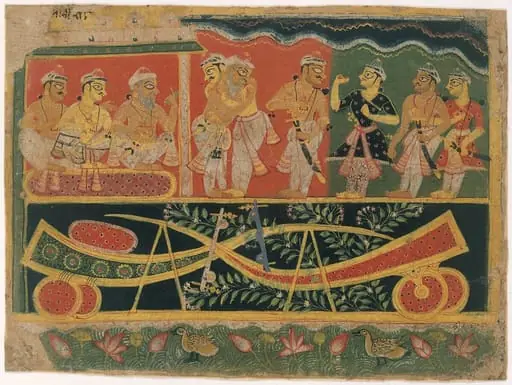 Untitled
 Worship of the Gods (16 of 17)
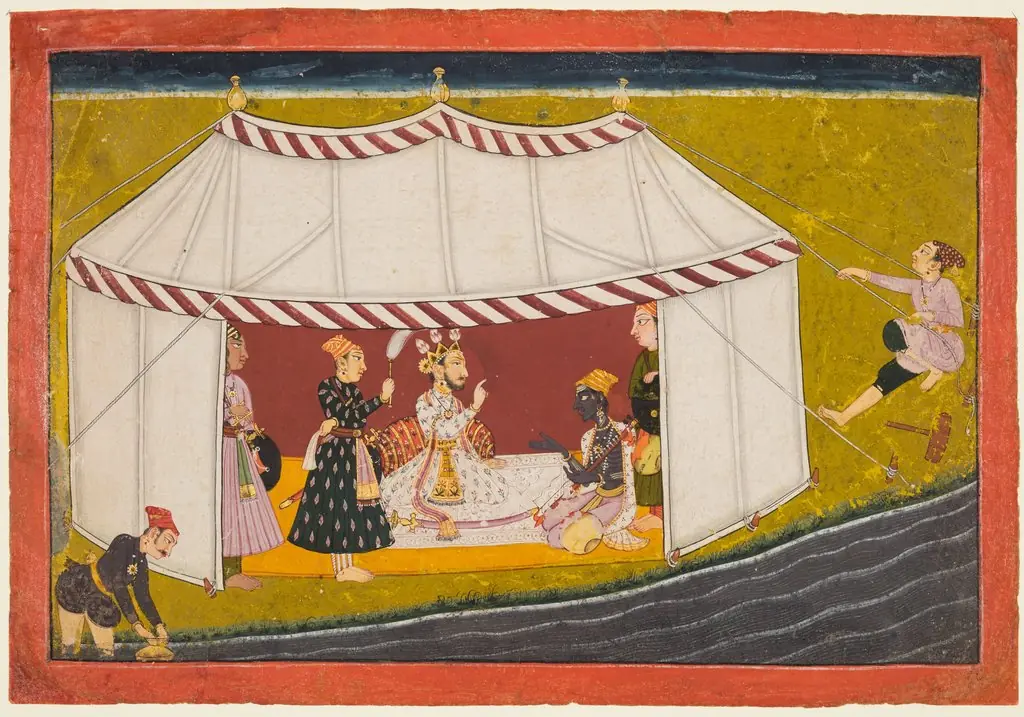 King Bikramaditya Summons Madhava, from a Madhavanala Kamakandala
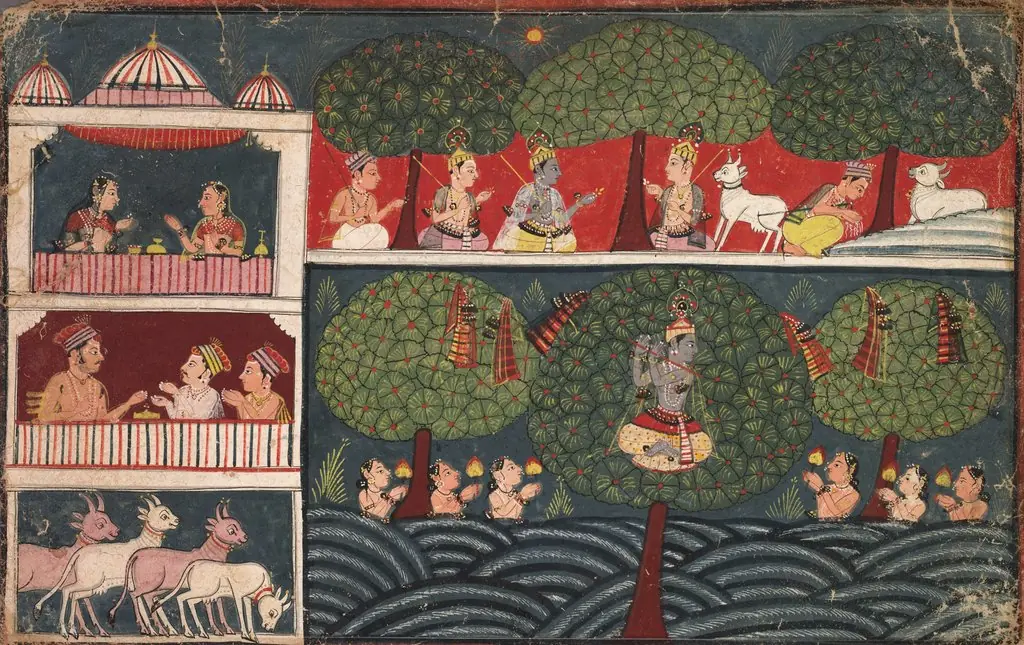 Krishna Steals the Clothes of the Milkmaids and Expounds on the Virtue of Trees, from a Braj Bhagavata Purana
 Krishna and Balarama
 The Demon Sambar Throws the Infant Pradyumna into the River, page from a manuscript of the Bhagavata Purana
 Rukmini Seeks Krishna's Permission to Visit her Brother Rukma, page from a manuscript of the Bhagavata Purana
 Mu'nim Khan and Khan Zaman