Artwork
Beggar Seated on a Bank
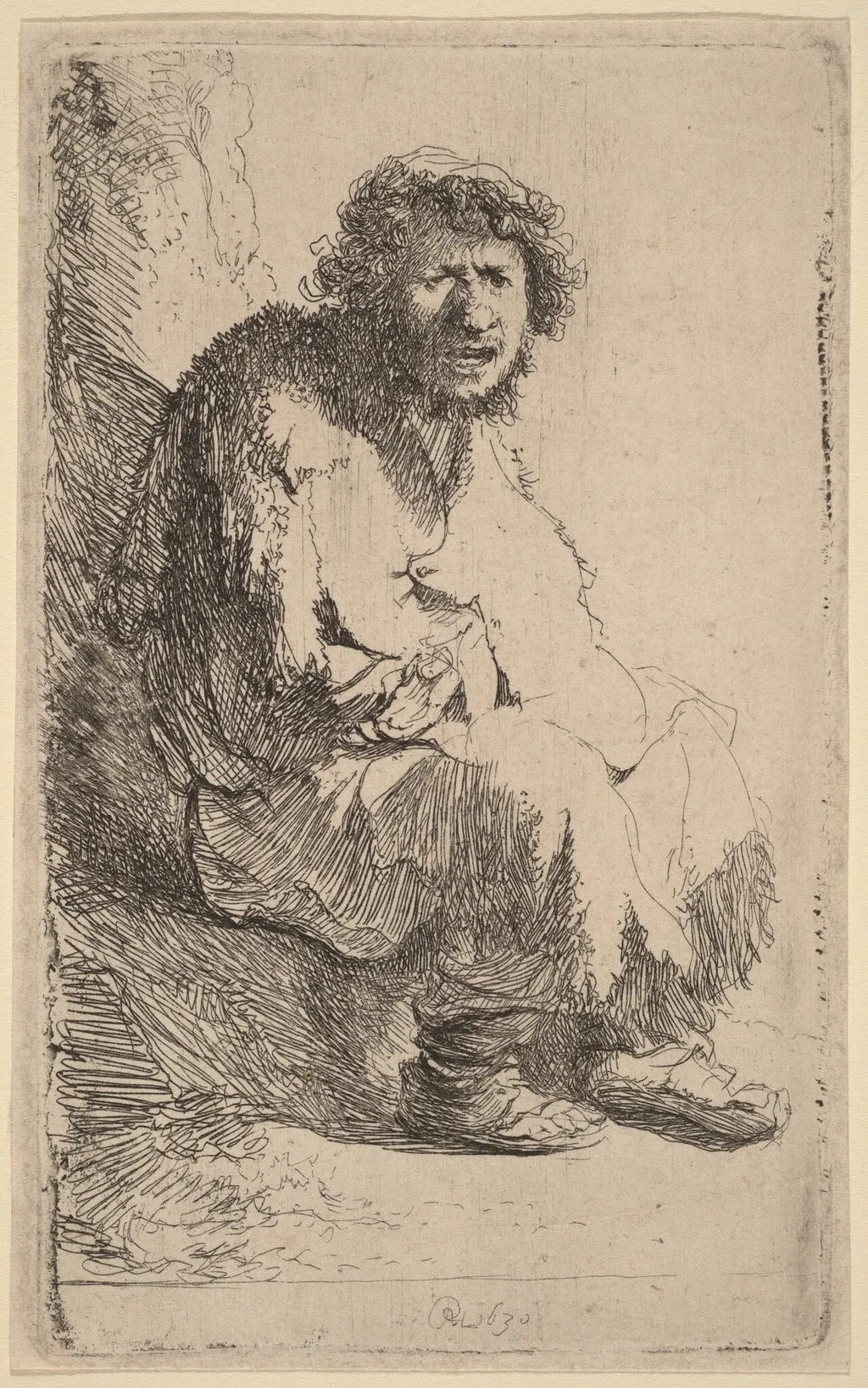
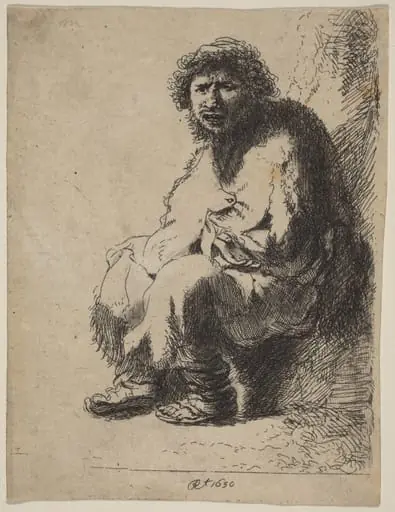
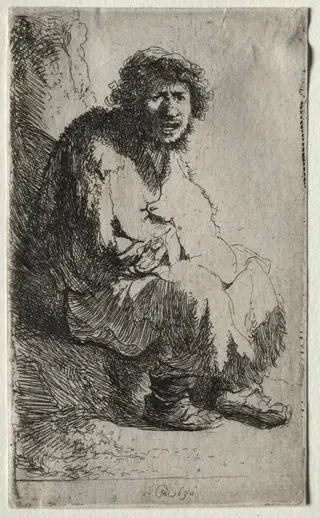
Beggar Seated on a Bank is an ink print by the Baroque artist Rembrandt van Rijn. It dates from 1630 and is held in the collection of the National Gallery of Art.
About this work
Overview
This piece exemplifies Rembrandt's youthful interest in genre subjects and the depiction of the lower classes, a theme he would revisit throughout his career.
Beggar Seated on a Bank is an etching created by Rembrandt van Rijn in 1630, during his formative years in Leiden. The work depicts a solitary, hunched figure seated on an earthen embankment, his body wrapped in a tattered coat that suggests exposure to the elements. Rembrandt renders the subject with a focus on physical texture and psychological presence; the man's face remains partially obscured in shadow, directing attention to his gnarled, weathered hands resting heavily on his knees.
Executed with rapid, energetic burin lines, the etching exhibits the artist's early experimentation with light and atmosphere, utilizing deep blacks and stark contrasts to define the figure against a minimal background. This piece exemplifies Rembrandt's youthful interest in genre subjects and the depiction of the lower classes, a theme he would revisit throughout his career. Created when the artist was twenty-four, the work demonstrates his emerging mastery of the etching medium, moving beyond mere representation to capture the dignity and hardship of the human condition.
It stands as a significant example of his early Leiden period, where he developed the expressive line work and intimate scale that would characterize his initial output before his move to Amsterdam.
Subject & Meaning
The image focuses on a destitute man, his face obscured by shadow, emphasizing anonymity rather than individual identity. By portraying the beggar without romanticizing his condition, Rembrandt invites contemplation of poverty as a universal human experience, aligning the work with a broader 17th‑century interest in everyday life and social reality.
Technique & Style
Created through the etching process, the plate was incised with acid, allowing ink to fill the resulting lines. Rembrandt’s handling is notably vigorous; the lines appear loose and hurried, yet they convey texture and immediacy. The rough, ragged edges of the drawing contribute to the work’s expressive quality, highlighting the artist’s early skill in rendering atmospheric depth with minimal means.
History & Provenance
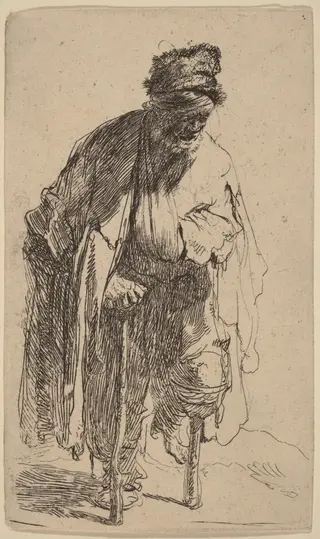
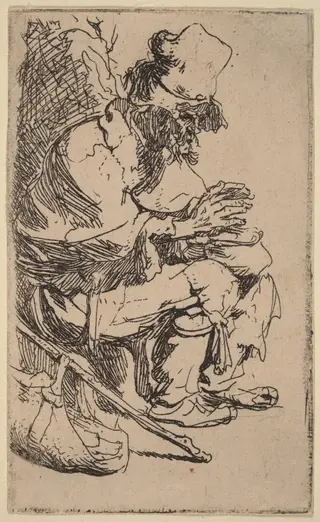
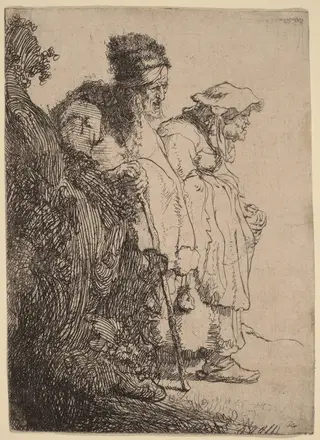
The print belongs to a small series of beggar subjects that Rembrandt produced in the early 1630s, a theme relatively uncommon among his contemporaries. While specific ownership records are limited, the work has been documented in several major print collections and continues to be cited as an early example of Rembrandt’s engagement with social subjects.
Own this work as a print
Artist & collection

Artist
Rembrandt Harmenszoon van Rijn, known mononymously as Rembrandt, was a Dutch Golden Age painter, printmaker, and draughtsman.