Artwork
Jatayu, Sita and Ravana
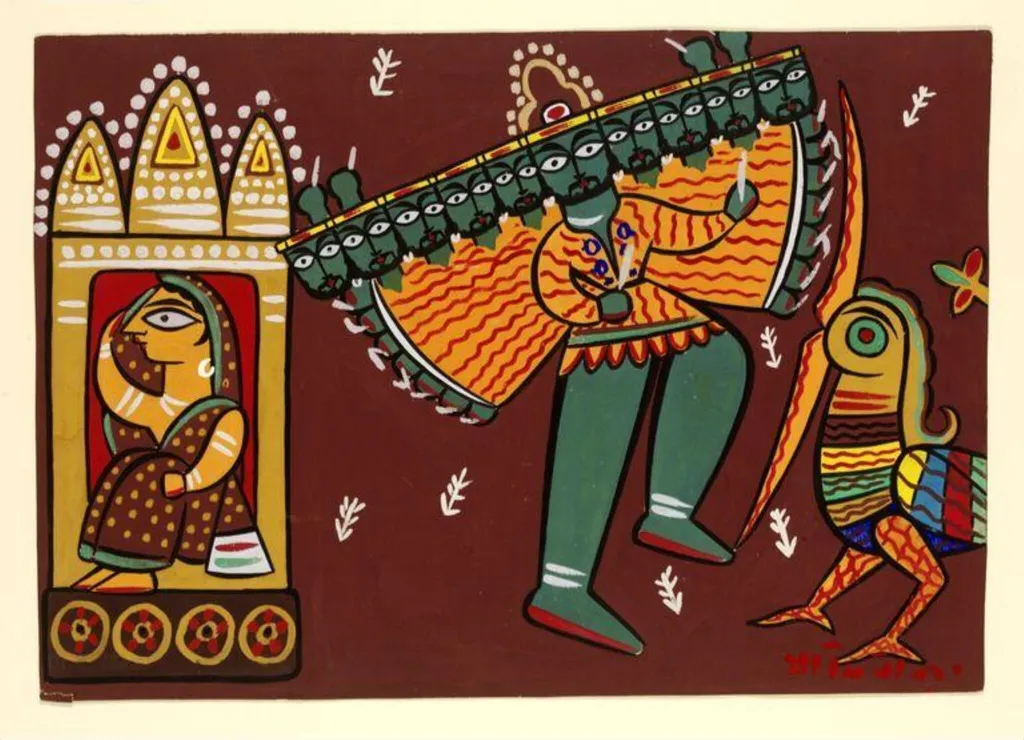
Jatayu, Sita and Ravana is a paint painting by the Bengal School artist Jamini Roy. It dates from 1940 and is held in the collection of the Victoria and Albert Museum.
About this work
Overview
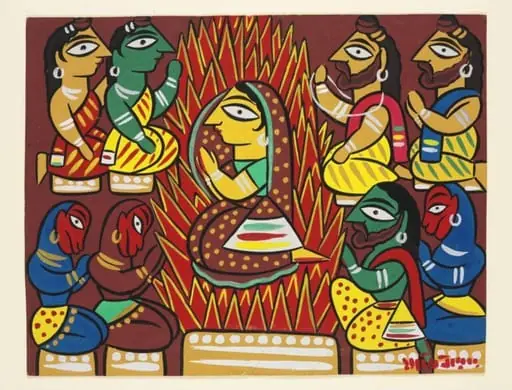
Jamini Roy, a pivotal figure in 20th-century Indian art, moved away from Western academic styles to draw from Bengali folk traditions. His work often featured simplified forms, unmodulated color, and strong outlines. This painting, likely produced in his workshop, depicts a scene from the Ramayana, reflecting his commitment to indigenous aesthetics and collective artistic practice.
Subject & Meaning
The scene illustrates Jatayu, the divine vulture king, attacking Ravana, the ten-headed demon, as he carries away Sita. Sita watches helplessly from a small structure, her stillness contrasting with the dynamic struggle above. The white arrows symbolize the force of Jatayu’s assault, reinforcing the myth’s moral tension between protection and abduction, virtue and violence.
Technique & Style
Roy employed flat, unshaded areas of color and thick, confident outlines to define forms, rejecting naturalism in favor of rhythmic clarity. The dark brown background isolates the figures, heightening their symbolic presence. White lines, possibly representing motion or divine energy, cut across the composition, adding urgency without depth or perspective.
History & Provenance
This work was likely created by apprentices in Roy’s Calcutta workshop, where standardized motifs were reproduced under his supervision. While signed by Roy, the hand of the individual artisan remains anonymous, aligning with his revival of collaborative, craft-based production. The piece reflects his deliberate shift from individual authorship to communal art-making.
Context
Roy’s artistic choices emerged during India’s independence movement, as he sought to redefine modern Indian identity through local traditions rather than colonial models. By embracing folk motifs and workshop methods, he challenged elite art institutions and positioned rural aesthetics as culturally authentic and politically resonant.
Legacy
Roy’s synthesis of folk idioms with modernist simplification influenced generations of Indian artists. His workshop model redefined artistic production, emphasizing accessibility and cultural continuity over individual genius. Today, his works are recognized for their role in reshaping the narrative of modern Indian art beyond Western frameworks.
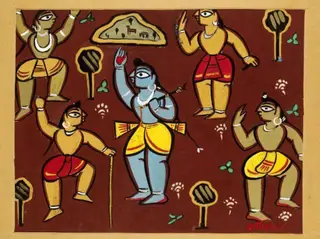
Artist & collection
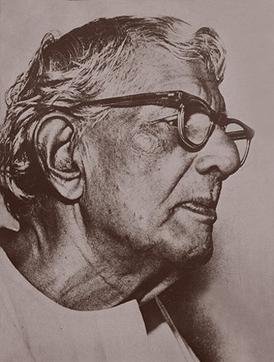
Artist
Jamini Roy was an Indian painter. He was honoured by the Government of India the award of Padma Bhushan in 1954. He remains one of the most famous pupils of Abanindranath Tagore, another praised Indian artist and…