Artwork
Farmhouse at Le Pouldu
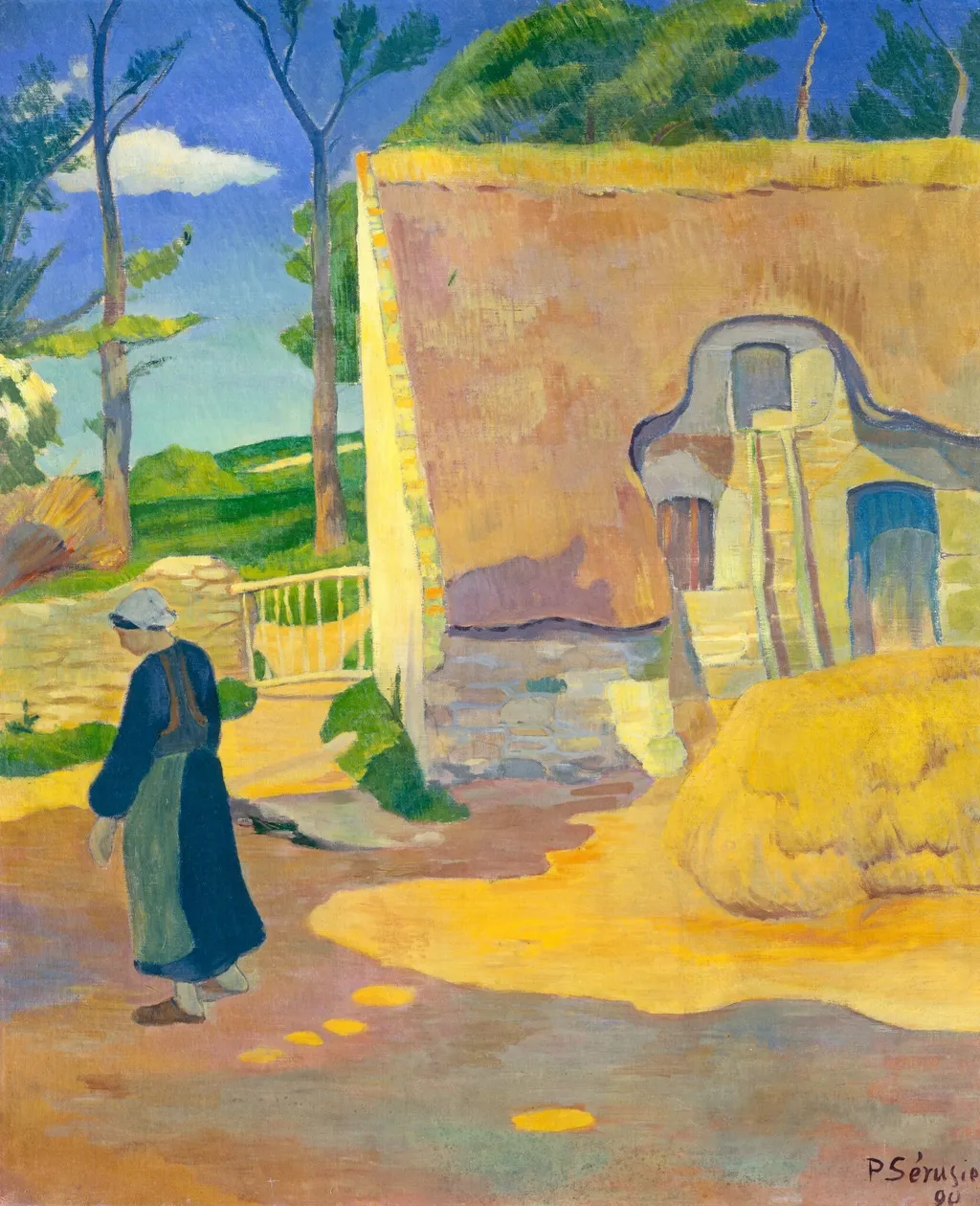
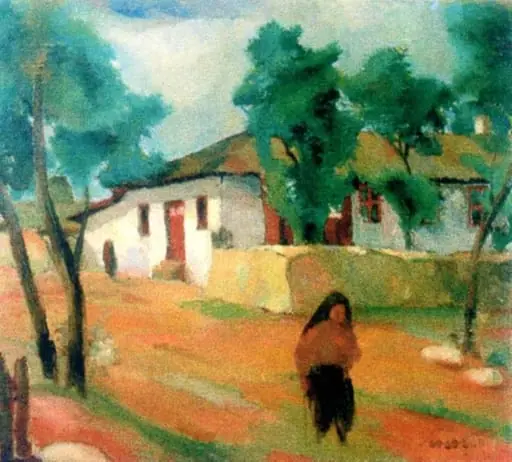
Farmhouse at Le Pouldu is an oil painting by the Impressionist artist Paul Sérusier. It dates from 1890 and is held in the collection of the National Gallery of Art.
- Inscription
- Inscribed:lower right: PSérusier / 90
About this work
Subject & Meaning
The composition emphasizes the interplay of built and natural forms, the farmhouse, trees, and human figure, capturing a moment of everyday rural existence.
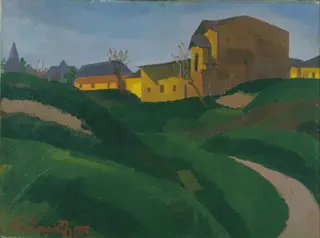
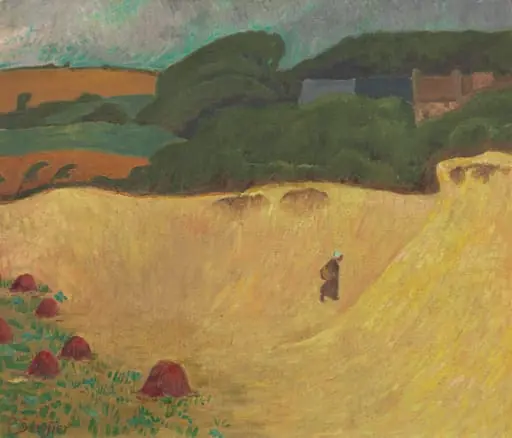
The painting depicts a rural farmhouse in Le Pouldu, a coastal village in Brittany, rendered in vertical format. A Breton peasant woman in local costume stands in the courtyard, anchoring the scene in local life and tradition. The composition emphasizes the interplay of built and natural forms, the farmhouse, trees, and human figure, capturing a moment of everyday rural existence.
Through its depiction of place and identity, the work reflects late-19th-century French interest in regional specificity and the poetic evocation of landscape, aligning with broader Symbolist and Synthetist tendencies in which external appearance serves as a vehicle for deeper feeling and cultural resonance.
Technique & Style
Executed in 1890, Farmhouse at Le Pouldu is an oil painting on canvas with vertical orientation, measuring 72 cm in height and 60 cm in width. The technique is consistent with post-Impressionist handling, employing fluid, layered brushwork to articulate form and atmosphere. Stylistically, the composition synthesizes structured geometry with luminous color planes, reflecting Sérusier’s engagement with the Pont-Aven circle while retaining a localized Breton subject.
The landscape depicts a coastal farm with a solitary tree and a Breton peasant woman in the courtyard, rendered through abbreviated, rhythmic strokes that flatten space and emphasize chromatic harmony.
History & Provenance
The work was painted by Paul Sérusier in 1890, during his early period at Le Pouldu. It belonged to the collector Hugo Troendle in Munich and was purchased from him in 1925 by the Ulm Museum, Germany. After the museum deaccessioned it, the painting passed through the Stuttgarter Kunstkabinett Roman Norbert Ketterer sale (29 November–1 December 1955) and was acquired by Hermann & Günther Abels, Cologne, in January 1956.
It was then owned by Josef and Hadassah Rosensaft before entering the New York art market via the Marlborough-Gerson Gallery. By 2000 it belonged to Mr. and Mrs. Alexander M. Laughlin, who gave it as a partial and promised gift to the National Gallery of Art, Washington, D.C.; the gift was completed in 2024.
Overview
Paul Sérusier's 1890 oil on canvas, Farmhouse at Le Pouldu, presents a tranquil rural scene. The painting centers on a modest farmhouse, partially obscured by a prominent tree, set within a quiet landscape. Through its composition and use of color, the work evokes a sense of calm and simplicity, characteristic of the artist's engagement with everyday subjects.
Own this work as a print
Artist & collection
Artist
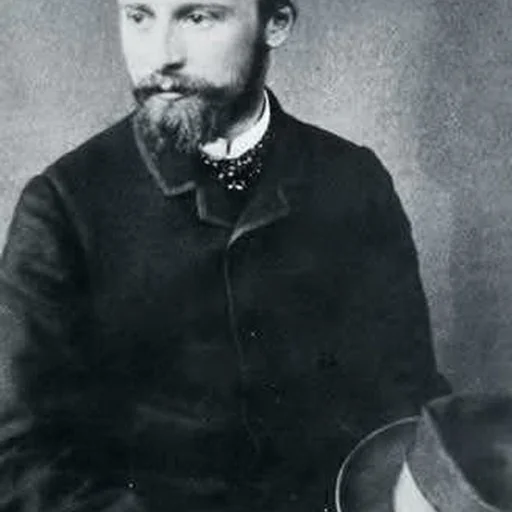
Paul Sérusier was a French painter who was a pioneer of abstract art and an inspiration for the avant-garde Nabis movement, Synthetism and Cloisonnism.