Artwork
The Street Vendor (La Marchande ambulante)
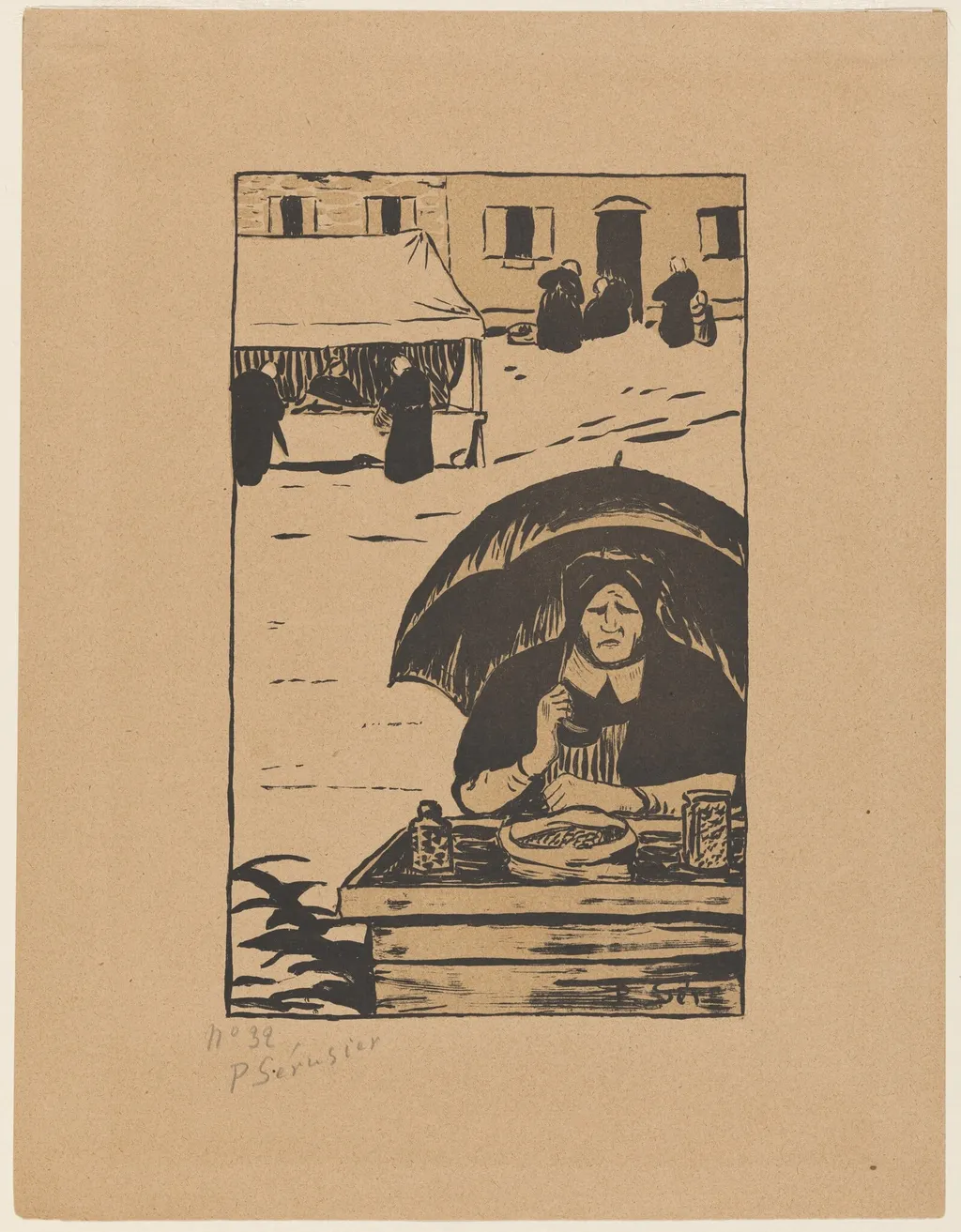
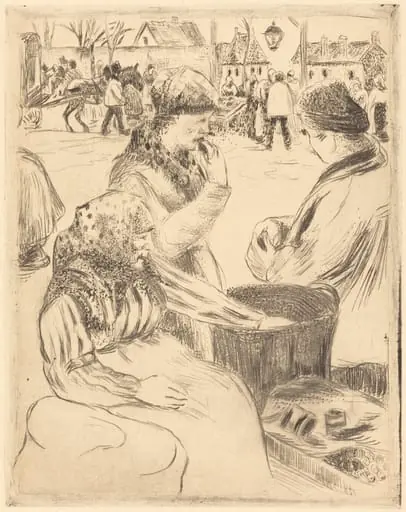
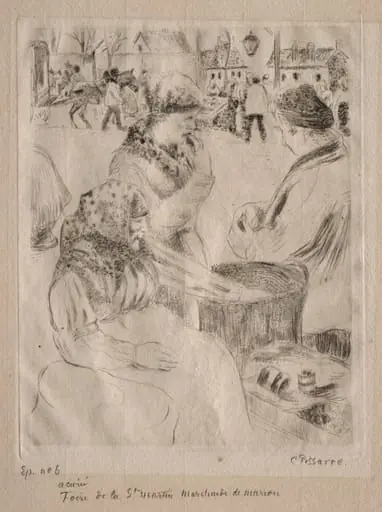
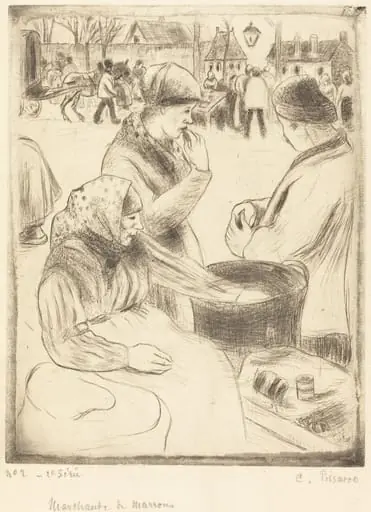
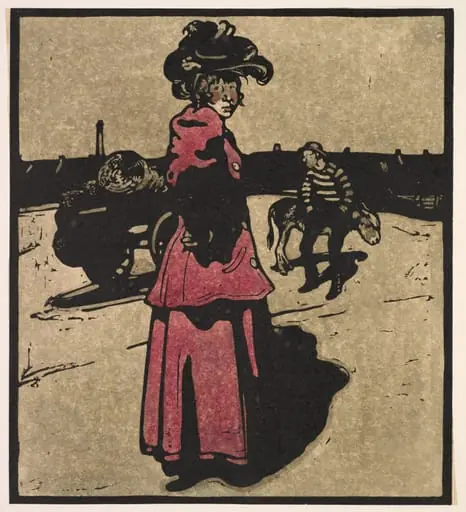
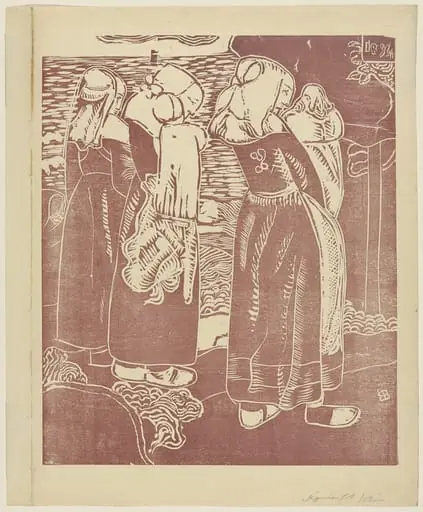
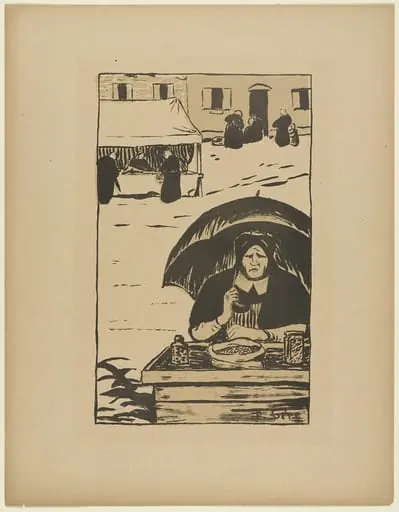
The Street Vendor (La Marchande ambulante) is an ink print by the Impressionist artist Paul Sérusier. It dates from 1895 and is held in the collection of the National Gallery of Art.
- Inscription
- Inscribed:lower left in graphite: No 32 / P Sérusier
About this work
Overview
Its restrained palette and focused composition reflect Sérusier’s interest in everyday life, filtered through a contemplative lens rather than overt narrative.
Paul Sérusier created this lithograph in 1895, depicting a solitary street vendor in a quiet urban setting. Rendered in black and brown ink on beige paper, the work belongs to the print collection of the National Gallery of Art in Washington, D.C. Its restrained palette and focused composition reflect Sérusier’s interest in everyday life, filtered through a contemplative lens rather than overt narrative.
Subject & Meaning
The central figure is a woman seated beneath an umbrella, facing the viewer with a composed, unsmiling expression. Before her, a bowl and cup suggest the sale of food or drink. Around her, scattered figures near a tent imply a market or fair, yet they remain peripheral.
The woman’s isolation and stillness evoke a sense of quiet endurance, emphasizing the dignity of labor without romanticizing it.
Technique & Style
Sérusier employed lithography to achieve soft tonal gradations and subtle texture, using only black and brown inks to define form and atmosphere. The lines are deliberate but not overly detailed, favoring simplified shapes and flat planes. This approach aligns with Symbolist tendencies, where emotional tone overrides realism, and the environment serves as a mood rather than a precise setting.
History & Provenance
The print was produced in 1895, during a period when Sérusier was exploring printmaking alongside his painting. It entered the National Gallery of Art’s collection through established acquisition channels, likely as part of a broader effort to document late 19th-century French graphic art. No record of prior private ownership is widely documented, suggesting it was retained by the artist or his circle before institutional acquisition.
Context
Created during the height of Symbolism in France, the work reflects a broader cultural turn toward introspective subjects and everyday rituals. While contemporaries like Toulouse-Lautrec captured the vibrancy of Parisian nightlife, Sérusier focused on quieter, more solitary moments. His choice to depict a vendor, rather than a performer or aristocrat, aligns with a growing interest in the lives of ordinary people.
Legacy
Though not among Sérusier’s most widely reproduced works, this lithograph contributes to understanding his shift from the bright hues of the Nabis to a more subdued, introspective style. It stands as an example of how printmaking allowed artists to explore mood and economy of form. Its presence in a major American museum underscores its role in documenting the quieter currents of French visual culture at the century’s end.
Own this work as a print
Artist & collection

Artist
Paul Sérusier was a French painter who was a pioneer of abstract art and an inspiration for the avant-garde Nabis movement, Synthetism and Cloisonnism.