Artwork
Frontispiece: Allegorical Composition (Composition allegorique)
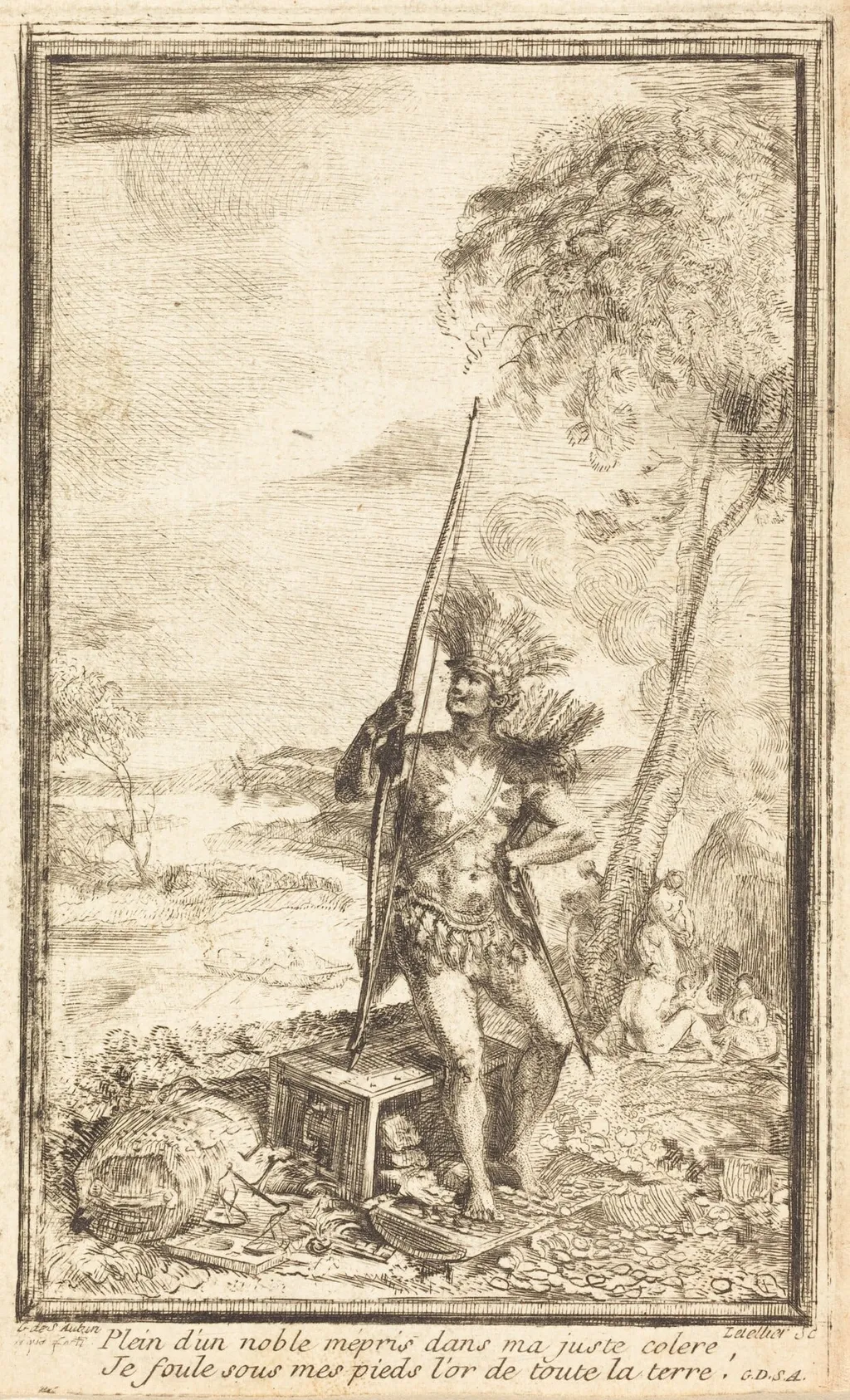
Frontispiece: Allegorical Composition (Composition allegorique) is an ink print by the Romanticist artist Gabriel de Saint-Aubin. It dates from 1767 and is held in the collection of the National Gallery of Art. Gabriel de Saint‑Aubin’s Frontispiece: Allegorical Composition is an 1767 etching executed on laid paper.
- Inscription
- Inscribed:recto: in plate, in image, at lower left: aubin; in plate, below image, at left: G de S Aubin / aqua forti; in plate, below image, at right: Letellier Sc; verso: at center in graphite in later hand: Bossu / P de B 37
- Markings
- Marked:recto: none; verso: National Gallery of Art
About this work
Overview
Gabriel de Saint‑Aubin’s Frontispiece: Allegorical Composition is an 1767 etching executed on laid paper. Designed as a frontispiece for a publication, the print presents a monochrome scene that functions as a visual preface, introducing the work’s thematic concerns through symbolic imagery.
Subject & Meaning
At the centre stands a muscular figure wielding a spear, poised atop a shattered box. The terrain is littered with rocks, sparse vegetation, a solitary tree and distant hills, suggesting a rugged landscape. Beneath the figure a French inscription reads, “plein d’orgueil noble dans ma juste colère,” conveying a tone of dignified, righteous anger that frames the allegorical intent.
Technique & Style
The image was produced by traditional copper‑plate etching, a process in which acid bites lines into a metal surface that is then inked and pressed onto laid paper. Saint‑Aubin’s handling of line creates a stark contrast between deep shadows and fine hatching, emphasizing the figure’s muscularity and the texture of the surrounding terrain.
History & Provenance
Created in the late eighteenth century, the print served as the decorative frontispiece for a contemporary book, a common practice for enhancing textual works with visual allegory. It remains documented in several French print collections, reflecting Saint‑Aubin’s active role in the Parisian art market of the period.
Context
The work belongs to a broader tradition of allegorical frontispieces that combined moral or philosophical statements with classical motifs. Saint‑Aubin, part of a family of artists, often produced such prints, aligning with Enlightenment interests in reason, virtue, and the didactic potential of art.
Legacy
While not as widely reproduced as later prints, this etching exemplifies the technical skill and intellectual engagement characteristic of mid‑century French printmaking, offering insight into the visual culture surrounding Enlightenment literature.
Own this work as a print
Artist & collection


![Flight of M. de Belle-Isle, Prisoner with theAttakapas [right], by Gabriel de Saint-Aubin](https://artifactworldgallery.com/img/gabriel-de-saint-aubin--flight-of-m-de-belle-isle-prisoner-with-theattakapas-right--c4658fbaef898dca-w320.webp)