Artwork
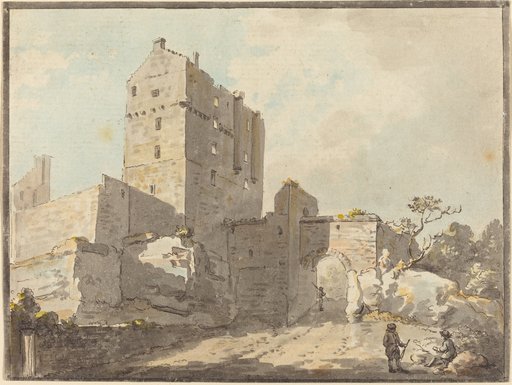
Benton Castle, Looking down the Reach to Milford Haven
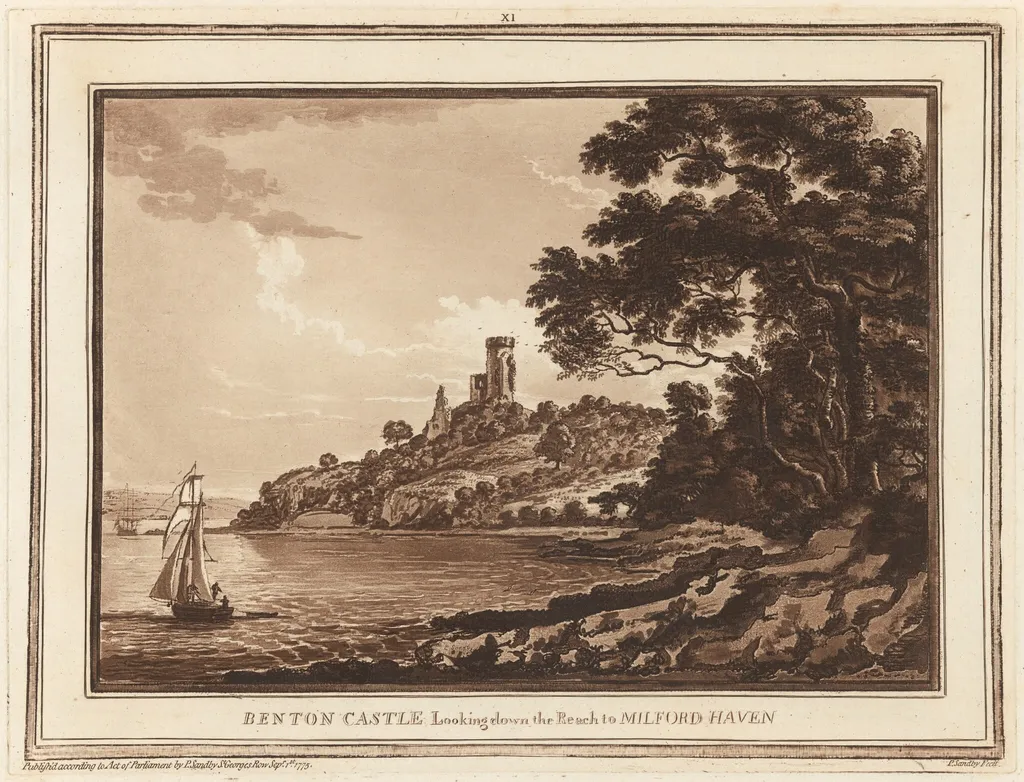
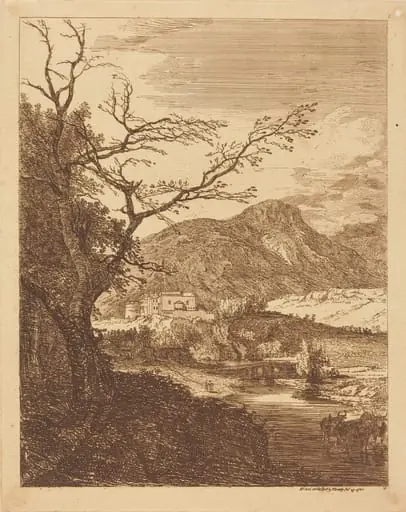
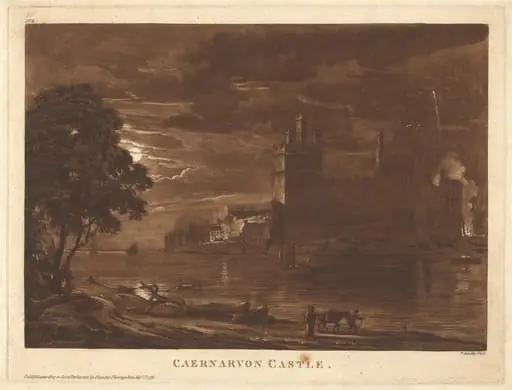
Benton Castle, Looking down the Reach to Milford Haven is an ink print by the Romanticist artist Paul Sandby. It dates from 1775 and is held in the collection of the National Gallery of Art.
- Inscription
- Inscribed:Upper center in plate: XI; lower center in plate: BENTON CASTLE, Looking down the Reach to MILFORD HAVEN; lower left in plate: Publish'd according to Act of Parliament by P. Sandby St. Georges Row Sepr. 1st. 1775.; lower right in plate: P. Sandby Fecit.; within image, lower center, on rock by water: P. Sandby 1774
About this work
Overview
Created in 1775, Benton Castle, Looking down the Reach to Milford Haven is a topographical print by Paul Sandby, executed in brown ink on laid paper.
Created in 1775, Benton Castle, Looking down the Reach to Milford Haven is a topographical print by Paul Sandby, executed in brown ink on laid paper. The work combines etching, aquatint, roulette, and mezzotint to achieve subtle tonal gradations and textured surfaces. Sandby, known for his precise landscape documentation, used these techniques to render the Welsh coastline with careful attention to natural detail and atmospheric depth.
Subject & Meaning
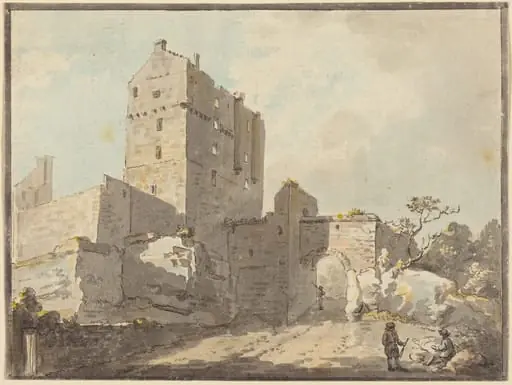
The scene captures Benton Castle perched on a rocky promontory overlooking Milford Haven, a natural harbor in Pembrokeshire. A solitary sailboat drifts on calm waters, emphasizing the quiet isolation of the site. The composition invites contemplation of the relationship between human architecture and the enduring landscape, reflecting an 18th-century interest in recording place with both accuracy and quiet reverence.
Technique & Style
Sandby employed multiple intaglio methods to build layered effects: etching defined fine lines, aquatint created soft tonal areas, roulette added stippled texture to rock and foliage, and mezzotint deepened shadows. The uniform brown ink unified the tonal range, enhancing the sense of atmospheric cohesion. His approach blended topographical precision with painterly nuance, avoiding overt drama in favor of observed reality.
History & Provenance
The print was made during Sandby’s extensive surveying work in Wales, part of a broader effort to document British landscapes. As a founding member of the Royal Academy, he was embedded in the emerging culture of artistic documentation. While specific early ownership records are sparse, the work aligns with his published series of Welsh views, circulated among antiquarians and landowners interested in regional topography.
Context
In the 1770s, British artists increasingly turned to landscape as a subject worthy of serious study, moving beyond pure cartography. Sandby’s work bridged scientific surveying and artistic expression, influenced by the Enlightenment’s emphasis on observation. His prints contributed to a growing public appetite for visual records of the nation’s geography, particularly in regions like Wales, then considered remote and picturesque.
Legacy
Sandby’s technical innovations in printmaking helped elevate landscape etching beyond mere documentation. His use of aquatint and mezzotint influenced later artists seeking to capture natural light and texture. Though less celebrated than his contemporaries, his systematic approach to recording place laid groundwork for the topographical tradition in British printmaking, preserving regional views with enduring clarity.
Own this work as a print
Artist & collection
Artist
Paul Sandby, (1731 – 7 November 1809) was an English mapmaker and painter who specialised in landscape art. Along with his older brother Thomas Sandby, he was one of the founding members of the Royal Academy in 1768.