Artwork
Street in Venice
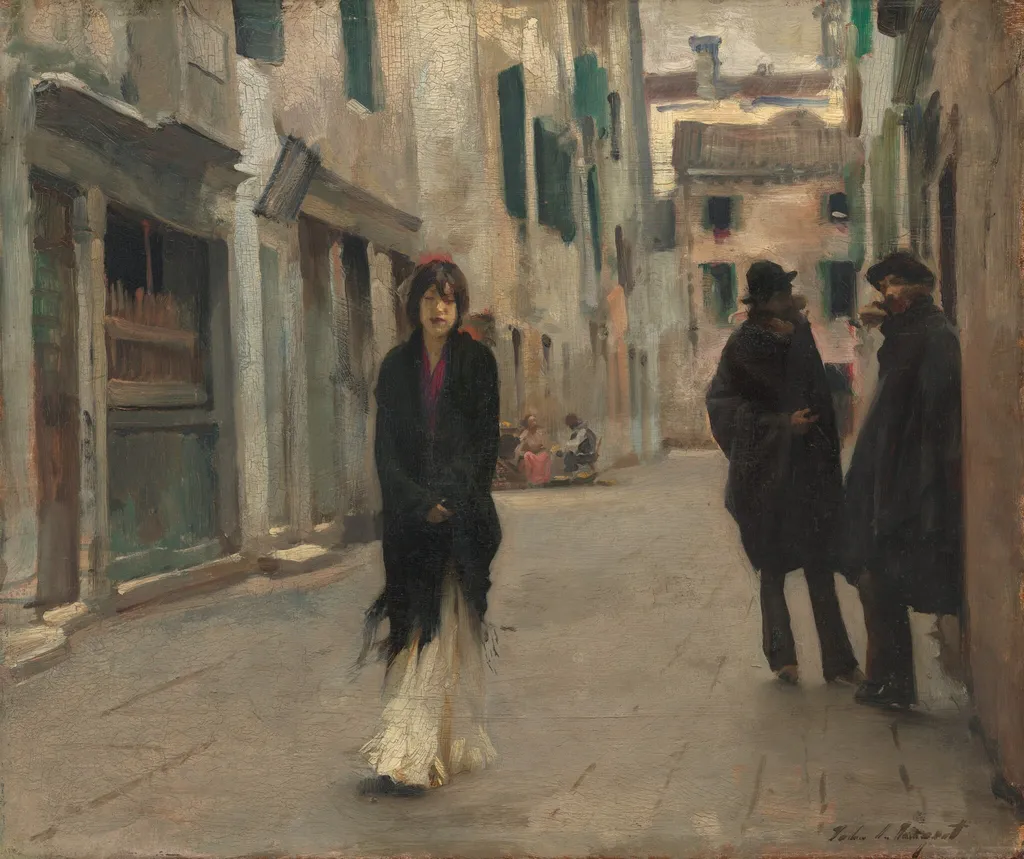
Street in Venice is an oil painting by the Impressionist artist John Singer Sargent. It dates from 1882 and is held in the collection of the National Gallery of Art.
- Inscription
- Inscribed:lower right: John S. Sargent
About this work
Subject & Meaning
This dynamic illustrates the painting's primary concern with the invasive nature of the male gaze and its psychological effect on the passing woman.
Depicting a quiet backstreet off the Calle Larga dei Proverbi near Venice's Grand Canal, the work centers on a young woman, likely the model Gigia Viani, walking briskly while kicking her skirt. She is observed by two men in the shadows, with one man's gaze following her as she deliberately averts her eyes. This dynamic illustrates the painting's primary concern with the invasive nature of the male gaze and its psychological effect on the passing woman.
Unlike typical Venetian scenes that highlight architecture, the composition focuses on edgy, everyday urban tension, utilizing a claustrophobic arrangement of descending rectangles and monochrome tones to emphasize the mood. The setting in Venice, rather than a more cosmopolitan city, underscores the specific social atmosphere Sargent sought to capture.
Technique & Style
The work is an oil painting on wood panel, measuring 45.1 cm by 53.9 cm, created around 1882 in Venice. Sargent renders the street scene with broad, dark silhouettes against lighter ground to define figures, emphasizing tonal contrast over color. The composition features descending rectangular forms that create a near-telescopic depth, culminating in the girl's head, while touches of red appear in her comb, dress, and a nearby cafe.
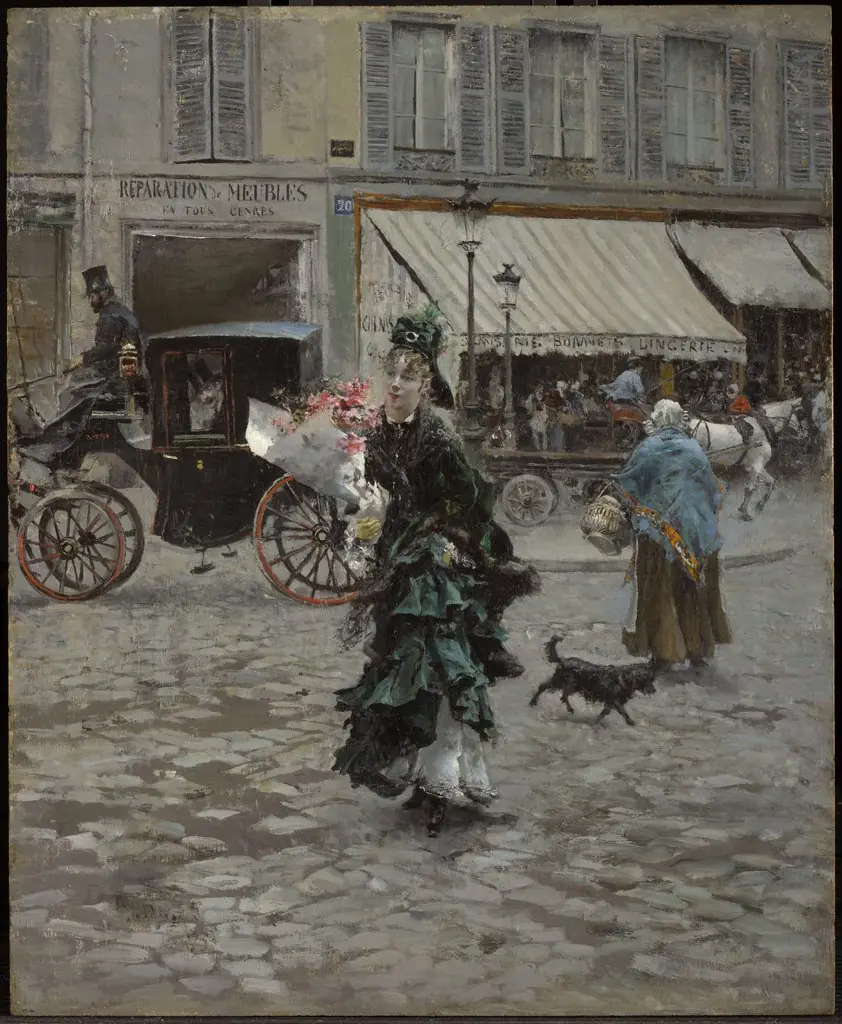
Influences from Velázquez are evident in the use of shadow and light, and the close cropping and frozen movement suggest photographic inspiration from Carlo Naya's Venice photography. The painting avoids architectural landmarks, focusing instead on intimate, shadowed backstreet interactions, with the woman's downcast eyes and swift motion contrasting the lingering gazes of two men. This approach links it to Boldini's Crossing the Street and reflects Sargent's Impressionist handling of brushwork and unconventional framing.
History & Provenance
John Singer Sargent created Street in Venice in 1882 during his time in the city. The work was first exhibited at the Galerie Georges Petit in Paris that same year. According to curatorial records and correspondence, the artist presented the painting to the architect Stanford White as a wedding gift in late October 1887, though an alternative provenance note states White received it in exchange for professional services.
Elizabeth Chanler of Boston purchased the work on January 30, 1888, from the St. Botolph Club Exhibition and subsequently gave it to White. The painting remained in the White family, passing to his wife Bessie Smith White, then to their son Lawrence Grant White and his wife Laura Astor Chanler White. The National Gallery of Art in Washington, D.C., acquired the piece in 1962, where it is inventoried as accession number 1962.2.1.
Context
Scholars situate _Street in Venice_ within Sargent's turn to Venetian genre scenes in the early 1880s, when he traded cosmopolitan portraiture for intimate urban vignettes. The work was first shown at the Galerie Georges Petit in Paris in 1882, aligning it with contemporary French Impressionist exhibitions rather than American venues. Margaret Conrads links its composition and mood to Giovanni Boldini's _Crossing the Street_, underscoring a trans-European dialogue in late nineteenth-century street imagery.
The painting's cropped, near-photographic framing and emphasis on tone over color reflect Sargent's engagement with both Impressionism and the photographic studies of Carlo Naya, whose Venetian views were widely circulated. Its quiet backstreet setting, away from Venice's grand canals, typifies Sargent's focus on edgy, peripheral life rather than monumental landmarks.
Overview
Created around 1882, this oil painting on wood depicts a narrow Venetian backstreet near the Calle Larga dei Proverbi, close to the Grand Canal. The composition captures a fleeting moment as a young woman in a dark coat and white skirt passes two shadowed men, the scene rendered with the immediacy characteristic of late‑19th‑century Impressionism.
Own this work as a print
Artist & collection

Artist
John Singer Sargent (; January 12, 1856 – April 15, 1925) was an American expatriate artist, considered the "leading portrait painter of his generation" for his evocations of Belle Époque and Edwardian-era luxury.