Artwork
Annunciation with Saints Maxima and Ansanus
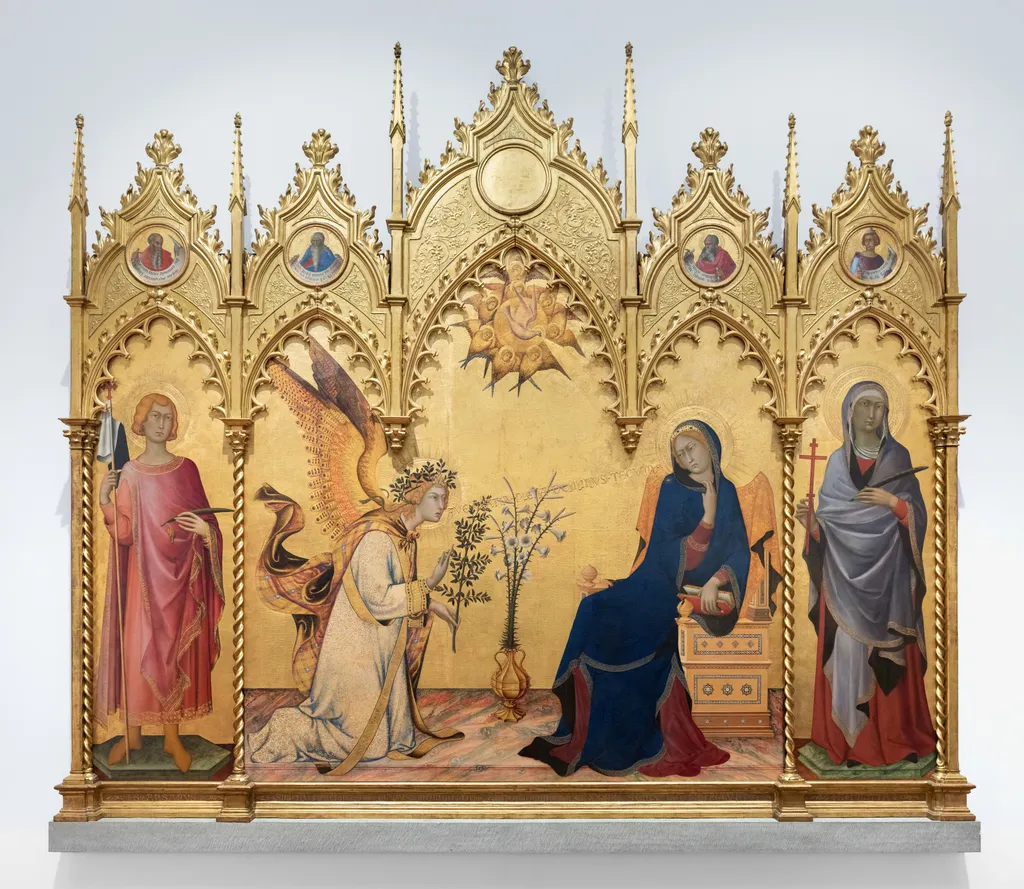
Annunciation with Saints Maxima and Ansanus is a tempera painting by the Gothic painting artist Simone Martini. It dates from 1333 and is held in the collection of the Uffizi Gallery.
About this work
Technique & Style
Figures display aristocratic grace with dematerialized forms, where drapery folds create rhythmic arabesques rather than defining anatomical volume.
Executed in 1333, this large wooden triptych measures 305 by 265 cm and is painted in tempera with extensive gold leaf on a panel support. The artists employed costly materials, including lapis lazuli and lacquer, to demonstrate the commission's prestige. The central panel is three times wider than the lateral sections featuring the saints, all set against a dazzling, abstract gold background that enhances the work's spiritual quality.
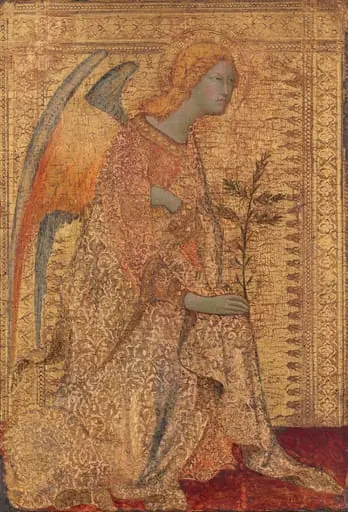
Stylistically, the piece exemplifies International Gothic through its extraordinary linear refinement and calligraphic details, such as the angel's mantle patterned like Tartar cloth and wings rendered with fine gilt feathers. The composition departs from Byzantine two-dimensionality by incorporating realistic elements like a marble floor and a vase of lilies, though spatial coherence remains secondary to decorative elegance. Figures display aristocratic grace with dematerialized forms, where drapery folds create rhythmic arabesques rather than defining anatomical volume.
History & Provenance
Commissioned for a side altar in Siena Cathedral dedicated to Saint Ansanus, the triptych was painted in 1333 by Simone Martini and his brother-in-law Lippo Memmi. The contract’s date is preserved in a fragment of the original frame, which carries the inscription naming both artists and the year MCCCXXXIII.
The work remained in the cathedral until 1799, when Grand Duke Ferdinand III transferred it to Florence in exchange for two canvases by Luca Giordano; it entered the Uffizi Gallery the same year and has been housed there since.
The *Annunciation with Saints Maxima and Ansanus* is currently held in the Uffizi Gallery in Florence, Italy, specifically located in Room A5 (Lorenzetti - Simone Martini). The work has no separate inventory number listed in the provided sources, but it is cataloged within the gallery's collection. Originally commissioned for the altar of Saint Ansanus in Siena Cathedral, the painting remained in its ecclesiastical setting until 1799. In that year, Grand Duke Peter Leopold (also referred to as Ferdinand III in some accounts) ordered its transfer to Florence, exchanging it for two canvases by Luca Giordano. The panel was exhibited at the Uffizi in the same year it arrived, 1799. The original 14th-century frame, carved by Paolo di Camporegio, was renovated in 1420 and eventually replaced by a modern frame in the 19th century.
Context
Widely regarded as the masterpiece of Simone Martini and a defining work of Sienese Gothic painting, this altarpiece is celebrated for its extraordinary linear refinement. Art historians note that the work has no direct contemporary parallels in Italy, instead sharing stylistic affinities with French illuminated manuscripts and paintings from Germany or England. This distinct "Northern European" aesthetic facilitated Martini's subsequent recruitment to the papal court in Avignon, where the classical monumentality of Giotto's Florentine style found little favor.
Critical reception has evolved significantly since the revival of interest in "primitive" art. While nineteenth-century writers like the Goncourt brothers perceived a sinister sensuality in the angel's depiction, later scholars such as Bernard Berenson and Roberto Longhi championed the painting as a symbol of pure linear elegance, comparing its grace to Persian miniatures and East Asian art. The work remains one of the most acclaimed holdings of the Uffizi Gallery.
Legacy
The Annunciation with Saints Maxima and Ansanus exerted significant influence on later Gothic painting through its innovative composition and stylistic synthesis. Its large central panel depicting the Annunciation, framed by side saints and prophet tondi, demonstrated a refined linear elegance that departed from Byzantine two-dimensionality, incorporating realistic details such as perspective architecture and naturalistic drapery. This approach, blending French manuscript illumination and German/English painting traditions with Italian Gothic elements, established a 'northern European' aesthetic that shaped Simone Martini's reputation as a bridge between traditions. The work's prestige was amplified by its papal patronage and the documented exchange of artistic techniques, notably in its use of gold leafing and lapis lazuli, which underscored contemporary civic pride. Its legacy was cemented through 19th-century rediscovery by figures like the Goncourt brothers and Berenson, who celebrated its linear grace as emblematic of Gothic art's sophistication, influencing assessments of Martini's role in art history.
Own this work as a print
Artist & collection


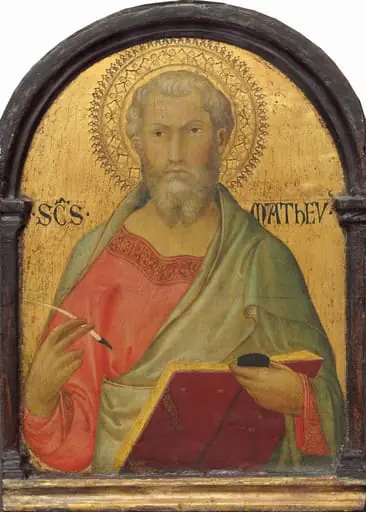
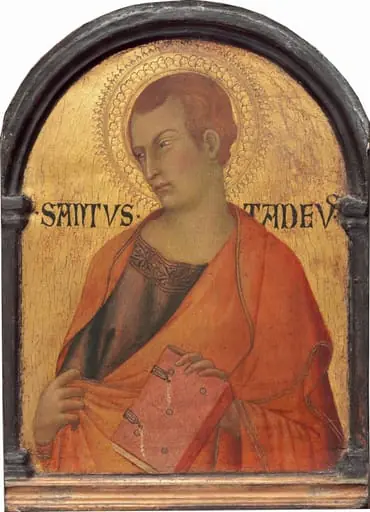
- Annunciation
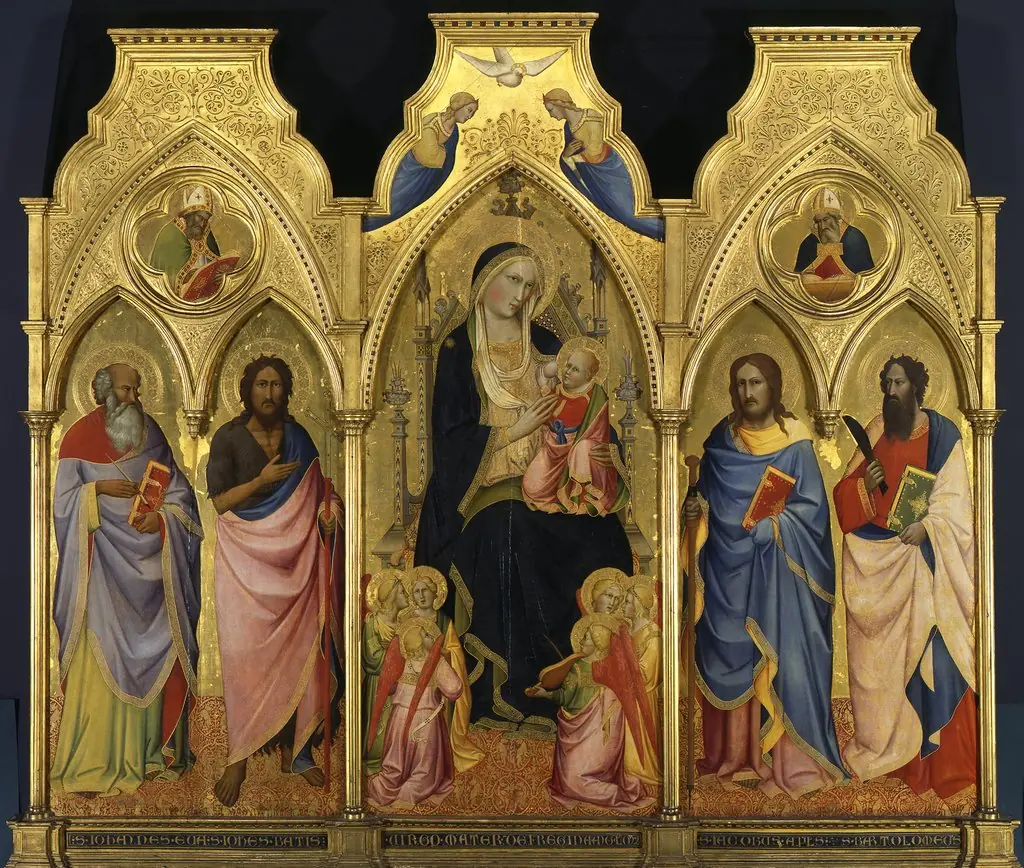 Triptych
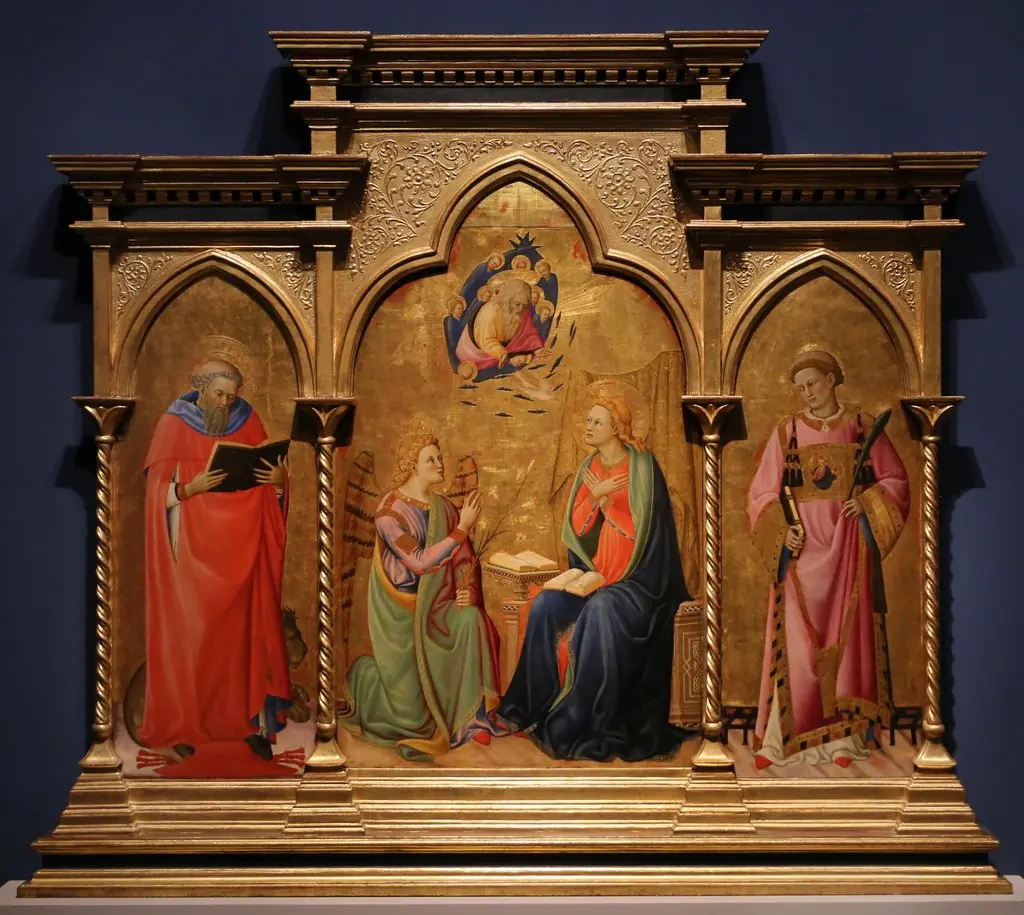 Parts of a triptych: Annunciation and saints Jerome and Lawrence
![Madonna and Child with Saints Andrew, Benedict, Bernard, and Catherine of Alexandria with Angels [entire triptych], by Agnolo Gaddi](https://artifactworldgallery.com/img/agnolo-gaddi--madonna-and-child-with-saints-andrew-benedict-bernard-and-ca--93a6585f38530738-w320.webp) Madonna and Child with Saints Andrew, Benedict, Bernard, and Catherine of Alexandria with Angels [entire triptych]
Madonna and Child with Saints Andrew, Benedict, Bernard, and Catherine of Alexandria with Angels [entire triptych]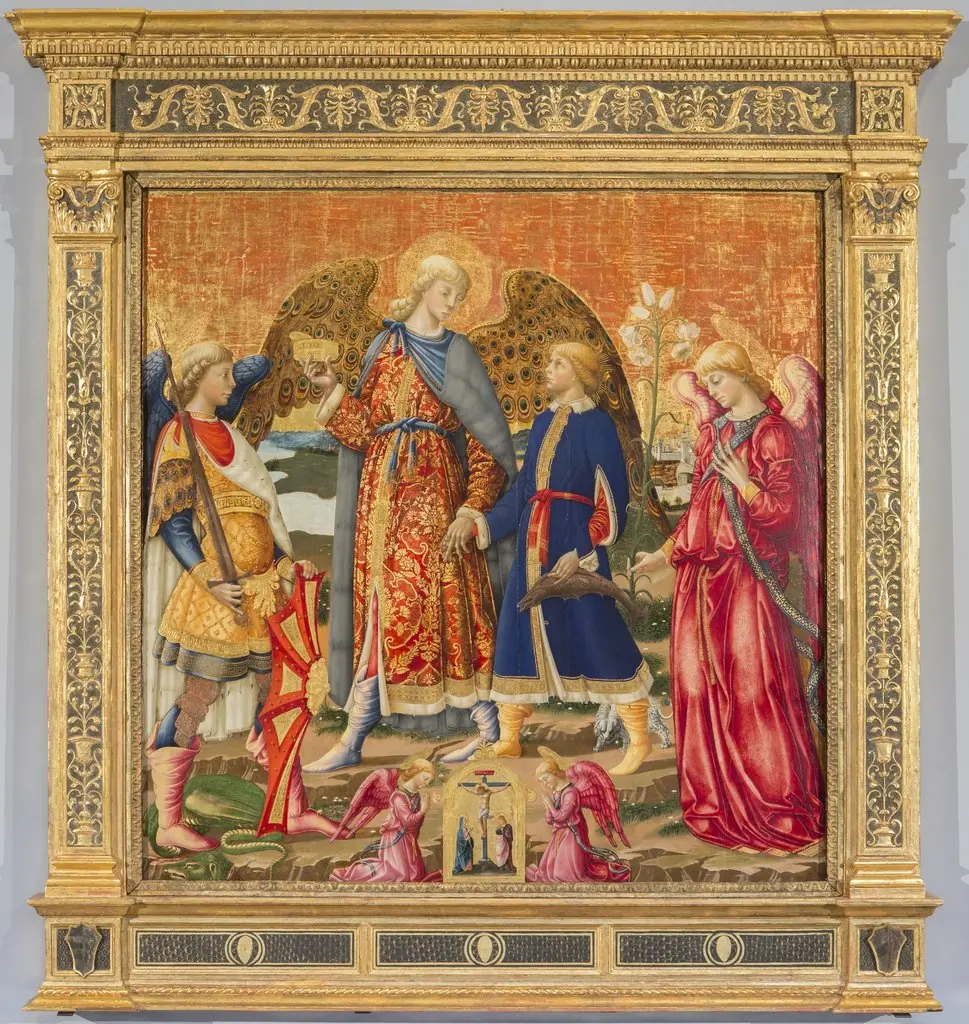 Tobias and Three Archangels
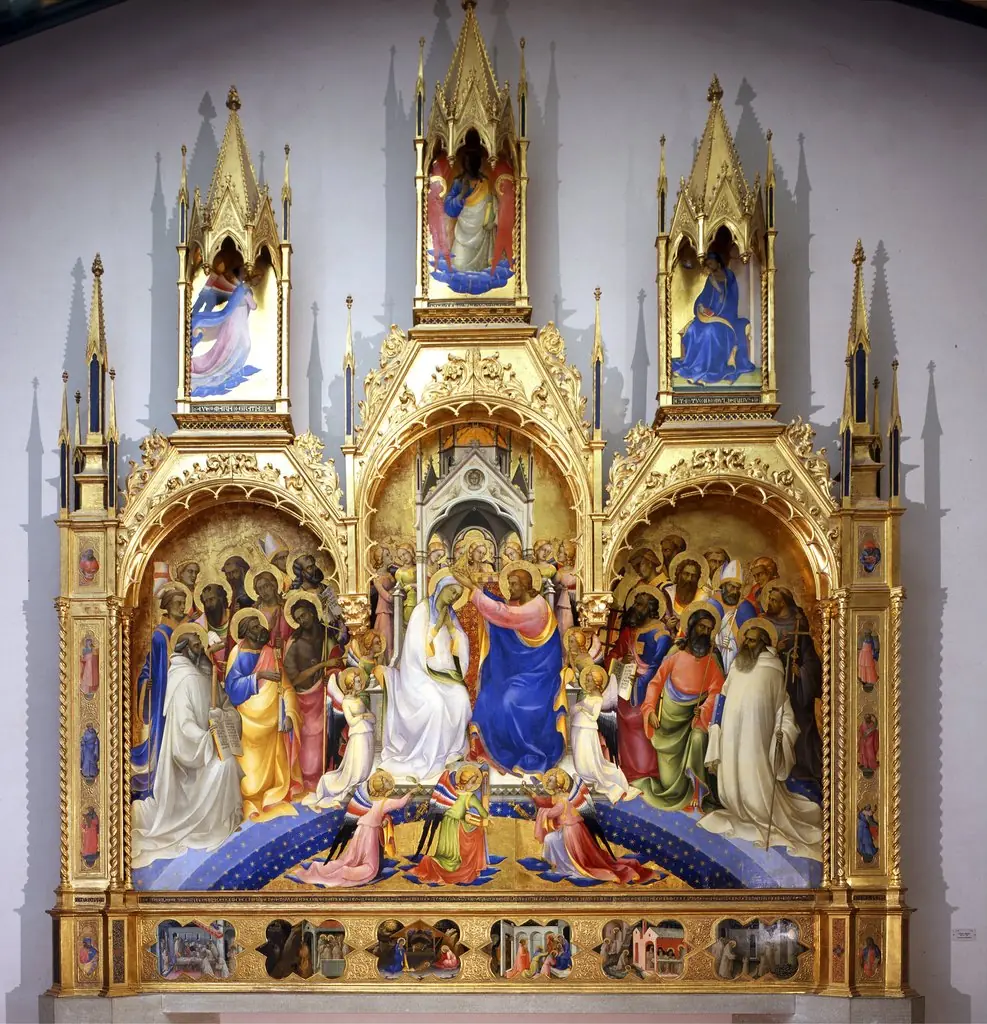 Coronation of the Virgin
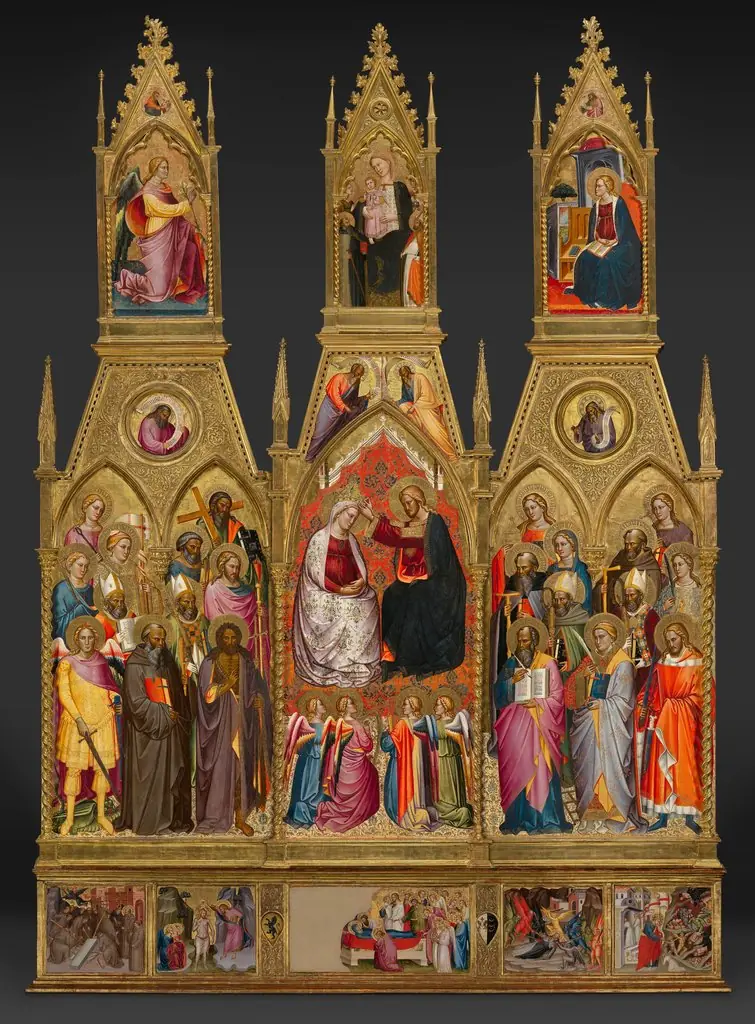 Polyptych with Coronation of the Virgin and Saints
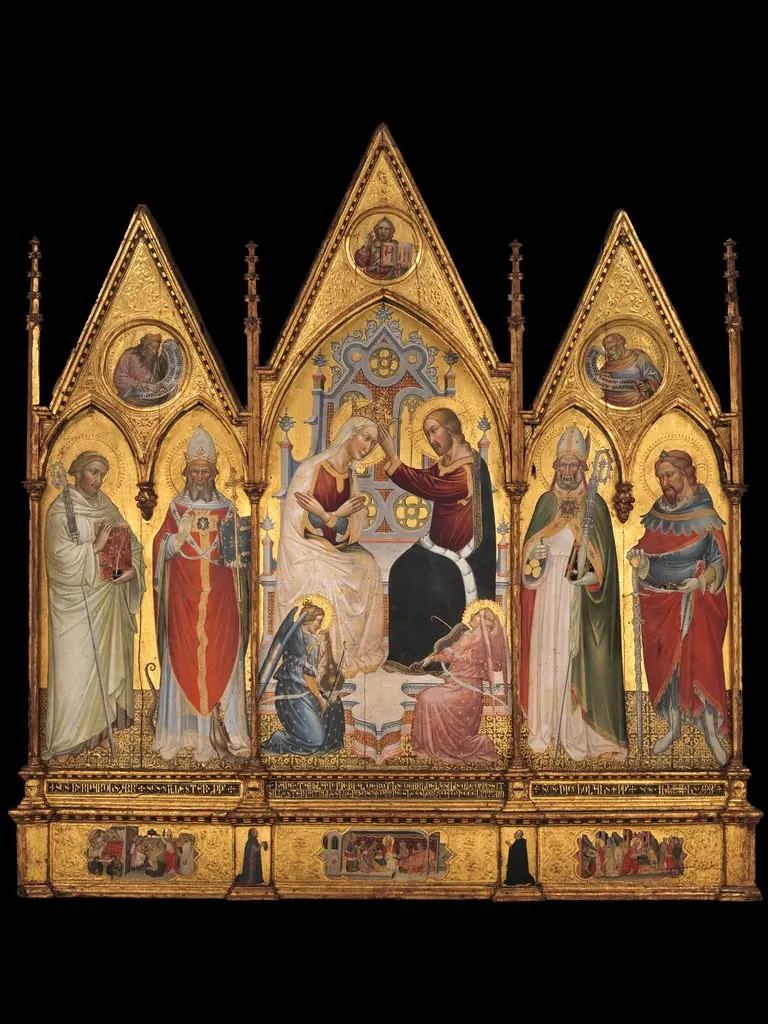 The Coronation of the Virgin, and Saints
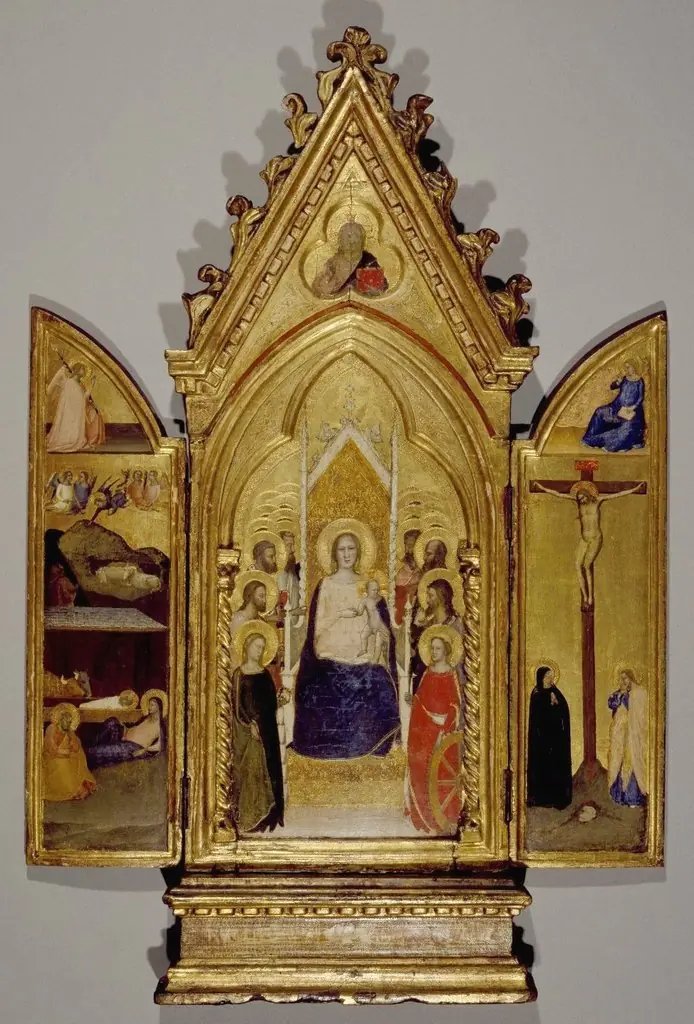 Triptych: Madonna with Saints and Christ Blessing (Center); The Nativity and the Annunciate Angel (Left Wing); Crucifixion and the Virgin Annunciate (Right Wing)
![Saint Anthony Abbot [left panel], by Puccio di Simone](https://artifactworldgallery.com/img/puccio-di-simone--saint-anthony-abbot-left-panel--b93626e2d00b6158-w320.webp) Saint Anthony Abbot [left panel]
Saint Anthony Abbot [left panel]![Madonna and Child Enthroned with Four Saints and Eighteen Angels [middle panel], by Puccio di Simone](https://artifactworldgallery.com/img/puccio-di-simone--madonna-and-child-enthroned-with-four-saints-and-eighteen-an--24dd12ad513d60ea-w320.webp) Madonna and Child Enthroned with Four Saints and Eighteen Angels [middle panel]
Madonna and Child Enthroned with Four Saints and Eighteen Angels [middle panel]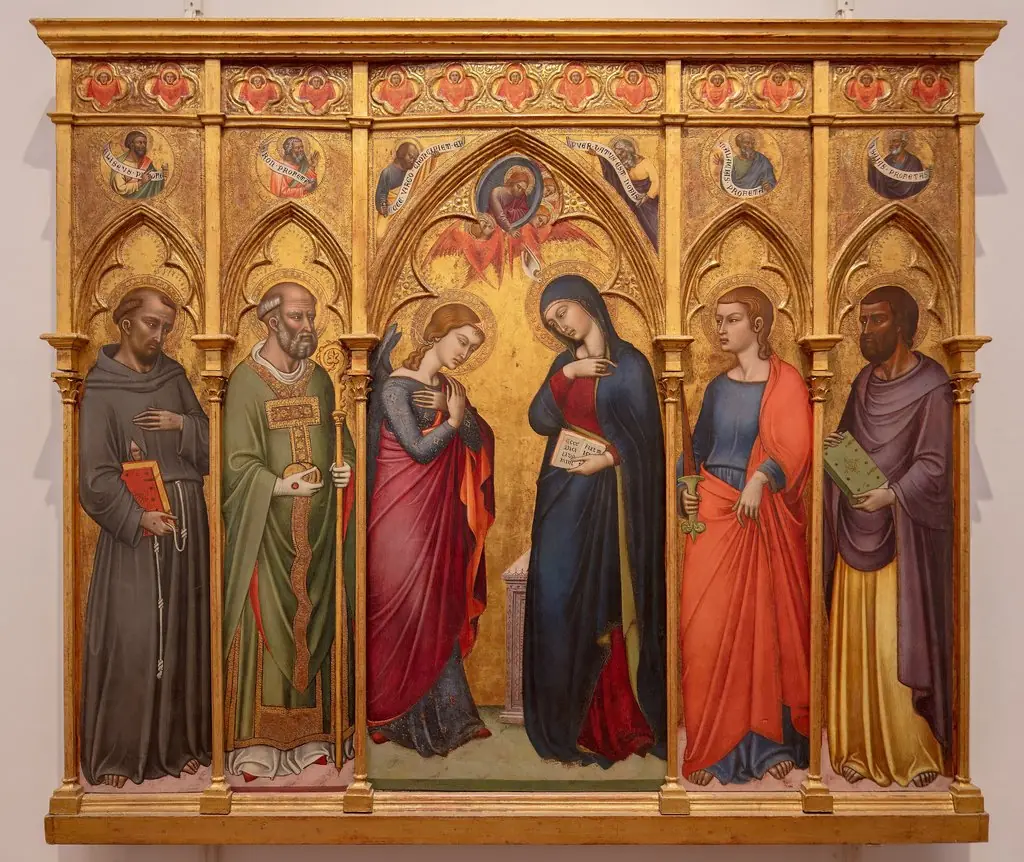 Annunciation with SS. Francis, Nicholas, Thomas, and Evangelist