Artwork
The Last Judgment
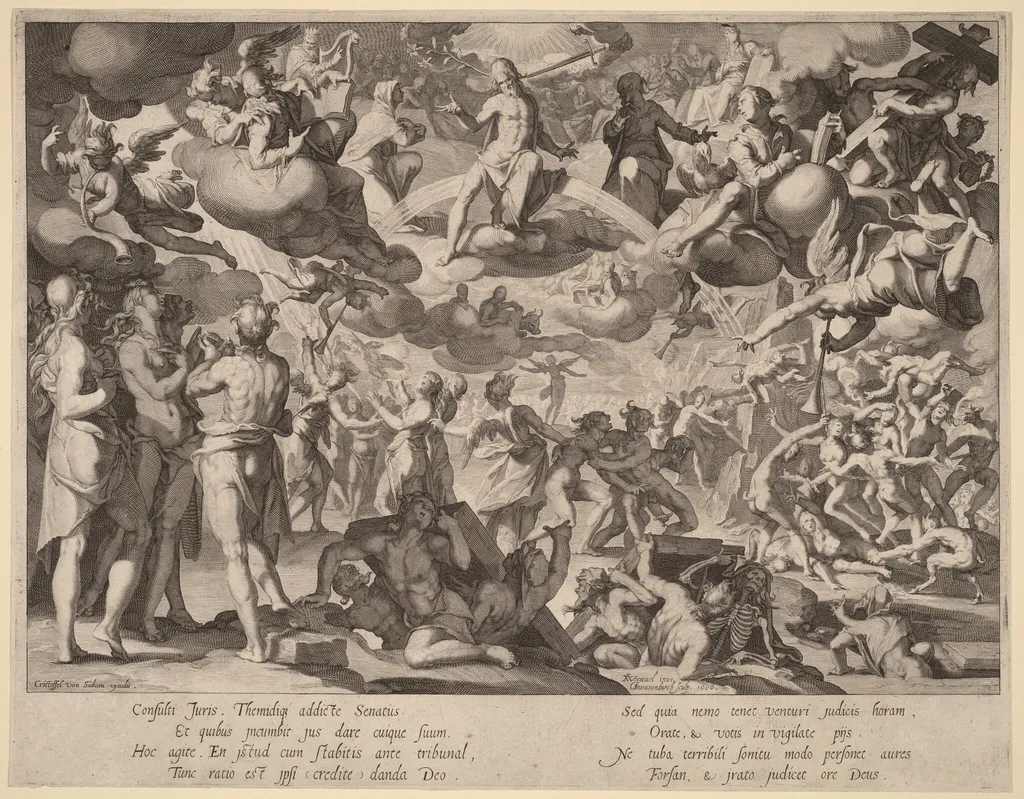
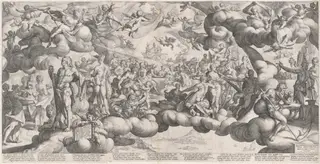
The Last Judgment is an ink print by the Baroque artist Willem van Swanenburgh. It dates from 1606 and is held in the collection of the National Gallery of Art.
- Inscription
- Inscribed:lettered in image, at lower center: IWtewael inue. / GSwanenburch sculp. 1606; in image, at lower left: Cristoffel von Sichem excudit.; lettered in margin: Consulti Juris, Themidique addicte Senatus / Et quibus incumbit ius dare cuique suum. / Hoc agite. En istud cum stabitis ante tribunal, / Tunc ratio est ipsi (credite) danda Deo. / Sed quia nemo tenet venturi judicis horam, / Orate, & votis in vigilate pijs. / Ne tuba terribili sonitu modo personet aures / Forsan, & irato judicet ore Deus.; on verso, in graphite, by various later hands: 20 Bo; 16924; W. 32. Various differences (?); C35940; The Last Judgement, D74KB519 (?) W. Swanenburgh I, after J. Uytewael 325
About this work
Overview
The composition is densely populated with figures in dynamic, often contorted poses, arranged in a vertical axis that divides salvation from damnation.
Created in 1606 by Willem van Swanenburgh, this engraving depicts the Last Judgment on laid paper. The composition is densely populated with figures in dynamic, often contorted poses, arranged in a vertical axis that divides salvation from damnation. Sharp, intricate lines define each form, generating a sense of turbulent motion and emotional intensity. The work exemplifies the technical precision of early 17th-century Northern European printmaking.
Subject & Meaning
The scene illustrates the Christian eschatological moment when souls are separated by divine judgment. Above, figures reach toward celestial light, while below, others collapse in despair or are dragged downward. Latin inscriptions at the base reinforce the theological narrative, invoking themes of divine justice and human accountability. The arrangement reflects contemporary religious anxieties and the moral urgency of the Reformation era.
Technique & Style
Van Swanenburgh employed fine, controlled engraving lines to model volume and shadow, creating a striking sense of three-dimensionality within a flat medium. Cross-hatching and varying line density build texture and contrast, particularly in the clustering of bodies. The composition’s complexity demands close viewing, revealing individual gestures and expressions through meticulous draftsmanship typical of Dutch engraving traditions.
History & Provenance
The print was produced in the Netherlands during a period of intense religious and artistic activity. While specific early ownership records are sparse, similar engravings by van Swanenburgh circulated among educated collectors and clergy. Its survival in multiple institutional collections suggests it was widely reproduced and valued for its devotional and artistic merit in the decades following its creation.
Context
Van Swanenburgh worked in a tradition influenced by Italian Mannerism and Northern printmakers like Albrecht Dürer. His depiction of the Last Judgment aligns with contemporaneous religious imagery produced after the Council of Trent, which emphasized vivid, emotionally charged scenes to reinforce Catholic doctrine. The print also reflects the Dutch Republic’s engagement with theological debate despite its Protestant majority.
Legacy
Though less known than his contemporaries, van Swanenburgh’s engraving contributed to the dissemination of apocalyptic imagery in Northern Europe. Its technical rigor and emotional gravity influenced later printmakers interested in narrative complexity and anatomical expression. The work remains a documented example of how religious themes were rendered in intimate, portable formats for private contemplation.
Own this work as a print
Artist & collection

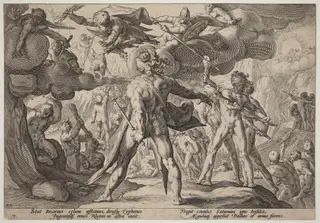 The Giants Climbing the Heavens
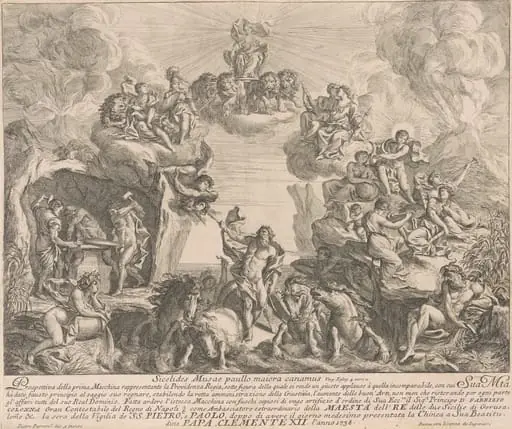 The Prima Macchina for the Chinea of 1738: Allegory of Regal Providence
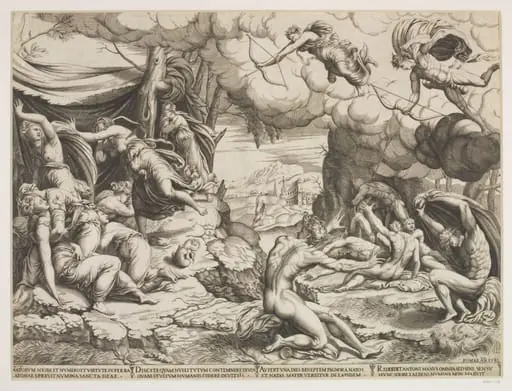 The Daughters of Niobe
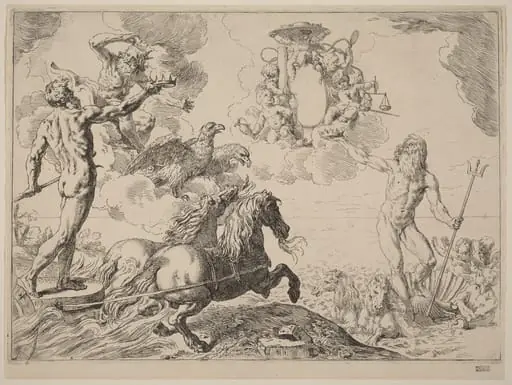 Jupiter, Neptune and Pluto
 Jupiter Taking Counsel from the Gods about the Destruction of the Universe
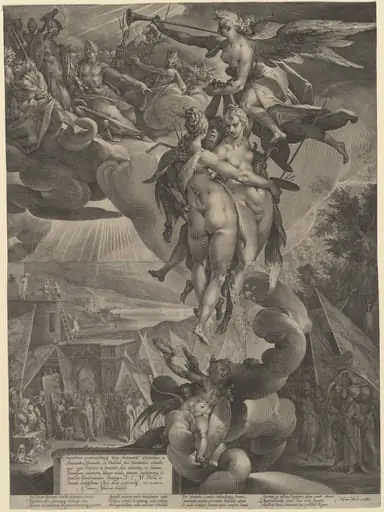 The Apotheosis of the Arts
 The Wedding of Cupid and Psyche
 Banquet of the Gods at the Wedding of Peleus and Thetis
 Apollo and the Muses