Artwork
Arcadia
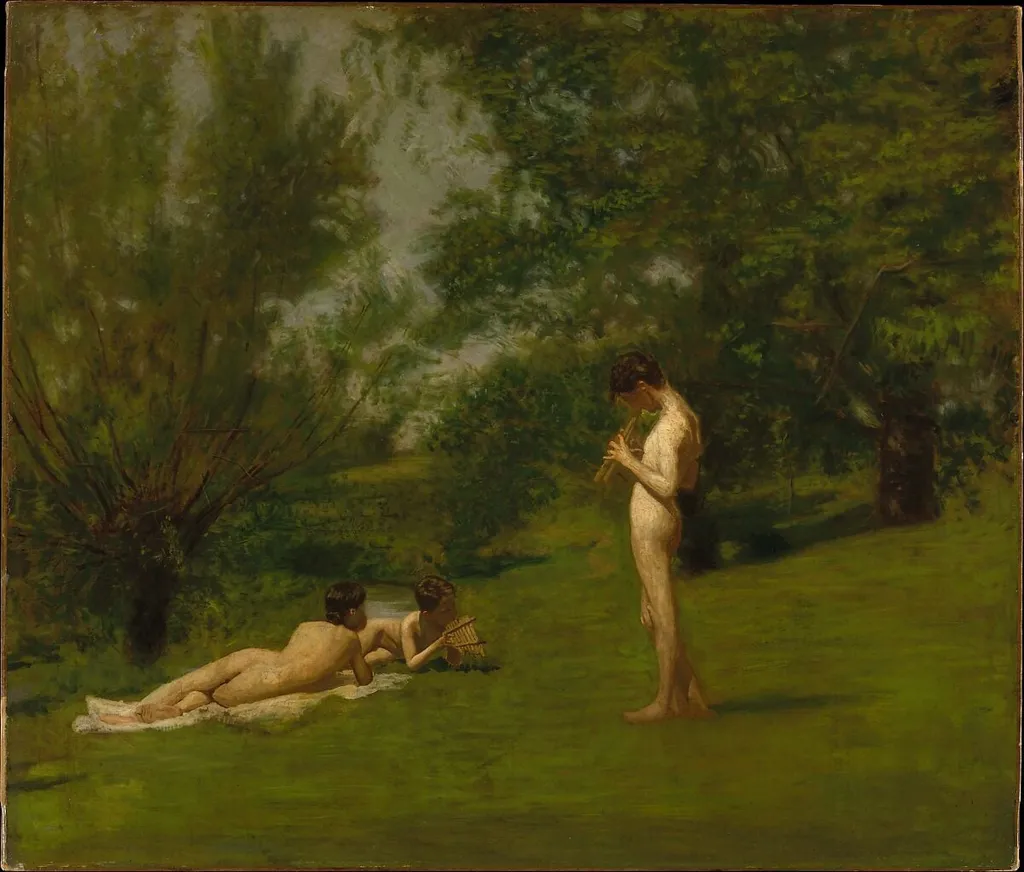
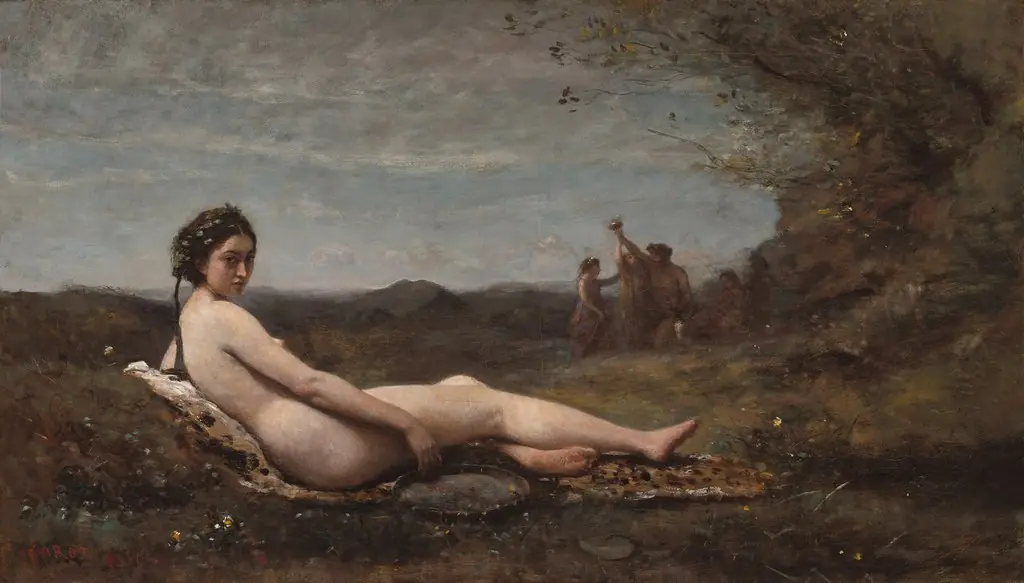
Arcadia is an oil painting by the American Impressionist artist Thomas Eakins. It dates from 1883 and is held in the collection of the Metropolitan Museum of Art.
About this work
Subject & Meaning
Eakins utilized the setting to explore the human form within a timeless, bucolic context, diverging from his usual realistic observations of contemporary life.
Thomas Eakins's Arcadia (c. 1883) depicts an idealized pastoral landscape rather than a scene from daily life, drawing upon classical representations of Arcadia as a utopian region of preserved nature. The composition features three nude youths: a standing figure playing a double flute, a reclining boy playing Pan's pipes, and a girl identified by her hair tied in a knot at the nape of her neck. While the figures are modeled after the artist's specific friends, students, and family members, the work functions as an allegory of youth and nature.
Eakins utilized the setting to explore the human form within a timeless, bucolic context, diverging from his usual realistic observations of contemporary life. The painting represents a personal meditation on classical ideals, with the artist even photographing himself as the piper, underscoring the intimate and symbolic nature of the subject matter.
Technique & Style
Arcadia is an oil on canvas painting measuring 98.1 × 114.3 cm, executed by Thomas Eakins around 1883. The work is one of Eakins's rare nude paintings, and unlike most of his oeuvre, which typically observes everyday life, it presents an idealized pastoral landscape rather than a scene drawn from daily experience. Eakins made the study of the nude integral to his teaching and drew inspiration from classical representations of Arcadia as a utopian region of preserved nature.
The composition shows three youths: two reclining on the grass and one standing while playing a double flute, with the sex of the figures deliberately ambiguous. Photographic studies preceded the painting, as was Eakins's working method for such Arcadian subjects; the models posed outdoors on a farm belonging to one of the artist's sisters in Avondale, Pennsylvania.
History & Provenance
Arcadia was painted by Thomas Eakins around 1883. Eakins executed the work while serving as an instructor at the Pennsylvania Academy of the Fine Arts, where he had begun photographing models in classical poses. He posed his three models at the farm of one of his sisters near Avondale, Pennsylvania.
The sitters were his six-year-old nephew Ben Crowell, his former student and future wife Susan Macdowell, and his teaching assistant J. Laurie Wallace. Eakins gifted the painting to his friend and fellow painter William Merritt Chase. The canvas initially remained untitled and was never publicly exhibited during Eakins's lifetime.
After his death in 1916, his widow Susan gave the work the title Arcadia. The painting entered the Metropolitan Museum of Art in 1967 through the estate of Adelaide Milton de Groot.
The painting Arcadia (c. 1883) is housed in the Metropolitan Museum of Art, New York, where it is recorded under inventory number 196 in the Goodrich catalogue of Eakins’s works. Its dimensions are 98.1 × 114.3 cm. The work entered the museum’s collection in 1967 as a bequest from Adelaide Milton de Groot, having previously been gifted by Thomas Eakins to his colleague William Merritt Chase and remained untitled and unexhibited during the artist’s lifetime. Consequently, Arcadia’s exhibition history begins only after Eakins’s death, when the renamed canvas was shown as part of the Met’s permanent displays.
Context
Created around 1883, Arcadia occupies a unique position in Thomas Eakins's oeuvre as one of his rare allegorical works and few paintings featuring nudes. Unlike his typical realist depictions of daily life, the painting presents an idealized pastoral landscape inspired by classical conceptions of Arcadia. The work's history reflects its personal significance to the artist; Eakins gifted it to his colleague William Merritt Chase, and it remained untitled and unpublished during his lifetime.
It was only after Eakins's death in 1916 that his widow, Susan, designated it Arcadia. The painting entered the Metropolitan Museum of Art's collection in 1967 from the estate of Adelaide Milton de Groot. Its creation involved extensive photographic studies of family members and students posed on a farm in Avondale, Pennsylvania, bridging Eakins's rigorous academic approach with a rare foray into mythological subject matter.
Legacy
After the artist's death, Eakins's widow Susan bestowed the title Arcadia on the work, which had remained untitled and unseen publicly during his lifetime; the painting entered the Metropolitan Museum of Art's collection in 1967. Its status as one of Eakins's few overtly allegorical nudes and its integration of photographic studies contributed to renewed scholarly attention on his synthesis of classical ideals and modern realism, influencing assessments of his role in American figurative art.
Overview
Thomas Eakins's Arcadia, painted around 1883, is an oil on canvas housed in the collection of the Metropolitan Museum of Art in New York. This work, identified as #196 in the Goodrich catalogue of Eakins's oeuvre, reflects the artist's distinctive approach to figural representation and landscape. It is a notable example within the museum's American Wing, showcasing a blend of classical themes with a modern sensibility.
Artist & collection
Artist
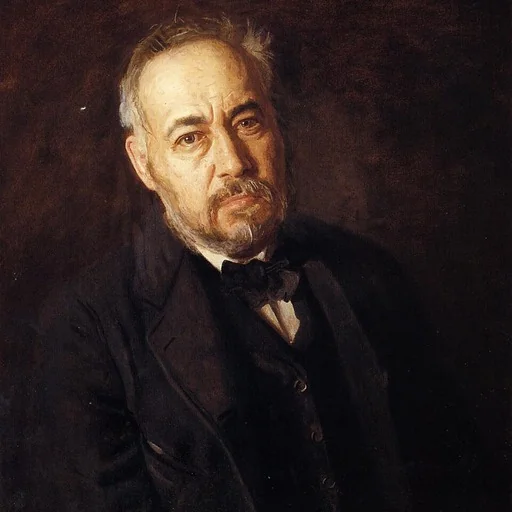
Thomas Cowperthwait Eakins (; July 25, 1844 – June 25, 1916) was an American realist painter, photographer, sculptor, and fine arts educator.