Artwork
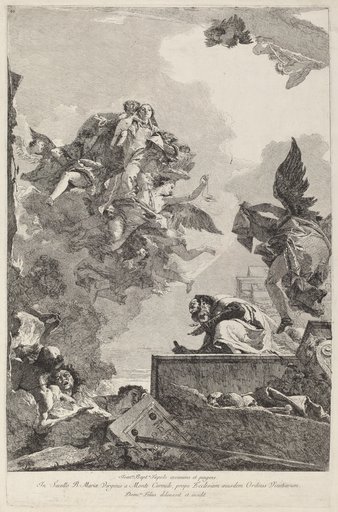
Venice Receiving the Homage of Neptune
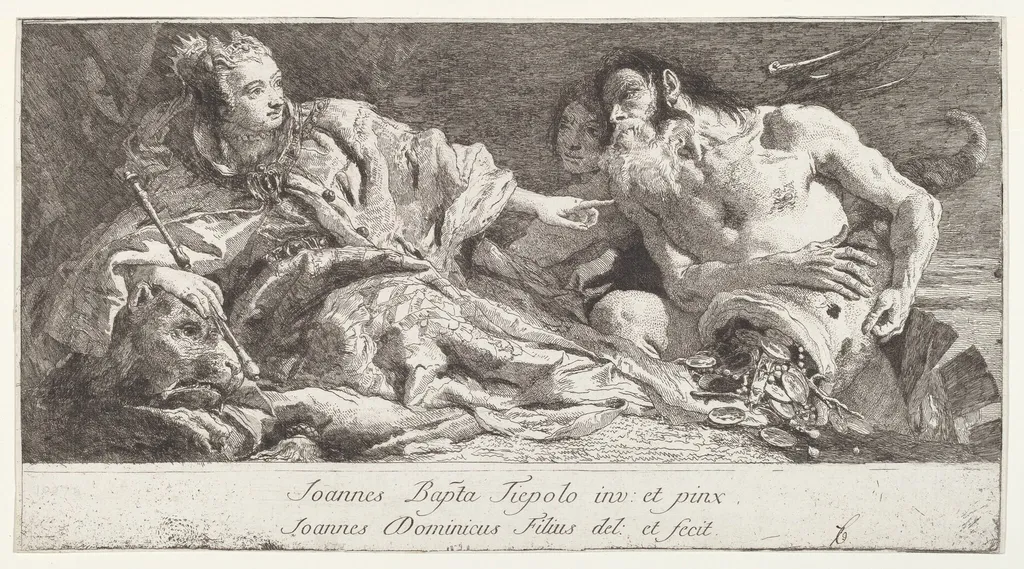
Venice Receiving the Homage of Neptune is an ink print by the Baroque artist Giovanni Domenico Tiepolo. It dates from 1748 and is held in the collection of the National Gallery of Art.
- Inscription
- Inscribed:lower margin in plate: Joannes Bapta Tiepolo inv: et pinx / Joannes Dominicus Filius del: et fecit.; by later hand, lower left, in graphite: 10076; by later hand, lower right, in pen and black ink: C.; by later hand, verso lower left, in graphite: G. D. Tiepolo "Venice receiving Neptune's homage" / Venitian (1727-1804); by later hand, verso lower center, in graphite: [R. / 107]; by later hand, verso lower right, in graphite: 750D678
- Markings
- Marked:stamp: verso lower left, in blue ink: Douane Centrale [Paris customs]
About this work
Overview
Created in 1748, this etching by Giovanni Domenico Tiepolo presents a mythological allegory centered on Venice and the sea. Executed on laid paper, the work belongs to a series of prints that reflect the city’s symbolic identity through classical imagery. As a printmaker and painter, Tiepolo employed etching to explore civic themes with the precision and delicacy characteristic of his time.
Subject & Meaning
The imagery reinforces Venice’s self-image as a sovereign state whose authority and prosperity derive from its dominion over the sea.
The scene portrays Venice as a regal female figure, crowned and holding a staff, receiving homage from Neptune, the Roman god of the sea, depicted with a beard, trident, and fish tail. Their mutual gaze suggests a pact between the maritime republic and the ocean’s power. The imagery reinforces Venice’s self-image as a sovereign state whose authority and prosperity derive from its dominion over the sea.
Technique & Style
Tiepolo used etching to achieve fine, fluid lines that capture the turbulence of waves and the texture of drapery and scales. The composition is tightly framed, emphasizing the confrontation between the two figures against a rugged, storm-tossed backdrop. The delicate cross-hatching and controlled ink tone reflect the precision of his draftsmanship and the Rococo preference for dynamic, theatrical detail.
History & Provenance
The print was produced during Tiepolo’s early career, shortly after his father Giovanni Battista Tiepolo gained prominence in Venetian art circles. It was likely intended for private collectors and connoisseurs interested in allegorical subjects tied to Venetian identity. No major public collection records exist for the first decades after its creation, suggesting limited initial circulation.
Context
In mid-18th century Venice, allegorical prints like this served to reinforce civic pride amid political decline. Mythological narratives were favored over direct portraiture, allowing artists to celebrate the city’s legacy without confronting its diminishing power. Tiepolo’s work aligns with a broader trend of using classical figures to express contemporary political ideals through symbolic language.
Legacy
Though less celebrated than his father’s frescoes, Giovanni Domenico’s etchings contributed to the dissemination of Venetian Rococo aesthetics beyond painting. This print exemplifies his skill in translating grand themes into intimate graphic form. It remains a reference for understanding how printmaking sustained civic symbolism in a period of cultural transition.
Artist & collection
Artist
Giovanni Domenico Tiepolo (August 30, 1727 – March 3, 1804) was an Italian painter and printmaker in etching. He was the son of artist Giovanni Battista Tiepolo and elder brother of Lorenzo Baldissera Tiepolo.