Artwork
「阿蘭陀人持渡駱駝」|Camels with Dutch Handlers
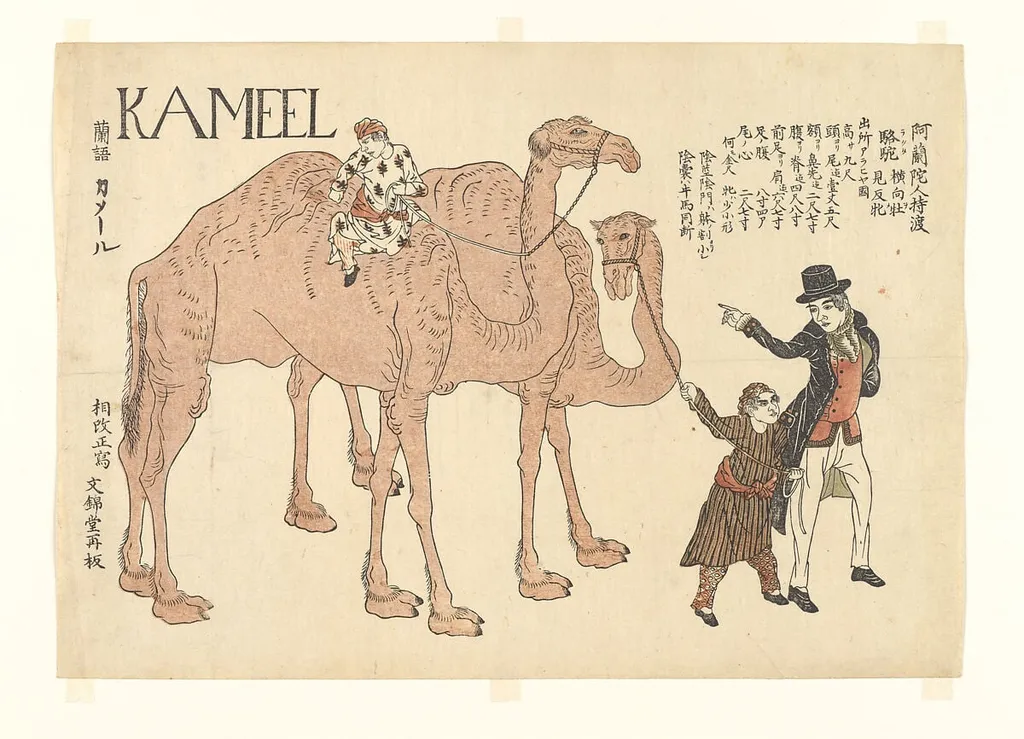
「阿蘭陀人持渡駱駝」|Camels with Dutch Handlers is an ink print by the Romanticist artist Unknown. It dates from 1821 and is held in the collection of the Metropolitan Museum of Art. This woodblock print depicts two camels accompanied by a Dutch man and a boy, rendered in ink and stencil color on paper.
About this work
Overview
This woodblock print depicts two camels accompanied by a Dutch man and a boy, rendered in ink and stencil color on paper.
This woodblock print depicts two camels accompanied by a Dutch man and a boy, rendered in ink and stencil color on paper. The horizontal ō-ōban format emphasizes the animals’ imposing presence. European attire and unfamiliar creatures are juxtaposed with Japanese textual elements, reflecting a moment of cultural curiosity during Japan’s limited foreign contact. The composition is straightforward, with minimal background detail and bold outlines defining the figures.
Subject & Meaning
The scene portrays camels, rare in Japan, as exotic imports, likely associated with Dutch traders from Dejima. The man in elaborate clothing gestures assertively, while the boy attends to the lead camel’s reins, suggesting a narrative of guidance or instruction. The prominent labeling 'KAMEEL' signals an attempt to identify the unfamiliar for a Japanese audience, blending practical information with visual novelty. The image functions as both documentation and spectacle.
Technique & Style
The print employs traditional ukiyo-e methods: hand-carved woodblocks, ink outlines, and stencil-applied color. Palette is restrained, using flat areas of muted hues. Lines are strong and unmodulated, avoiding shading or perspective, which enhances the graphic clarity.
The stylistic simplicity reflects mass production for popular consumption, prioritizing legibility over naturalism, while retaining the aesthetic discipline of Edo-period printmaking.
History & Provenance
Created during the late Edo period, likely in the 1820s–1840s, the print emerged amid Japan’s controlled engagement with Dutch traders. It reflects growing public interest in foreign goods and creatures introduced through Nagasaki. Such images circulated widely as curiosities, often sold as part of illustrated guides or novelty prints. No specific artist is recorded, suggesting it was produced by a commercial workshop responding to market demand.
Context
At a time when Japan restricted foreign influence, Dutch traders were the sole Western presence permitted on Dejima island. Camels, unknown in Japan, became symbols of distant lands and trade. This print belongs to a genre of 'foreign curiosity' imagery that included exotic animals, ships, and clothing.
It reveals how Japanese artists interpreted and translated the unfamiliar through familiar visual conventions, filtering foreign elements into local artistic frameworks.
Legacy
The print stands as a quiet record of early cross-cultural observation in Japan. It contributed to a visual lexicon of the foreign that persisted into the Meiji era. Though not widely studied today, such works illustrate how ordinary citizens encountered global difference through mass-produced imagery.
Its blend of factual labeling and stylized representation offers insight into pre-modern Japanese perceptions of the wider world.
Artist & collection