Artwork
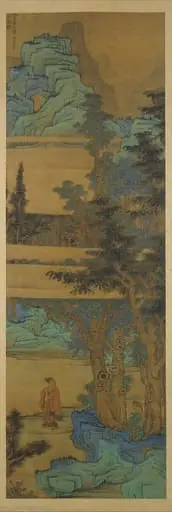
明/清 佚名 董源(僞款) 高樹叠嶂圖 軸|Mountain Landscape
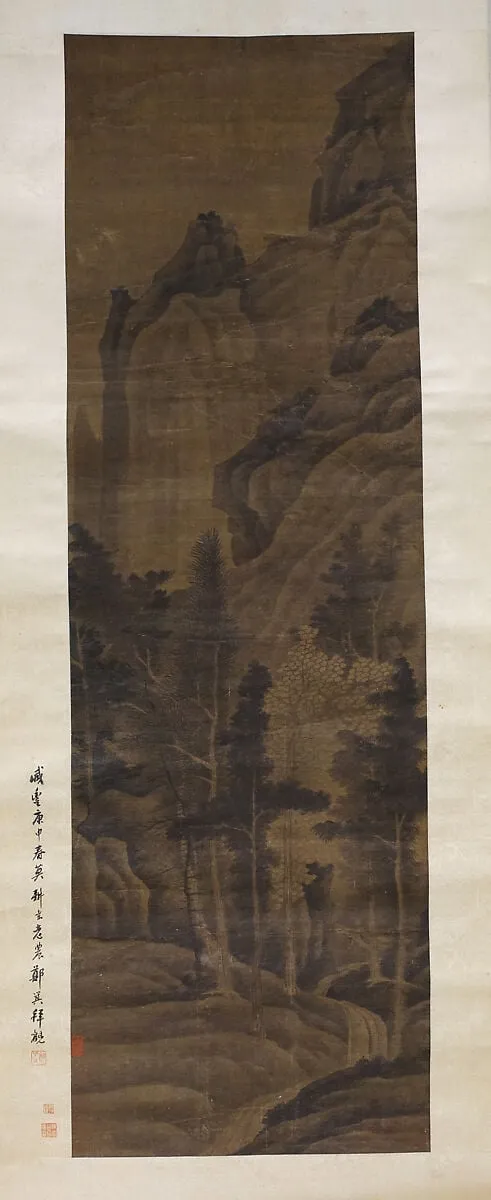
明/清 佚名 董源(僞款) 高樹叠嶂圖 軸|Mountain Landscape is an ink painting by the Song dynasty landscape artist After Dong Yuan. It dates from 1639 and is held in the collection of the Metropolitan Museum of Art.
About this work
Technique & Style
Created in 1639, this artwork is a hanging scroll executed in ink on silk.
Created in 1639, this artwork is a hanging scroll executed in ink on silk. The physical support measures 160.3 cm in height and 50.6 cm in width. Stylistically, the piece is a landscape painting depicting mountainous terrain, attributed to an anonymous Chinese artist working in the tradition of Dong Yuan, whose signature appears as a pseudonymous inscription.
The work relies on monochromatic ink application typical of the medium, utilizing the silk substrate to render the formal qualities of stacked peaks and high trees. As a product of the Ming or Qing period, the handling of ink and the composition reflect the genre conventions of Chinese landscape painting during that era, despite the later attribution to the earlier master Dong Yuan.
History & Provenance
The hanging scroll, ink on silk, titled 山水图 (Mountain Landscape), was produced in China around 1639 and is attributed to an anonymous painter working in the tradition of Dong Yuan. The work entered the collection of the Metropolitan Museum of Art, where it is catalogued under accession number 47.18.56 and remains on display in New York. Its creation date is recorded as 1639‑01‑01 in the museum’s records, and the piece is classified as a landscape painting.
The attribution reflects the anonymous status typical of many 17th‑century Chinese works, with the style linked to the Southern School master Dong Yuan.
Context
The hanging scroll dated 1639, attributed to an anonymous painter working after Dong Yuan, exemplifies the continuation of Ming‑era mountain‑landscape idioms into the early Qing period. Scholarship notes its stylistic reliance on Dong Yuan’s monumental compositions while highlighting the anonymous hand’s subtle modulation of ink wash, situating the piece within the broader trajectory of Chinese landscape painting. Its inclusion in the Metropolitan Museum of Art’s collection has afforded scholarly attention to the transmission of Southern School aesthetics through anonymous workshops, reinforcing the work’s role as a representative artifact of cross‑dynastic artistic exchange.
Legacy
The hanging scroll attributed to the early Yuan master Dong Yuan, though executed in 1639 by an anonymous hand, has come to symbolize the transmission of early Chinese landscape ideals into the Qing period. Its composition of towering peaks and misty valleys set a precedent for subsequent artists who sought to emulate Dong Yuan’s spatial depth and brushwork. Scholars cite the work in studies of Qing court patronage and the revival of classical models, noting its presence in the Metropolitan Museum of Art as evidence of cross‑century appreciation.
The piece therefore functions as a reference point for later landscape painters seeking to revive earlier stylistic achievements.
Overview
This hanging scroll, titled Mountain Landscape, is an ink-on-silk work dated 1639, attributed to an anonymous artist working in the style of the Southern Song master Dong Yuan. The painting depicts a composition of towering, overlapping peaks that recede into a soft, misty atmosphere, characteristic of the literati landscape tradition. Executed with a relatively loose and sketch-like brushwork, the piece diverges from the meticulous detail often associated with earlier Song dynasty originals, reflecting the interpretive copying practices common in the late Ming period.
The silk support has darkened over time, adding a tonal depth to the monochromatic palette. Created more than six centuries after Dong Yuan's death, the work serves as a testament to the enduring influence of the Northern Song master, whose style was frequently emulated and reinterpreted by later generations. The inscription bearing Dong Yuan's name is considered a later addition or pseudonym, a common convention intended to lend authority to the work rather than to deceive.
This piece illustrates the continued vitality of the landscape genre in 17th-century China, where artists engaged deeply with historical models to explore personal expression within established formal traditions.
Subject & Meaning
The scroll depicts a tranquil mountain landscape, characterized by gently rolling peaks that dissolve into a hazy atmosphere. The composition evokes a sense of depth and vastness, inviting contemplation. The subtle interplay of ink and the thin silk medium contributes to an ethereal quality, making the distant peaks appear almost weightless and ephemeral, a common theme in East Asian landscape painting.
Artist & collection
Artist
This painter worked in the tradition of ink-on-silk landscape scrolls that flourished during China’s Five Dynasties and Northern Song period.

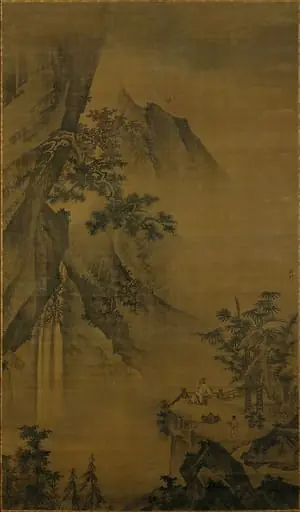 明 鍾禮 觀瀑圖 軸|Li Bai gazing at the waterfall on Mount Lu
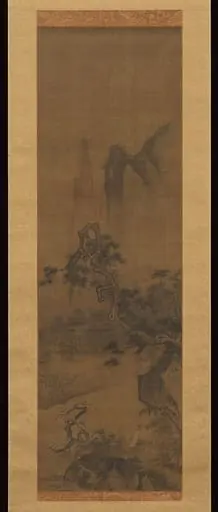 南宋 佚名 賞梅圖 軸|Scholar admiring plum blossoms
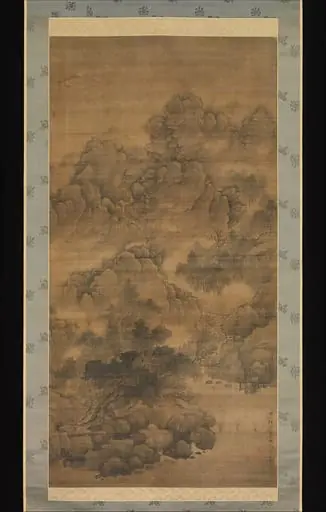 清 法若真 雲山圖軸|Cloudy Mountains
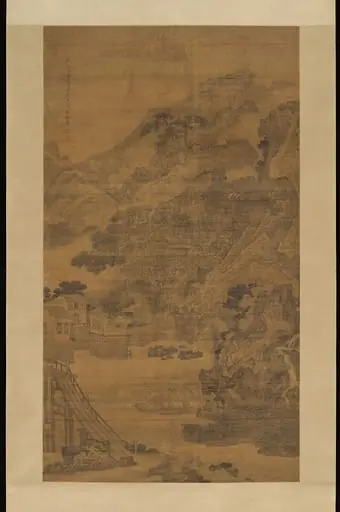 Untitled
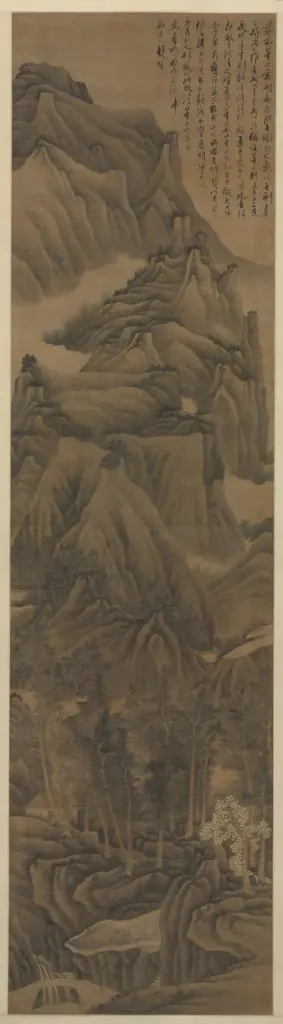 Landscape in the Style of Dong Yuan and Juran
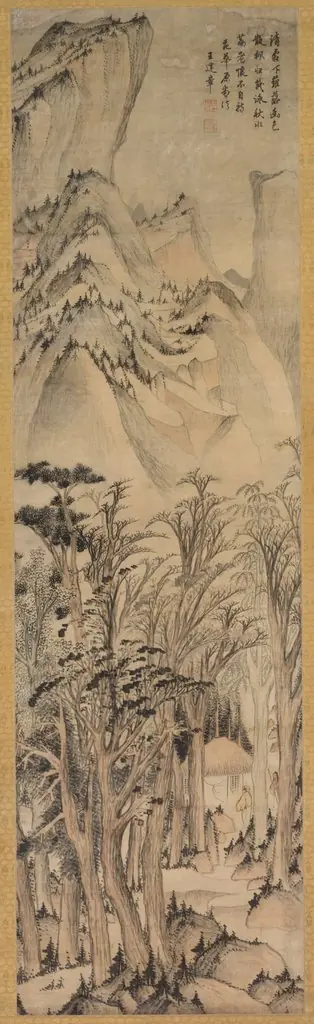 Solitary Colors of the Autumn Woods
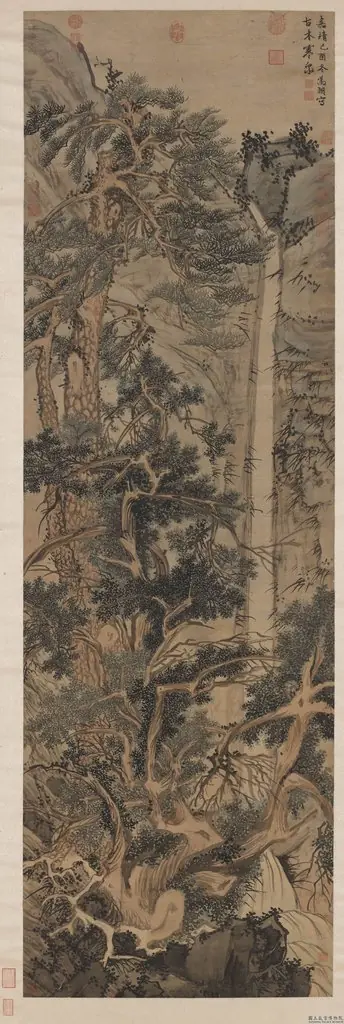 Old Trees by a Cold Waterfall
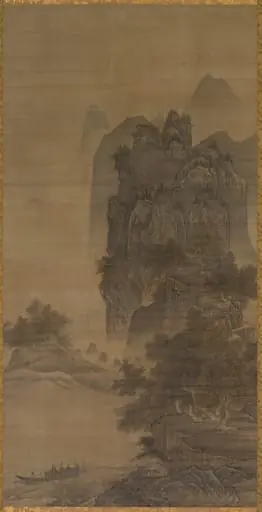 Sunset Glow over a Fishing Village, from Eight Views of Xiao-Xiang
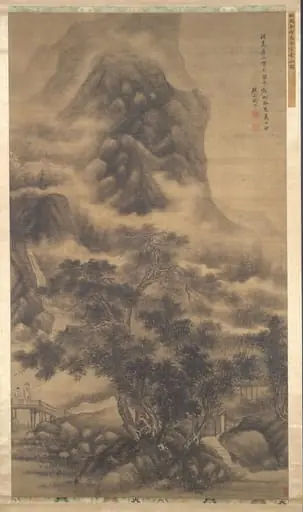 Clouds Visiting a Mountain Retreat
 明 陳洪綬 樹下高士圖 軸|Scholar-recluse in blue-green landscape