Artwork
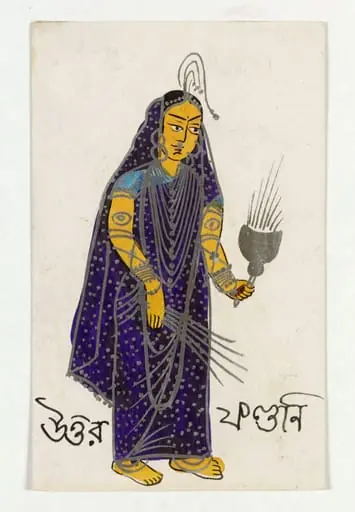
Abhimanyu and Uttara
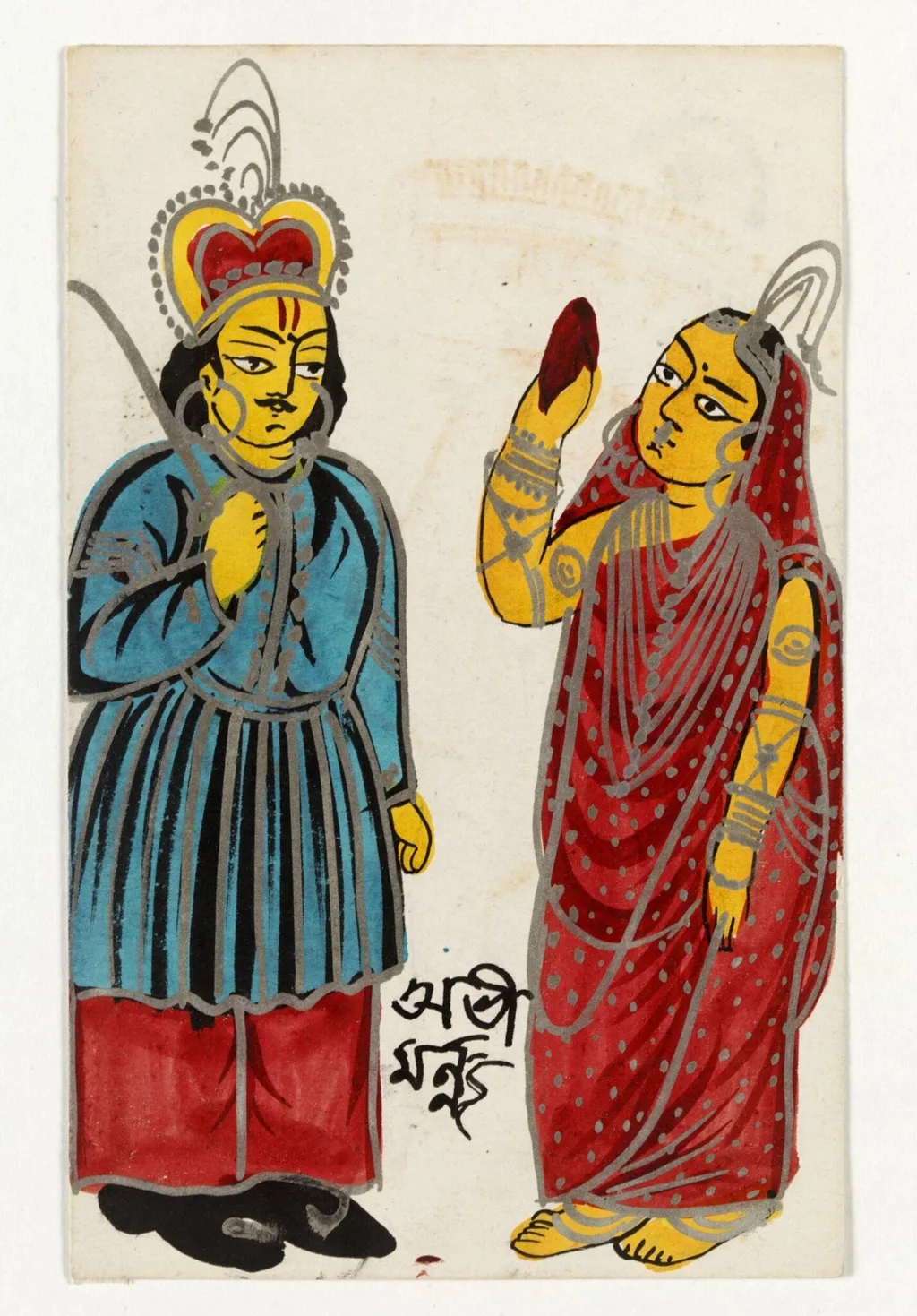
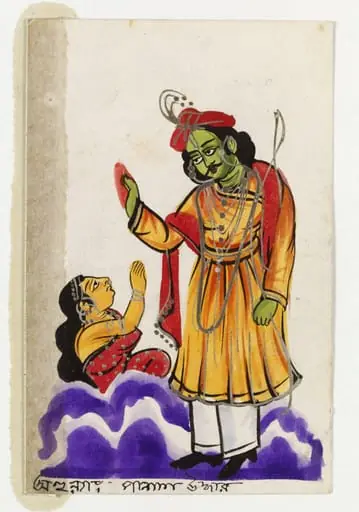
Abhimanyu and Uttara is a paint painting by the Impressionist artist Unknown. It dates from 1890 and is held in the collection of the Victoria and Albert Museum.
About this work
Overview
It depicts a scene from the Mahabharata, not the Ramayana, portraying Abhimanyu and his wife Uttara.
This 1890 watercolour and tin-alloy painting on paper originates from the Kalighat tradition in Calcutta, a style that developed among migrant artists responding to urban life under British rule. It depicts a scene from the Mahabharata, not the Ramayana, portraying Abhimanyu and his wife Uttara. The work exemplifies the rapid, expressive brushwork and vivid palette typical of Kalighat art, produced for a growing middle-class audience seeking religious and mythological imagery in accessible form.
Subject & Meaning
The painting captures Abhimanyu, the warrior prince, alongside his wife Uttara, moments after his death in the Kurukshetra war. Though often associated with heroism, this scene subtly emphasizes lineage and continuity, as Uttara carries their unborn child, the future king Parikshit. The figures’ solemn posture and symbolic halos suggest divine status, reinforcing the narrative’s spiritual weight within Hindu cosmology, rather than focusing on battle or violence.
Technique & Style
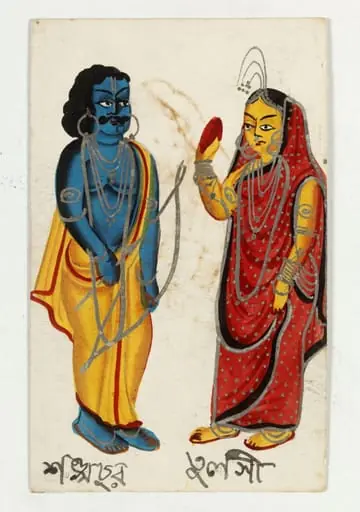
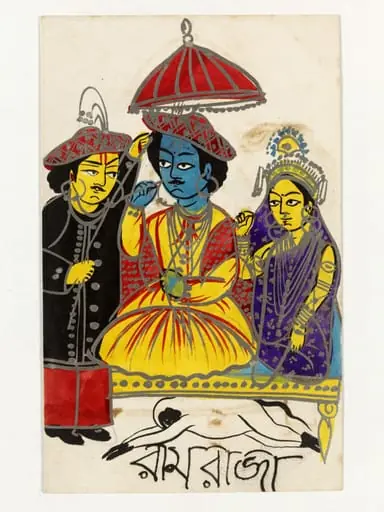
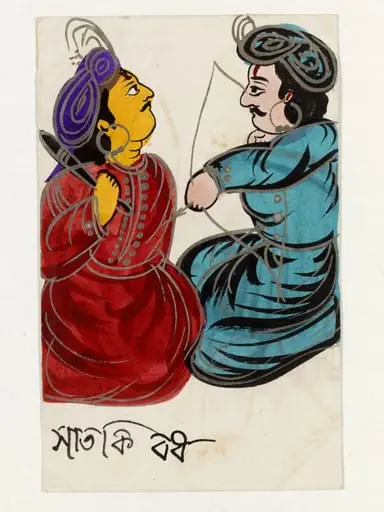
Rendered in watercolour with tin-alloy highlights, the painting employs flat, unmodulated colours and thick, confident outlines characteristic of Kalighat art. Gold accents trace jewelry and halos, adding ritual significance without naturalism. Facial features are simplified into bold, expressive forms, while patterns like the dotted red dress and striped garments reflect stylized conventions.
The composition is tightly framed, eliminating background detail to focus entirely on the figures’ presence and symbolic interaction.
History & Provenance
Created around 1890 in Calcutta, this work emerged during the height of the Kalighat school, which flourished between 1833 and 1912 near the Kalighat Kali Temple. Artists, often from rural Bengal, adapted traditional iconography for urban buyers and pilgrims. The painting likely originated as a devotional or souvenir object, sold in temple precincts.
Its survival reflects the durability of the medium and the enduring appeal of mythological narratives in colonial-era Bengal.
Context
Kalighat paintings arose as a response to shifting social dynamics under British rule, blending folk traditions with new urban audiences. While earlier patachitra depicted deities in elaborate detail, Kalighat artists streamlined forms for speed and affordability. This piece reflects a broader trend: mythological subjects were repurposed to resonate with contemporary concerns, including gender roles and moral duty, even as Western artistic norms began to influence local aesthetics.
Legacy
Though the Kalighat tradition declined after 1912 due to industrialization and changing tastes, its visual language influenced modern Indian art and popular illustration. This painting stands as a testament to the adaptability of religious imagery in a colonial context, preserving myth through accessible, emotionally direct forms. Today, it is studied not only for its aesthetic qualities but as a cultural artifact of Bengal’s artistic resilience during a period of profound transformation.
Artist & collection