Artwork
Album of Daoist and Buddhist Themes
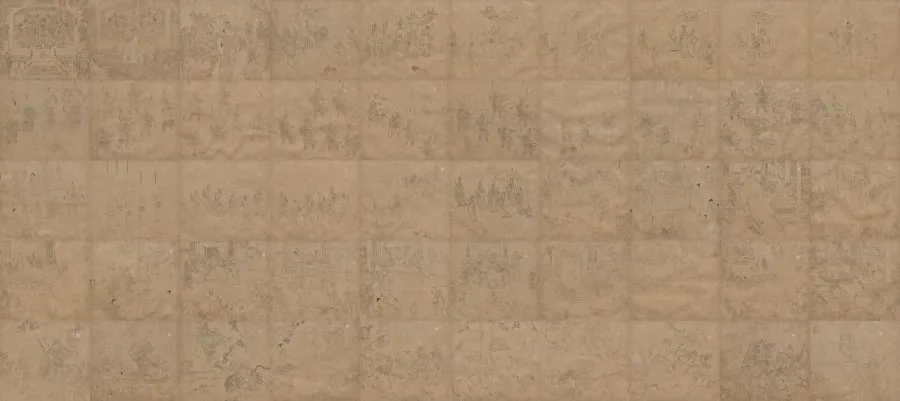
Album of Daoist and Buddhist Themes is an unspecified painting by the Song dynasty painting artist Unknown. It dates from 1204 and is held in the collection of the Cleveland Museum of Art. The album comprises fifty miniature paintings that illustrate a range of religious motifs.
- Accession no.
- 2004.1
- Credit line
- John L. Severance Fund in honor of Dr. Ju-hsi Chou and Gift of various donors to the department of Asian Art (by exchange)
About this work
Look up more pages from china, southern song dynasty (1127-1279) to see how these models shaped Chinese temple art for centuries.
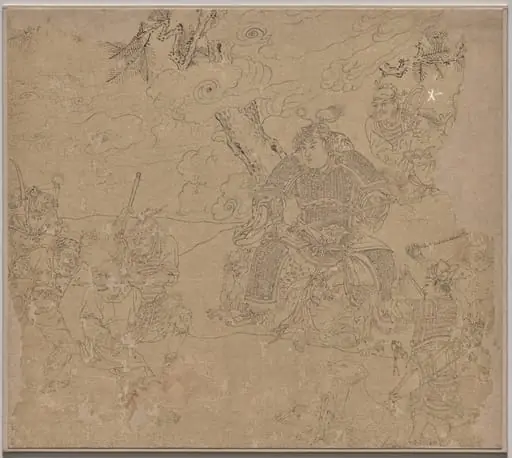
You see a small, detailed painting of gods and soldiers in bright robes, fighting demons in a rocky landscape.
This is one page from a 50-page teaching album. Artists used these pages like flashcards, copying the poses and faces to fill temple walls. The figures look almost like stickers: flat colors, no shadows, but every line is sharp and sure.
Look up more pages from china, southern song dynasty (1127-1279) to see how these models shaped Chinese temple art for centuries.
Overview
The album comprises fifty miniature paintings that illustrate a range of religious motifs. Produced during the Southern Song period (1127–1279), the collection served as a visual handbook for artists, offering ready-made designs for temple decoration and other commissions.
Subject & Meaning
The first twenty‑six leaves depict the Jade Emperor and the broader Daoist pantheon, while the subsequent fourteen illustrate the Buddhist Ten Kings of Hell overseeing the punishment of souls. A final segment, titled “Clearing the Mountains,” shows divine warriors, most likely led by Erlang Shen, battling hostile spirits in a rugged terrain.
Technique & Style
Rendered in flat, vivid pigments without shading, the figures appear as stylised cut‑outs, each line executed with precision. The compositions emphasize clear outlines and bold coloration, allowing apprentices to replicate poses and facial types accurately for larger mural projects.
History & Provenance
The album was probably assembled by several master craftsmen who intended it as a teaching tool for studio apprentices. Its function as a set of visual “flashcards” facilitated the transmission of standardized iconography across generations of temple painters.
Context
Within the Southern Song artistic milieu, such model books played a crucial role in standardising religious imagery. By providing a repertoire of canonical figures, the album helped maintain visual consistency in Daoist and Buddhist temple art throughout the era.
Legacy
The motifs and compositional schemes found in this album influenced Chinese temple decoration for centuries, shaping the visual language of religious murals well beyond the Song dynasty.
Artist & collection