Artwork
Durga Killing the Demon Mahisha
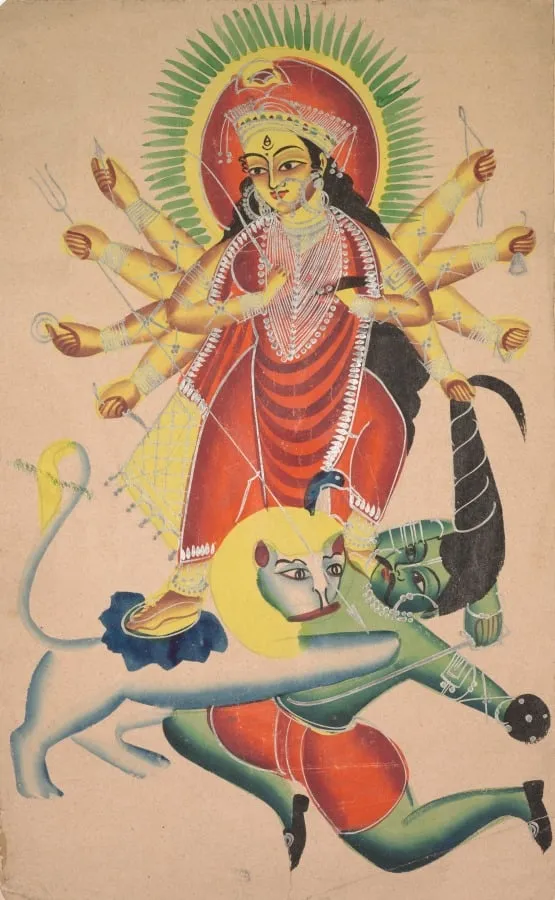
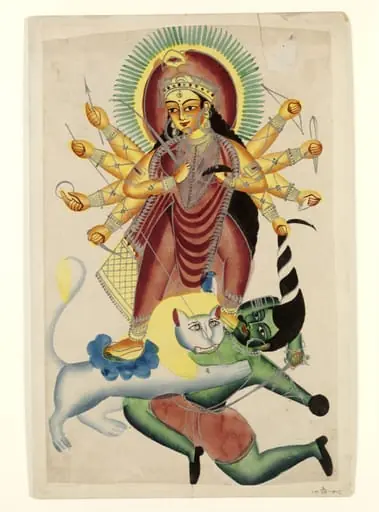
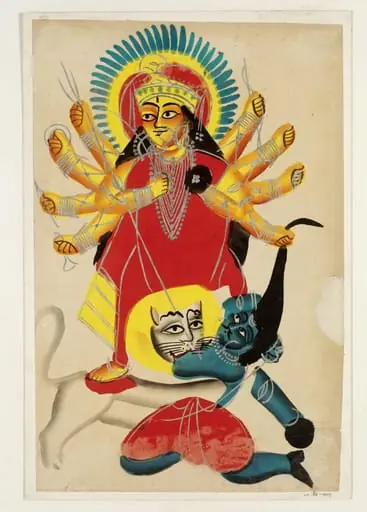
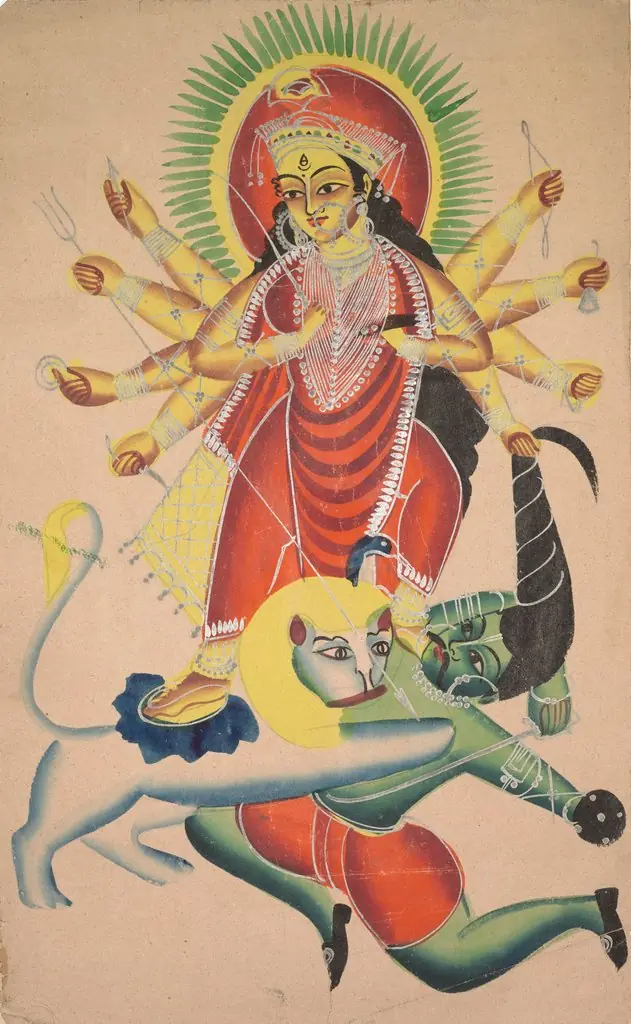
Durga Killing the Demon Mahisha is an unspecified painting by the Bengal School artist Unknown. It dates from 1890 and is held in the collection of the Cleveland Museum of Art. This painting depicts the Hindu goddess Durga in the act of slaying the buffalo demon Mahisha, a central myth in Shakti tradition.
- Accession no.
- 2003.103
About this work
Overview
Created in 19th-century Calcutta, it belongs to the Kalighat school of folk art, produced by itinerant artists near the Kalighat temple.
This painting depicts the Hindu goddess Durga in the act of slaying the buffalo demon Mahisha, a central myth in Shakti tradition. Created in 19th-century Calcutta, it belongs to the Kalighat school of folk art, produced by itinerant artists near the Kalighat temple. The work is executed swiftly on low-cost paper with diluted pigments, reflecting its function as an affordable devotional object for pilgrims and local devotees.
Subject & Meaning
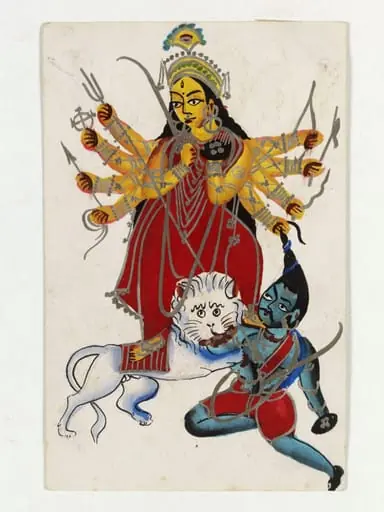
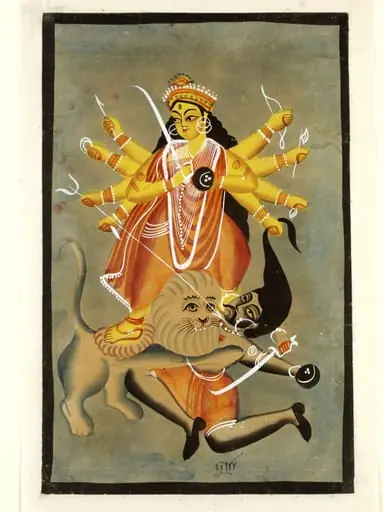
Durga, shown with ten arms wielding divine weapons, dominates the demon, whose hybrid buffalo-human form symbolizes chaos and ego. Her foot presses on his neck as she prepares to strike with a spear, embodying the triumph of cosmic order over destructive forces. The inclusion of European-style buckled shoes on the demon subtly signals the cultural intrusion of colonial presence, transforming a mythic narrative into a reflection of contemporary social reality.
Technique & Style
The painting employs rapid, fluid brushwork and thin, transparent layers of pigment, characteristic of Kalighat’s workshop practices. Artists prioritized expressive immediacy over detail, using bold outlines and saturated colors to convey emotional intensity. The flat perspective and stylized anatomy reflect a vernacular aesthetic, distinct from academic traditions, yet highly effective in communicating narrative and devotion to a broad, non-elitist audience.
History & Provenance
Produced in the British colonial enclave of Calcutta during the early to mid-1800s, these works were sold in the temple bazaar as souvenirs and ritual objects. Artists, often from artisan castes, adapted their imagery to local tastes and emerging urban influences. The painting’s survival in private and institutional collections today speaks to its dual role as both devotional artifact and early example of modern Indian popular art.
Context
Kalighat paintings emerged as urban folk art amid the cultural shifts of colonial Calcutta. As traditional patronage waned, artists turned to the public market, incorporating contemporary elements, like Western footwear, into sacred imagery. This blending of the divine and the mundane reveals how religious narratives absorbed the realities of colonial life, creating a visual language that was both rooted in tradition and responsive to change.
Legacy
Though initially dismissed as mere temple souvenirs, Kalighat paintings gained recognition in the 20th century for their expressive power and social commentary. Modern artists and scholars appreciated their bold forms and unfiltered vitality, seeing in them a precursor to Indian modernism. The style’s influence endures in contemporary Indian art, where its fusion of myth and modernity continues to inspire reinterpretation.
Artist & collection