Artwork
Glatz Madonna
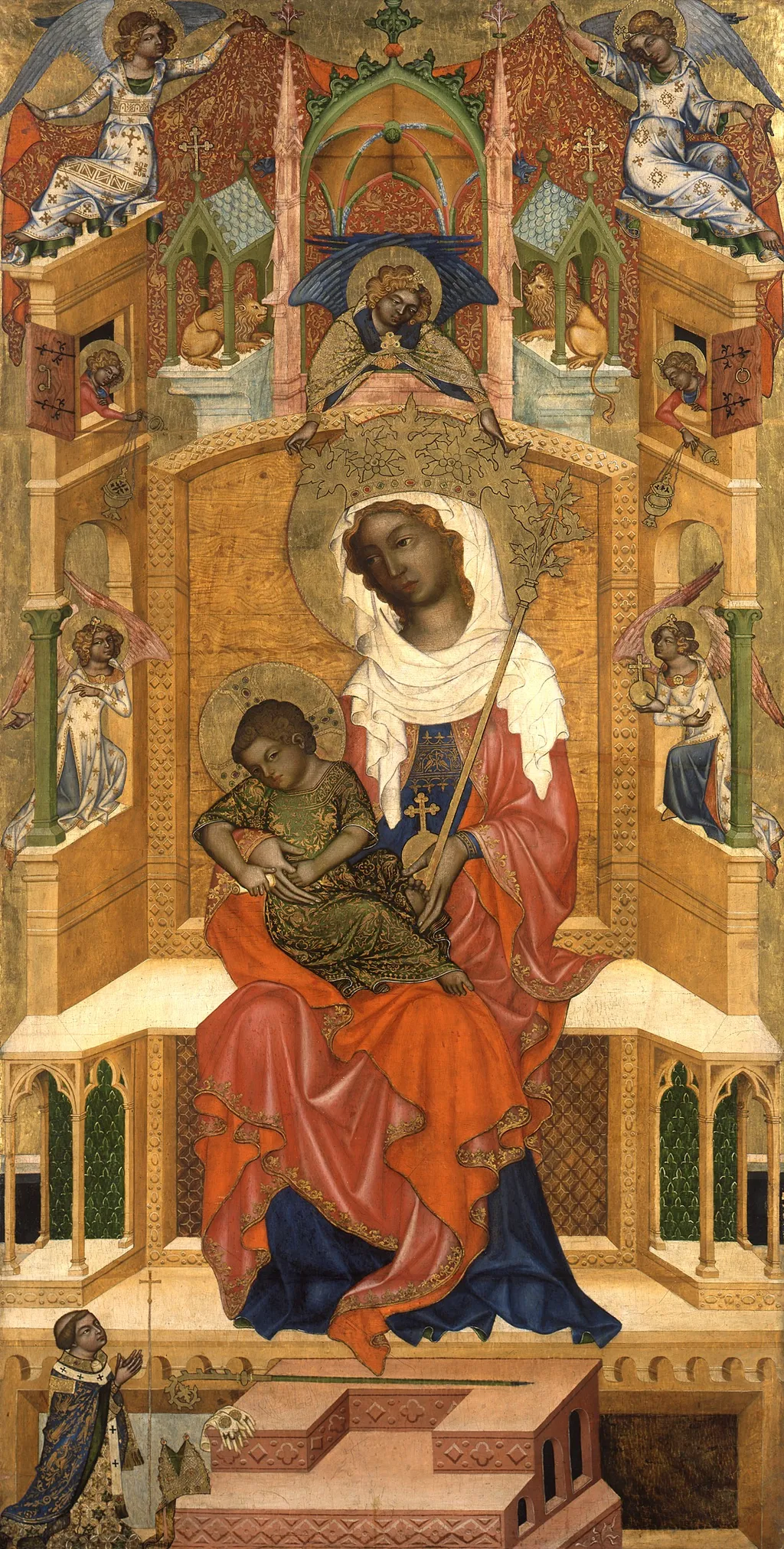
Glatz Madonna is a paint painting. It dates from 1343 and is held in the collection of the Gemäldegalerie Berlin.
About this work
Subject & Meaning
She supports the Christ Child on her lap with her right hand and holds a lily scepter in her left, with an orb (Reichsapfel) resting beside it.
The painting depicts the Madonna and Child enthroned, a subject identified in Christian art as the Sedes sapientiae, or "Throne of Wisdom," as referenced in the Litany of Loreto. Mary sits on a Gothic throne against a gold backdrop, her head inclined to the right. She supports the Christ Child on her lap with her right hand and holds a lily scepter in her left, with an orb (Reichsapfel) resting beside it.
Seven angels attend the throne: two hold a gold-embroidered cloth behind it, one above places a crown on Mary's head, two swing censers, one offers the orb, and another gestures toward the kneeling donor.
In the lower left corner, the donor Archbishop Arnošt of Pardubice is shown kneeling at a smaller scale before the throne, having laid down all the insignia of his ecclesiastical office and gazing up at the Virgin. The work was conceived as a painted Marian hymn, and the altarpiece originally included four side panels narrating scenes from the life of Christ: the Nativity, the Circumcision, the Flight into Egypt, and the Twelve-year-old Jesus in the Temple.
Technique & Style
The Glatz Madonna is executed in tempera on a poplar panel, measuring 186 × 95 cm. According to one account the paint layer is laid on canvas stretched over the wooden support, and the work originally formed the central panel of a larger winged altarpiece that included four additional scenes from the life of Christ. The panel has been trimmed on both sides, so that the original lateral wings no longer align with the surviving central image.
Stylistically, the painting is attributed to the circle of the Master of the Vyšší Brod Altarpiece, and its soft facial modelling links it to that master's workshop. The composition shows an enthroned Madonna and Child against a gold ground, with the throne rendered in perspectival recession, a colour-graded sense of spatial depth, and high-relief drapery folds. These features mark an important innovation within Bohemian panel painting of the mid-fourteenth century.
The dark-skinned complexion, the unusually large Christ Child, and the taste for precious fabrics derive from northern Italian models, while the leaf crown, the richly folded veil, and the Gothic throne architecture reflect archaic French prototypes transmitted through Bohemian book painting and ivory carving. A Rhineland mediation is also visible in several details.
History & Provenance
The Glatz Madonna was commissioned before 1350 by Arnošt of Pardubice, the first Prague archbishop and founder of the Augustinian monastery in Kłodzko (Glatz), where he had spent his youth and reportedly experienced a childhood vision of the Virgin Mary.
Painted around 1343–1344, likely in Prague, the work is attributed to the circle of the Master of the Vyšší Brod Altarpiece or a close follower. Originally the central panel of a five-part winged altarpiece, it depicted the Enthroned Madonna and Child flanked by narrative scenes of Christ’s Infancy. Archival evidence from 1664 records these side panels, Birth of Jesus, Circumcision, Flight to Egypt, and the Twelve-year-old Christ in the Temple, though the surviving work shows losses from later trimming.
After the monastery passed to the Jesuits in 1595 and was secularized in 1618, the altarpiece was removed for safekeeping during the Thirty Years’ War. In 1625 it was restored to the parish church in Kłodzko, where it remained until 1811. It then entered the collection of Ludwig Bittner, who restored it in 1834 before donating it to the royal grammar school.
In 1902 the Berlin Kaiser-Friedrich-Museum acquired the painting for 8,500 Marks; it has been held by the Berlin State Museums since.
The Glatz Madonna is held in the Gemäldegalerie in Berlin, part of the Berlin-Dahlem State Museums. Originally the central panel of an altarpiece for the Augustinian monastery in Kłodzko (Glatz), the painting was acquired by the Berlin Kaiser-Friedrich-Museum in 1902 for 8,500 Marks and formally incorporated into the Gemäldegalerie's collection in 1904 or 1905.
During World War II, the work survived intact but was subsequently seized by the Wiesbaden Central Collecting Point. It was included in a touring exhibition of 202 significant paintings displayed across fourteen American museums before being returned to Wiesbaden in 1948. The artwork was eventually restituted to the Berlin Gemäldegalerie.
Context
The Glatz Madonna is attributed to the circle of the Master of the Vyšší Brod (Hohenfurth) Altarpiece, situating it within the Bohemian school of panel painting. Stylistic features such as the soft modelling of faces link it to the Vyšší Brod panels, while the perspectival projection of the throne, the spatial depth achieved through graduated colour, the high-relief drapery, and the human warmth of the figures mark important innovations. From these qualities, scholars trace the development of the entire typology of Bohemian "loving Madonnas" through to the early 15th century.
The work synthesizes northern Italian motifs, including the enthroned Madonna surrounded by angels and the fondness for precious fabrics, with Rhineland mediation and archaic French models transmitted through Bohemian book painting, such as the crown of leaves and the throne architecture related to French ivory reliefs.
The painting was first recognized by art-historical scholarship as the earliest large panel of early German painting after the Berlin Kaiser-Friedrich-Museum acquired it in 1902 for 8,500 Marks. It is regarded, alongside the Madonna with the Sparrow, as one of the most significant Gothic Marian images from the former County of Glatz. Related works of the same period include the Madonna of Veveří and the Strahov Madonna, while the painter of the Kaufmann Crucifixion is associated with a broader circle possibly linked through prior training in the workshop of the Master of the Klosterneuburg Altarpiece.
Legacy
The Glatz Madonna became a cornerstone of Bohemian Marian imagery, shaping the typology of tender, humanized Madonnas in Central Europe through the early 15th century. Its innovations, perspectival throne, spatial depth via color gradation, and high-relief drapery, were widely emulated, linking it to later works like the Veveří and Strahov Madonnas. After its 1902 acquisition by Berlin’s Kaiser-Friedrich-Museum, the panel was recognized as the earliest monumental work of German Gothic painting, elevating its status in art-historical scholarship.
Its iconography, particularly the Sedes sapientiae motif, reinforced Marian devotion in the Glatz region, where it was venerated as a relic of Archbishop Arnošt of Pardubice’s vision. Modern studies, including Robert Suckale’s analysis, frame it as a “painted Marian hymn” central to Bohemian Gothic art.
Overview
The Glatz Madonna is a mid‑fourteenth‑century Bohemian panel painting, created between 1343 and 1344. It originally formed the central panel of a larger, winged altarpiece and is now recognized as a distinct work of devotional art.
Artist & collection

- Madonna of Humility (Madonna dell'Umiltà)
 The Virgin and Child enthroned with two angels
 Madonna and Child Enthroned (fragment of an altarpiece)
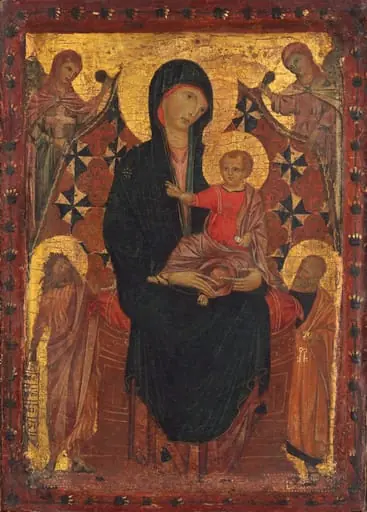 Madonna and Child with Saint John the Baptist, Saint Peter, and Two Angels
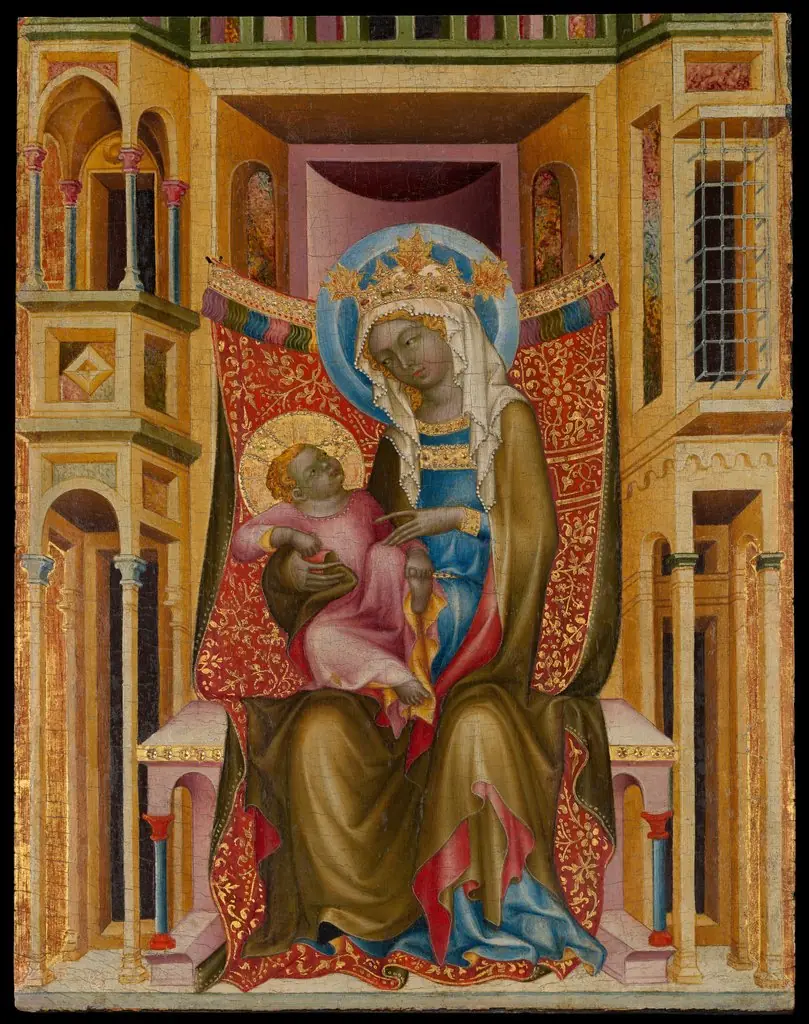 Virgin and Child Enthroned
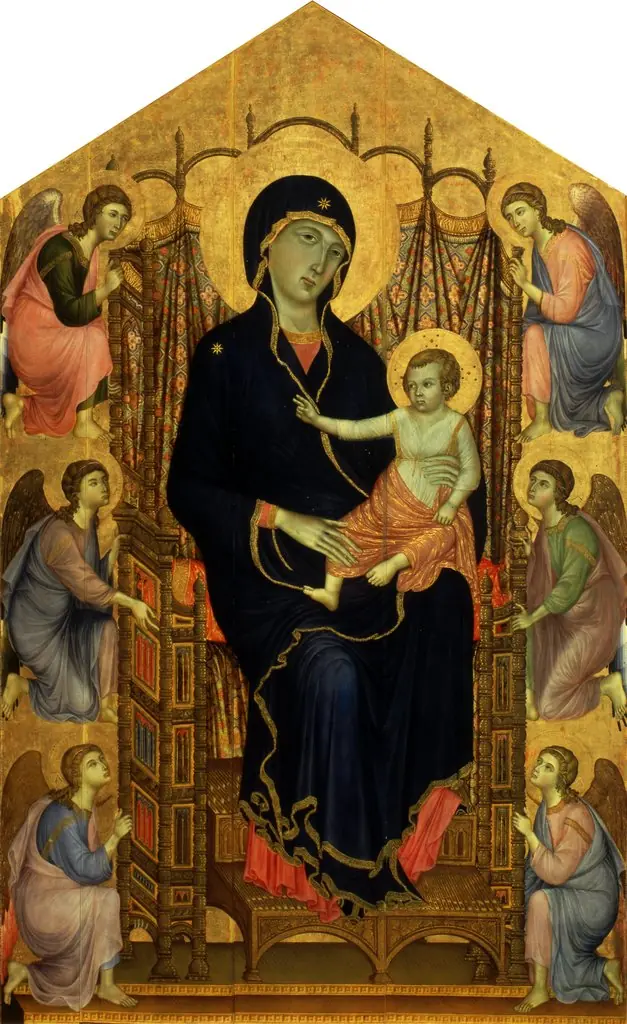 Rucellai Madonna
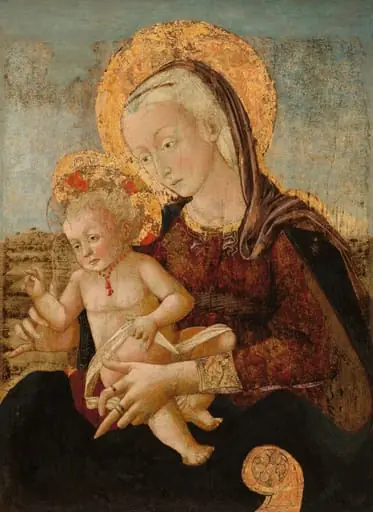 Madonna and Child
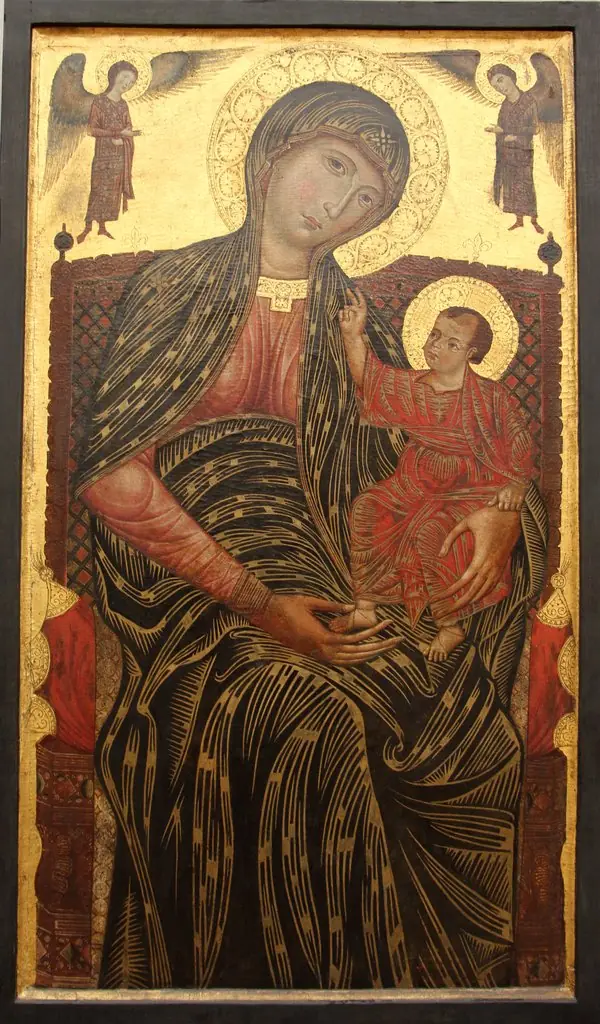 Madonna enthroned with two angels
![Madonna of Humility, The Blessing Christ, Two Angels, and a Donor [obverse], by Andrea di Bartolo](https://artifactworldgallery.com/img/andrea-di-bartolo--madonna-of-humility-the-blessing-christ-two-angels-and-a-don--d37c382429905539-w320.webp) Madonna of Humility, The Blessing Christ, Two Angels, and a Donor [obverse]
Madonna of Humility, The Blessing Christ, Two Angels, and a Donor [obverse]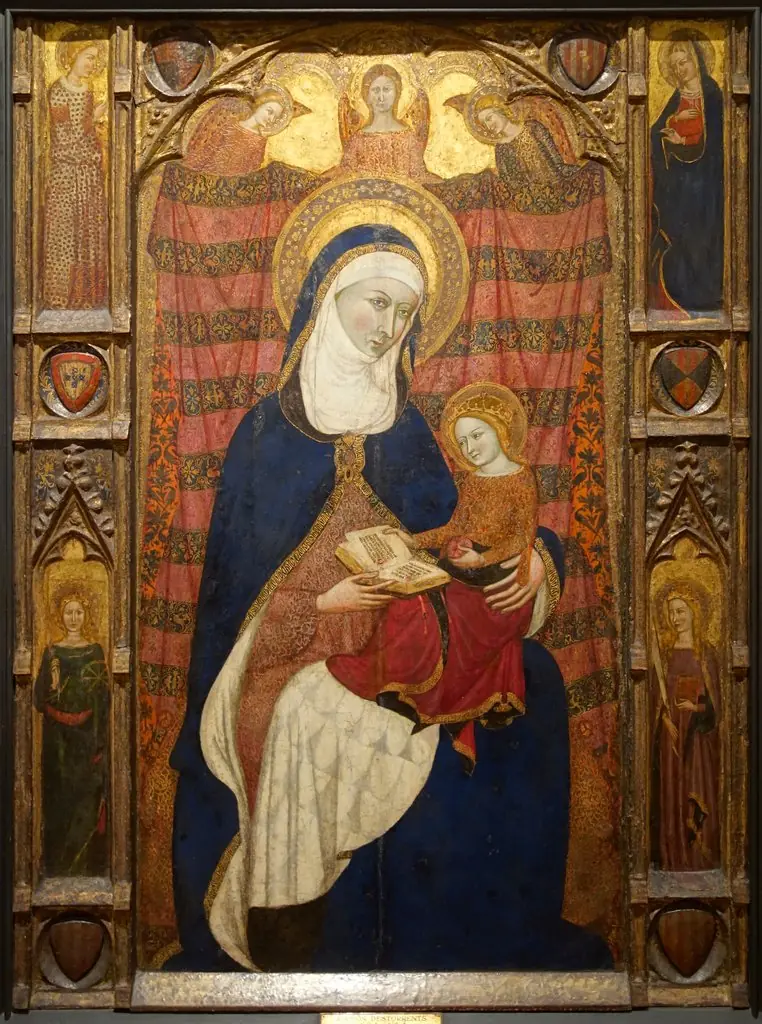 Retaule de Santa Anna i la Mare de Déu
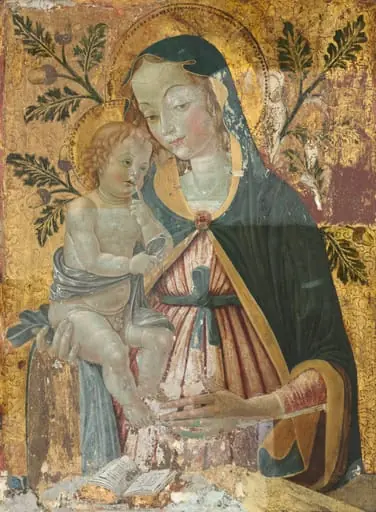 Virgin and Child
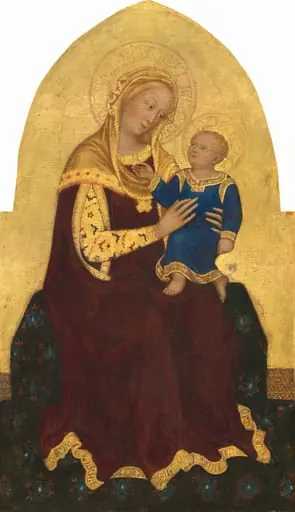 Madonna and Child Enthroned