Artwork
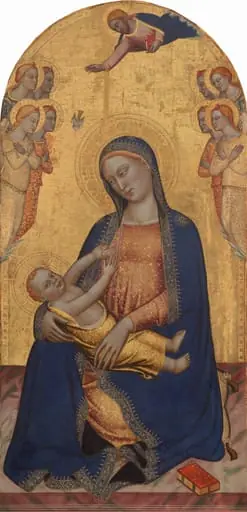
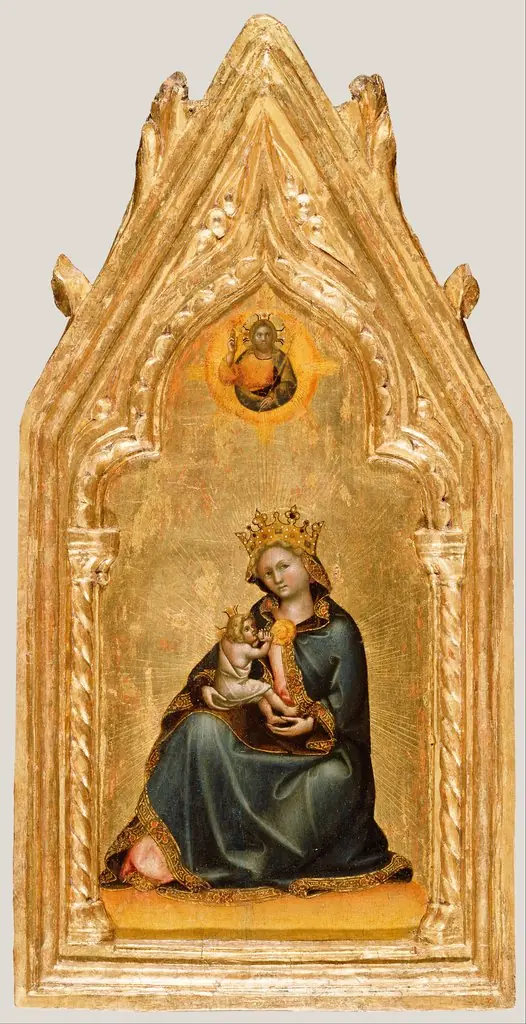
Madonna of Humility, The Blessing Christ, Two Angels, and a Donor [obverse]
![Madonna of Humility, The Blessing Christ, Two Angels, and a Donor [obverse], by Andrea di Bartolo, tempera, 1385](https://artifactworldgallery.com/img/andrea-di-bartolo--madonna-of-humility-the-blessing-christ-two-angels-and-a-don--d37c382429905539-w1024.webp)
Madonna of Humility, The Blessing Christ, Two Angels, and a Donor [obverse] is a tempera painting by the Byzantine icon painting artist Andrea di Bartolo. It dates from 1385 and is held in the collection of the National Gallery of Art.
About this work
Technique & Style
Created in 1380, the obverse panel of Madonna of Humility, The Blessing Christ, Two Angels, and a Donor is executed in tempera on a wood panel support.
Created in 1380, the obverse panel of Madonna of Humility, The Blessing Christ, Two Angels, and a Donor is executed in tempera on a wood panel support. This medium and substrate are characteristic of the Sienese school during the late fourteenth century, a period in which Andrea di Bartolo was active. The work is classified as a religious painting, adhering to the devotional traditions of its genre.
While specific details regarding the physical handling of the paint or the current conservation condition are not detailed in the available records, the piece remains part of the Samuel H. Kress Collection at the National Gallery of Art in Washington, D.C., where it has been held since 1939.
History & Provenance
The Madonna of Humility with The Blessing Christ, Two Angels, and a Donor (obverse) is attributed to Andrea di Bartolo and dated to circa 1380, as indicated by the artwork’s inscription and the NGA’s provenance record. No documentary evidence of a specific commission survives in the sources. The panel remained in an Italian private collection until at least the early 1920s; F. M. Perkins recalled seeing it there around 1919.
In October 1927 it was sold to Samuel H. Kress, transferred to the Kress Foundation in 1929, and entered the National Gallery of Art as a gift from the foundation in 1939, where it remains part of the Samuel H. Kress Collection.
The painting is held in the collection of the National Gallery of Art in Washington, D.C., specifically within the Samuel H. Kress Collection. Its provenance traces from a private Italian collection, noted by F. Mason Perkins in 1934 as having been viewed there around 1919, to a sale in October 1927 to Samuel H. Kress of New York. The work was transferred to the Samuel H. Kress Foundation in 1929 and subsequently gifted to the National Gallery of Art in 1939.
While the provided records detail this ownership lineage and the specific dates of transfer, they do not list any public exhibitions where the artwork has been displayed.
Context
The Madonna of Humility with the Blessing Christ, two angels and a donor, painted by Andrea di Bartolo circa 1380, exemplifies late‑Gothic devotional art in Tuscany.
Its attribution and provenance have been clarified through documentation in the Samuel H. Kress papers, including a 1934 expert assessment by F. Mason Perkins that confirmed its presence in an Italian private collection fifteen years earlier.
The painting entered the National Gallery of Art in 1939, reflecting early 20th‑century interest in early Italian panels and underscoring the artist’s role within the Bartolo workshop and the broader transition toward more naturalistic representation.
Overview
Andrea di Bartolo's painting, titled Madonna of Humility, The Blessing Christ, Two Angels, and a Donor, was created around 1385. This tempera on panel work depicts a central religious scene, characteristic of the period. It combines several sacred figures with a kneeling patron, offering a devotional image for contemplation. The composition emphasizes spiritual hierarchy and the act of supplication.
Subject & Meaning
The painting presents the Virgin Mary, seated in humility, cradling the infant Christ. Above them, a figure identified as the Blessing Christ appears, also holding an infant, suggesting a divine connection or prefiguration. Two winged angels flank the central group, while a kneeling female donor occupies the lower right, her presence indicating patronage and devotion.
The interaction between the figures, particularly the infant reaching upwards, conveys a sense of spiritual connection and grace.
Own this work as a print
Artist & collection


![Christ on the Cross [reverse], by Andrea di Bartolo](https://artifactworldgallery.com/img/andrea-di-bartolo--christ-on-the-cross-reverse--6bfe980f802a6327-w320.webp)