Artwork
Monk Teaching Lay Disciple: Colophon page from a Kalpa-sutra and Story of Kalakacharya of Devachandra

Monk Teaching Lay Disciple: Colophon page from a Kalpa-sutra and Story of Kalakacharya of Devachandra is an unspecified painting by the Indian Miniature artist Unknown. It dates from 1279 and is held in the collection of the Cleveland Museum of Art.
- Accession no.
- 1971.124
- Credit line
- Purchase from the J. H. Wade Fund
About this work
Overview
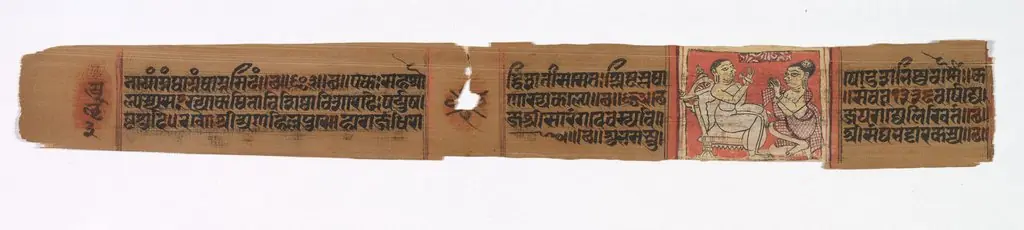
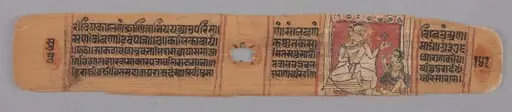
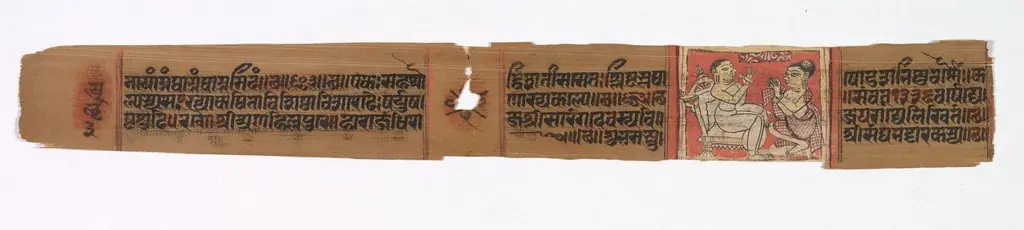
The illustration depicts a monk in a white robe imparting instruction to a lay disciple wearing a red turban, both seated beneath a tree.
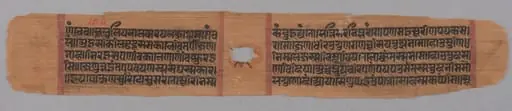
This colophon page belongs to a Jain manuscript produced before the widespread adoption of paper, when texts were inscribed on palm leaves assembled into a fan‑like bundle. The leaves are bound by a cord threaded through a central hole, allowing the pages to be turned horizontally. The illustration depicts a monk in a white robe imparting instruction to a lay disciple wearing a red turban, both seated beneath a tree.
Subject & Meaning
The scene portrays a lay follower reverently receiving teachings from a Jain monk, a motif traditionally employed to underscore piety and the transmission of doctrine. Such virtuous depictions were intended to enhance the sanctity of the manuscript, reinforcing the moral exemplariness of the figures for the reader.
Technique & Style
Rendered in miniature pigment on the surface of palm leaf, the image employs modest coloration and stylized forms typical of early Jain manuscript art. The composition is simple, focusing on the two figures and the tree canopy, with minimal background detail, reflecting the functional role of the illustration as decorative rather than narrative.
History & Provenance
The manuscript originates from the western Indian region of Gujarat, specifically the historic city of Patan (ancient Anahilapura). Produced during a period when palm leaf was the primary medium for sacred texts, the work exemplifies regional artistic conventions of Jain communities in that area.
Context
In Jain manuscript culture, painted embellishments served to beautify the text and increase its material value. Patrons who commissioned such adornments were believed to gain additional religious merit, as the visual splendor was seen as an offering to the divine.
Artist & collection









- Leaf from a Jain Manuscript: Colophon page, Kalpa-sutra and The Story of Kalakacharya of Devachandra: Monk Teaching Lay Disciple
 Monk Holding a Flower Venerated by a Lay Disciple: Folio 141 (verso), from a Kalpa-sutra and Story of Kalakacharya
 Leaf from a Jain Manuscript: Colophon page, Kalpa-sutra and The Story of Kalakacharya of Devachandra: Monk Teaching Lay Disciple (recto)
 Folio 141 (recto), from a Kalpa-sutra and Story of Kalakacharya
 Leaf from a Jain Manuscript: The Story of Kalakacharya of Devachandra: Text (recto)
 Two nuns teaching lay women, colophon page of folio 167 (recto) from a Kalpa-sutra and Story of Kalakacharya
 Leaf from a Jain Manuscript: The Story of Kalakacharya of Devachandra: Brahmanshanti Yaksha (verso)
 Leaf from a Jain Manuscript: Kalpa-sutra (verso)
 Leaf from a Jain Manuscript: The Story of Kalakacharya of Devachandra: Text (recto); Leaf from a Jain Manuscript: The Story of Kalakacharya of Devachandra: Brahmanshanti Yaksha (verso)
 Folio (recto) from a Kalpa-sutra and Story of Kalakacharya of Devachandra: Text
 Leaf from a Jain Manuscript: Kalpa-sutra
 Leaf from a Jain Manuscript: Kalpa-sutra (recto)