Artwork
Portrait of Admiral A. I. Rusin
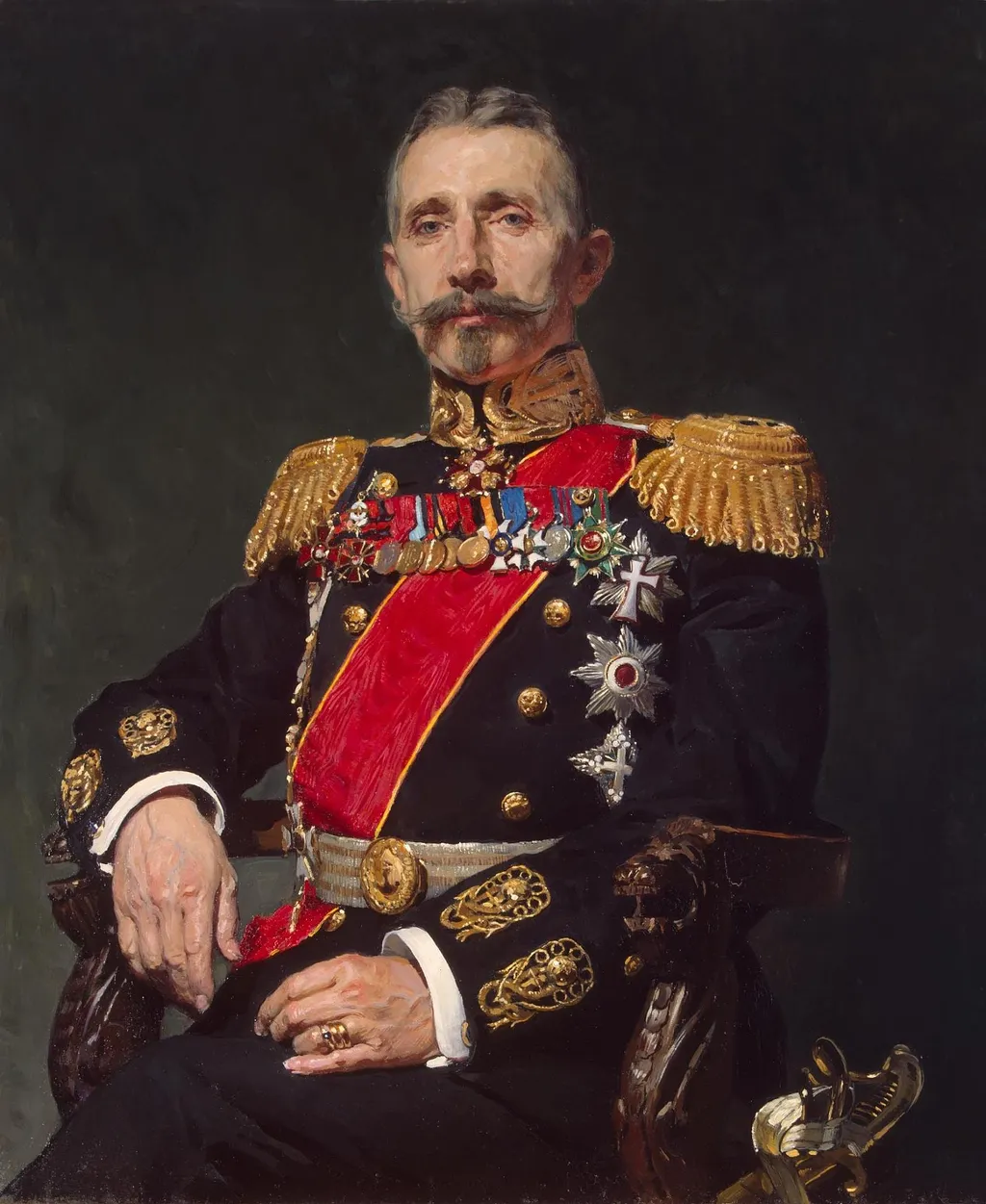
Portrait of Admiral A. I. Rusin is an oil painting by the Realist artist Unknown. It dates from 1900 and is held in the collection of the Hermitage Museum. The work is an oil painting portraying a uniformed officer seated against a dark backdrop.
About this work
Overview
Its presence in the Hermitage, one of the world's premier encyclopedic museums, ensures its continued accessibility to scholars and the public alike.
The Portrait of Admiral A. I. Rusin is an oil-on-canvas painting created in Russia in 1900 by an unknown artist. Measuring 91 by 78 centimeters, the work depicts Alexander Ivanovich Rusin (1861-1956), a Russian naval officer who rose to the rank of admiral. The painting is held in the collection of the State Hermitage Museum in St. Petersburg, where it remains on public view. As an anonymous early twentieth-century Russian portrait, it exemplifies the formal military portraiture tradition of the late Imperial period, offering insight into the visual culture of rank and service in pre-revolutionary Russia. Its presence in the Hermitage, one of the world's premier encyclopedic museums, ensures its continued accessibility to scholars and the public alike.
Subject & Meaning
The portrait depicts Alexander Ivanovich Rusin, a career naval officer whose life spanned the late Imperial and early Soviet periods. The composition centers on his elaborately decorated military uniform, which functions as the primary vehicle for conveying status and achievement. A wide red sash crosses his chest from right shoulder to left hip, while numerous medals, crosses, and orders in gold, silver, red, blue, and green are pinned across his chest. These decorations serve as visual records of his distinguished service and position within the military hierarchy. Gold epaulettes with fringe and gold buttons further emphasize his rank. The admiral's posture, relaxed yet upright, projects confidence and self-awareness of his importance. His hands rest in his lap, with a ring visible on the left hand, indicating wealth and social position. A sword with a gold hilt appears at lower right, reinforcing his military identity and suggesting readiness for action. The overall effect conveys quiet dignity, accumulated experience, and unwavering commitment to duty. The painting thus operates within a tradition that valued hierarchy, discipline, and the embodiment of state ideals through military service.
Technique & Style
The painting is executed in oil on canvas, with dimensions of 91 by 78 centimeters. The composition is vertically oriented and structured around a pyramidal form, with the subject's head forming the apex, lending stability and grandeur to the image. Light falls from the upper left, illuminating the face, hands, and gold elements while leaving the background in shadow. This carefully orchestrated lighting isolates the figure from any immediate context and emphasizes his presence. The brushwork varies across the surface: precise and meticulous on the face and medals, capturing the texture of skin, the slight furrowing around the eyes, and the precisely trimmed mustache, while looser and more suggestive in the background. The palette is dominated by black, gold, and red set against a gray-brown darkness. The uniform features white cuffs and a high gold collar, with carved wooden arms on the chair visible. This combination of precise facial rendering with looser background treatment is characteristic of formal portraiture of the period, where the sitter's likeness required accuracy while surroundings could remain suggestive.
History & Provenance
The portrait was created in Russia in 1900, during the final years of the Russian Empire. The circumstances of its commission remain unknown, as does the identity of the artist. The painting entered the collection of the State Hermitage Museum in St. Petersburg, where it is currently held. Its accession history and the details of how it passed into the museum's collection are not documented in the available sources. The work has been published and made available through the museum's digital platforms and licensed image partners, including Alamy, which distributes photographs of the painting for editorial and commercial use. No exhibition history beyond its permanent display at the Hermitage is recorded in the provided sources. The painting's survival through the revolutionary period and its subsequent institutional preservation at the Hermitage represent significant aspects of its material history, though specific details of its transit or conservation are unavailable.
Context
The portrait belongs to the tradition of Russian Imperial military portraiture, a genre that flourished in the late nineteenth and early twentieth centuries as the Russian state sought to commemorate its service elite. The work's anonymous authorship is not unusual for the period; many such portraits were produced by studio painters or minor artists working to satisfy institutional and private demand for official portraiture. Alexander Rusin himself lived until 1956, meaning this portrait captured him at age thirty-nine, relatively early in a career that would span the Russo-Japanese War, World War I, and the Russian Civil War. The painting's presence in the Hermitage collection places it within one of the world's most comprehensive repositories of Russian art, ensuring its preservation and study alongside works by known masters. Critical reception of the work has been limited in published scholarship, with the painting serving more as a document of its era and subject than as a focal point of art historical debate. Its value lies primarily in its representational function and its exemplification of the visual conventions through which military prestige was constructed and communicated in Imperial Russia.
Legacy
The portrait's afterlife is inextricably linked to the institutional prestige of the State Hermitage Museum and the expanding accessibility of its collections through digital reproduction and licensing. The work has been disseminated through commercial image libraries, most notably Alamy, which has distributed high-resolution photographs of the painting for editorial use. This circulation has introduced the portrait to audiences beyond the museum's physical visitors, though primarily as an illustrative document rather than as a work of individual artistic significance. The painting's cultural function has shifted over time: created as a commemoration of active service and living authority, it has become a historical artifact of a vanished political and social order. The longevity of its subject, Alexander Rusin, who survived the Russian Revolution and lived into the Soviet period, adds a biographical dimension that extends the work's relevance beyond its creation date. For scholars, the portrait remains a useful case study in anonymous official portraiture, the visual semiotics of military rank, and the material culture of Imperial Russian institutions. Its continued presence in the Hermitage ensures its preservation as part of the broader patrimony of Russian visual culture, even as the specific circumstances of its making remain obscure.
Artist & collection









 Portrait of Count P.A.Shuvalov
 Alfonso XIII con uniforme de capitán general
 Portrait of Pyotr Kleinmichel
 Portrait of Eduard I. Totleben
 Portrait of Alexander Menshikov
 Portrait D.B. Bronevskogo
 Portrait of Emperor Nicholas I
 Προσωπογραφία του Γεωργίου Σαχίνη
 El rey Alfonso XIII
 Ritratto di Francesco II di Borbone