Artwork
Portrait of Augustus II the Strong (1670–1733)
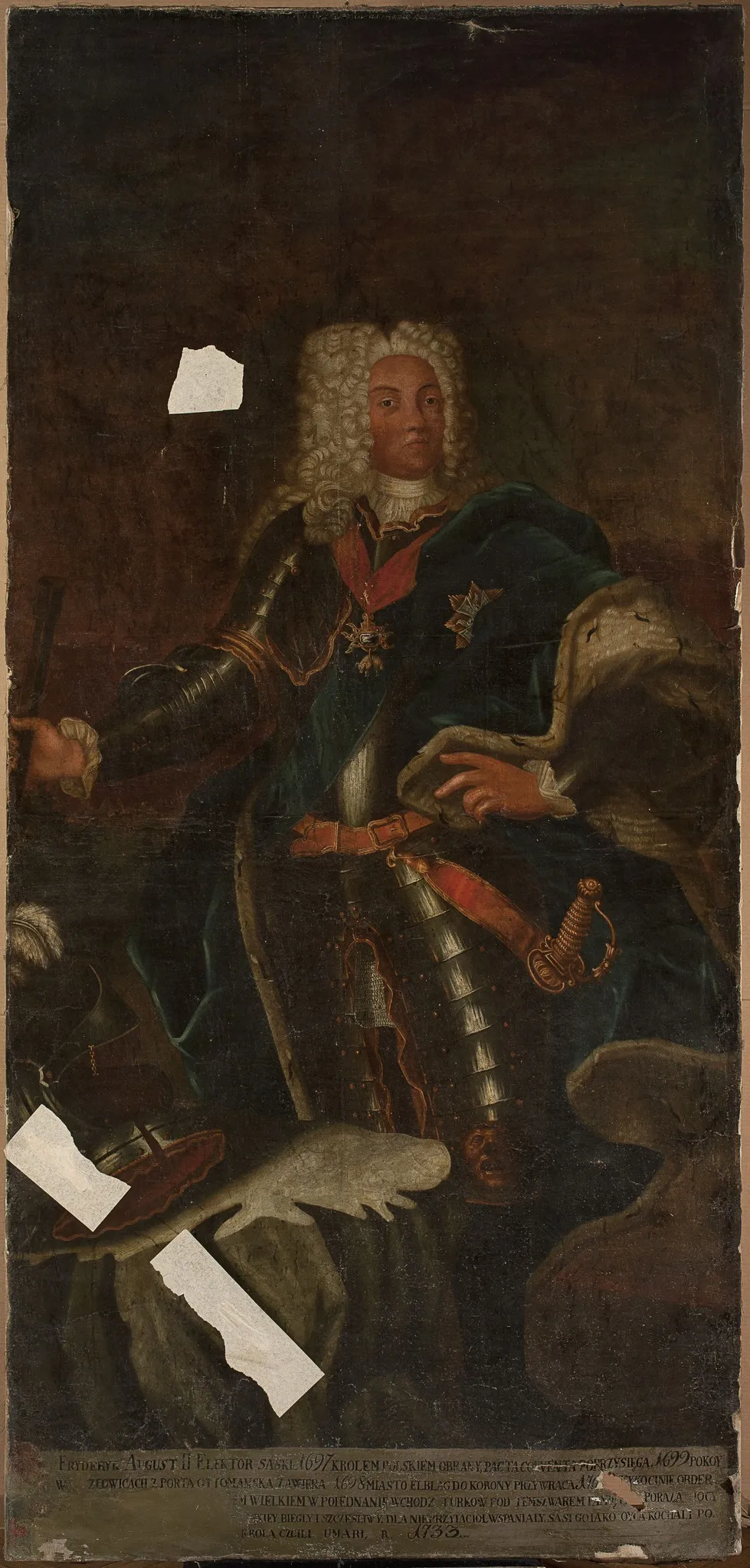
Portrait of Augustus II the Strong (1670–1733) is an oil painting by the Rococo painting artist Unknown. It dates from 1756 and is held in the collection of the National Museum in Warsaw. The oil painting depicts Augustus II the Strong, the Elector of Saxony and King of Poland, seated on a rocky outcrop.
About this work
Overview
The Portrait of Augustus II the Strong is an oil on canvas painting dated to 1756, created by an unknown Polish painter.
The Portrait of Augustus II the Strong is an oil on canvas painting dated to 1756, created by an unknown Polish painter. The full-length work measures 259 by 122.6 centimeters and is held in the National Museum in Warsaw. As a posthumous depiction executed more than two decades after the sitter's death in 1733, the painting draws heavily on the established iconography of the court painter Louis de Silvestre to project the enduring glory and authority of the Saxon elector and Polish king.
Subject & Meaning
The painting depicts Augustus II the Strong, Elector of Saxony and King of Poland, as a victorious commander and eminent statesman. He grips a baton in his right hand while his left hand rests near his waist, and a sword with an ornate gilt hilt hangs at his hip. The iconography emphasizes his dual royal and military status through his polished steel armor and a dark blue velvet cloak with fur trim. A red sash crosses his chest, where a star-shaped order and pendant are prominently displayed. These represent the Order of the White Eagle, which Augustus established in 1705, and the Order of the Golden Fleece, a highly prized decoration dating to the fifteenth century. An inscription above his head calls him the peace-making father of the homeland, cementing the work's function as a panegyric celebrating his rule.
Technique & Style
The artist employed oil paint on canvas to render the composition, utilizing a palette dominated by deep blues, blacks, and browns, punctuated by accents of red, gold, and the silvery white of the sitter's wig and armor highlights. Light falls from the upper left, illuminating the face, long curled white wig, and the metallic reflections of the armor. The brushwork is smooth and blended in the facial features and fabrics, transitioning to more defined strokes to capture the reflective qualities of the polished steel. The figure stands on rocky ground against a nearly black background, with a plumed helmet and red cloth resting on a stone ledge at the lower left. The surface exhibits age cracks and abrasion, and three white rectangular patches are visible on the canvas. A band of text runs along the bottom edge of the work.
History & Provenance
Created in 1756, the painting is a posthumous portrait produced in the workshop tradition of Louis de Silvestre, who served as the Saxon court painter in Dresden for over three decades. Silvestre's original prototypes, executed around 1718, set the standard for official depictions of the monarch, and this specific composition is very similar to another Silvestre portrait held in the Polish National Museum in Poznan. The 1756 canvas is now part of the collection of the National Museum in Warsaw. The broader dissemination of Silvestre's models is further evidenced by a related painting gifted to the elector's Swedish cousin, Ulrika Eleonora the Younger, around 1720.
Context
The visual language of the portrait is deeply rooted in the courtly aesthetics promoted by Louis de Silvestre, a French artist who arrived in Dresden in 1716 and became the first court painter to Augustus II. Silvestre's workshop defined the monarch's public image, producing numerous portraits and frescoes that blended French Baroque formality with Saxon political messaging. Although the 1756 Warsaw painting is attributed to an unknown Polish painter, its reliance on Silvestre's established compositions reflects the enduring influence of the court painter's models long after Augustus's death. Silvestre's style, characterized by contemporaries like Mariette as competent but conventional, nonetheless provided a crucial template for legitimizing and glorifying Wettin rule across Poland and Saxony.
Artist & collection