Artwork
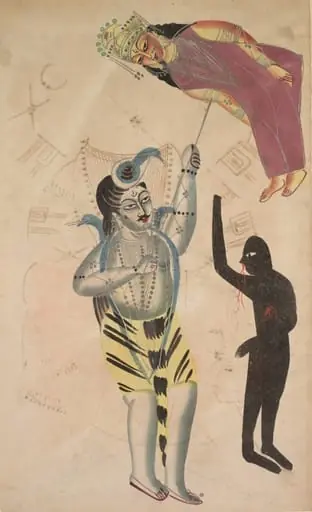
Shiva Bearing Aloft the Body of His Sati
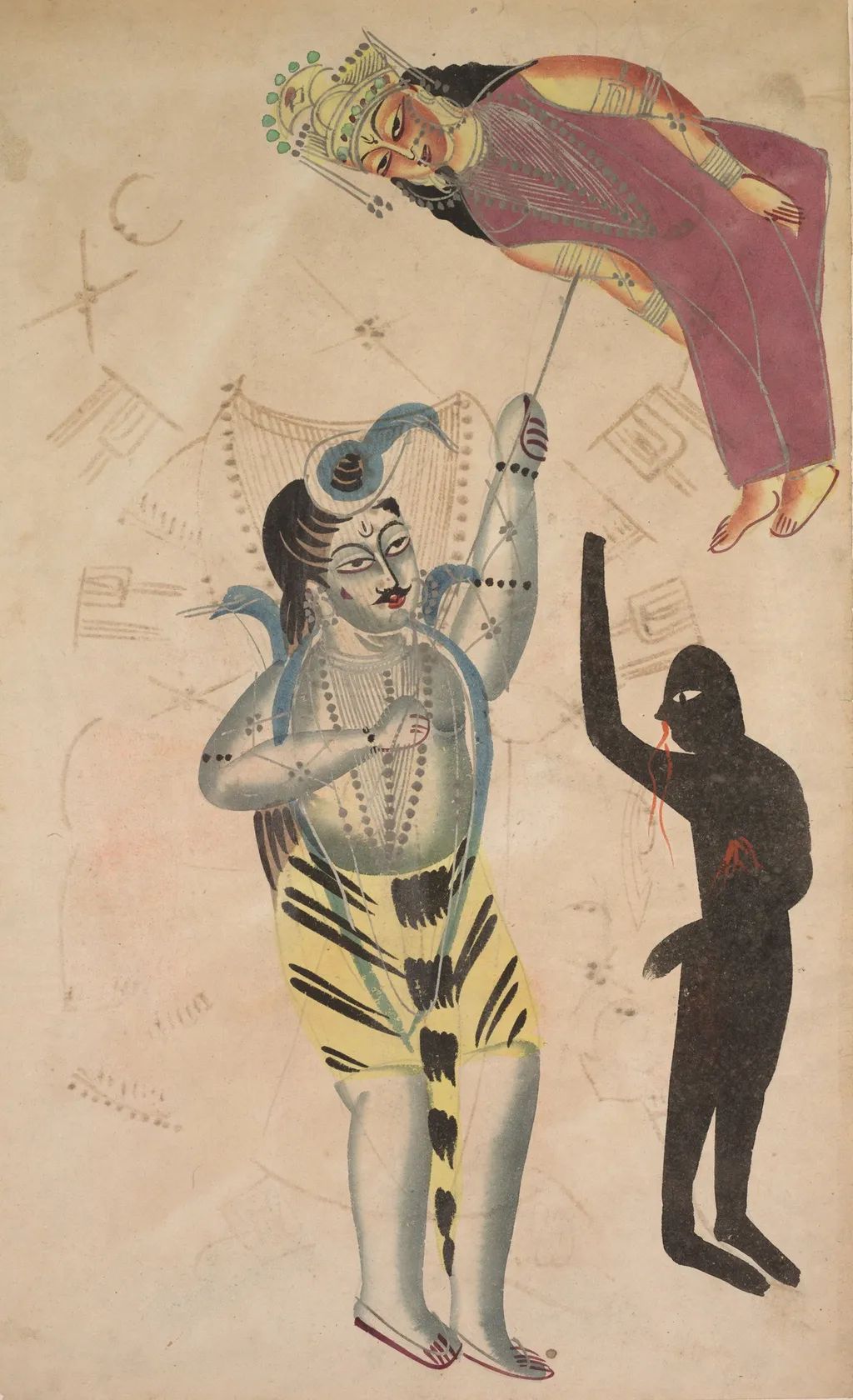
Shiva Bearing Aloft the Body of His Sati is an unspecified painting. It dates from 1896 and is held in the collection of the Cleveland Museum of Art.
About this work
Subject & Meaning
The artwork is housed in the Cleveland Museum of Art, where it is catalogued as part of the collection acquired in 2003 under accession number 2003.
In the painting Shiva Bearing Aloft the Body of His Sati, the Hindu deity is shown carrying the lifeless form of his consort Sati, a scene that embodies grief and divine detachment. The iconography combines ascetic Shaiva symbolism with colonial-era academic realism, reflecting the artist’s engagement with both indigenous myth and European technique. The work’s subject underscores themes of loss, cosmic cycles, and the tension between spiritual transcendence and earthly attachment, resonating with contemporary debates on cultural identity in 19th-century Bengal.
The depiction draws on mythic narratives in which Sati immolates herself and Shiva retrieves her corpse, a story that symbolizes devotion and the cyclical nature of creation and destruction. The painting’s composition, rendered in oil on canvas, foregrounds the weight of the corpse against Shiva’s serene posture, using chiaroscuro to dramatize the emotional gravity of the moment. This visual narrative aligns with scholarly interpretations of the subject as a meditation on sacrifice and divine sorrow.
The artwork is housed in the Cleveland Museum of Art, where it is catalogued as part of the collection acquired in 2003 under accession number 2003.131. Its provenance traces back to Kolkata, where it was likely produced by an anonymous practitioner trained in European academic conventions while maintaining devotional subject matter characteristic of Bengal’s artistic circles in the late 19th century.
The painting’s material and technical execution reflect the adaptation of Western oil medium to traditional Indian iconography, marking a synthesis of stylistic influences. Its presence in a Western museum highlights transnational movements of cultural objects during the colonial period, offering insight into the reception of Hindu mythology within global art histories.
History & Provenance
The painting titled Shiva Bearing Aloft the Body of His Sati was created in 1890 in Kolkata. The work is attributed to an unknown artist, reflecting a period when individual creatorship was often unrecorded for such regional productions. It entered the collection of the Cleveland Museum of Art in 2003, acquiring the accession number 2003.131.
No specific commission details or earlier ownership records are documented in the available sources, leaving the immediate provenance prior to its museum acquisition unverified.
The painting Shiva Bearing Aloft the Body of His Sati is held in the collection of the Cleveland Museum of Art. The work carries the accession number 2003.131 within the museum's holdings. Created in 1890, the piece was produced in Kolkata before entering the institution's care.
No specific exhibition history for this artwork is provided in the available records.
Context
The painting depicts Shiva carrying the corpse of his first wife Sati, a theme drawn from Hindu mythology rarely treated in 19th-century Western academic art. Its creation in Kolkata during 1890 places it at the intersection of colonial artistic encounters and Indian devotional traditions, reflecting how European techniques were adapted locally. While the artist's identity remains anonymous, the work's subject demonstrates scholarly interest in cross-cultural mythological narratives during the late 19th century.
The piece entered the Cleveland Museum of Art collection in 2003, documented under accession 2003.131, where it continues to be studied as an example of syncretic religious art from the Bengal region.
Overview
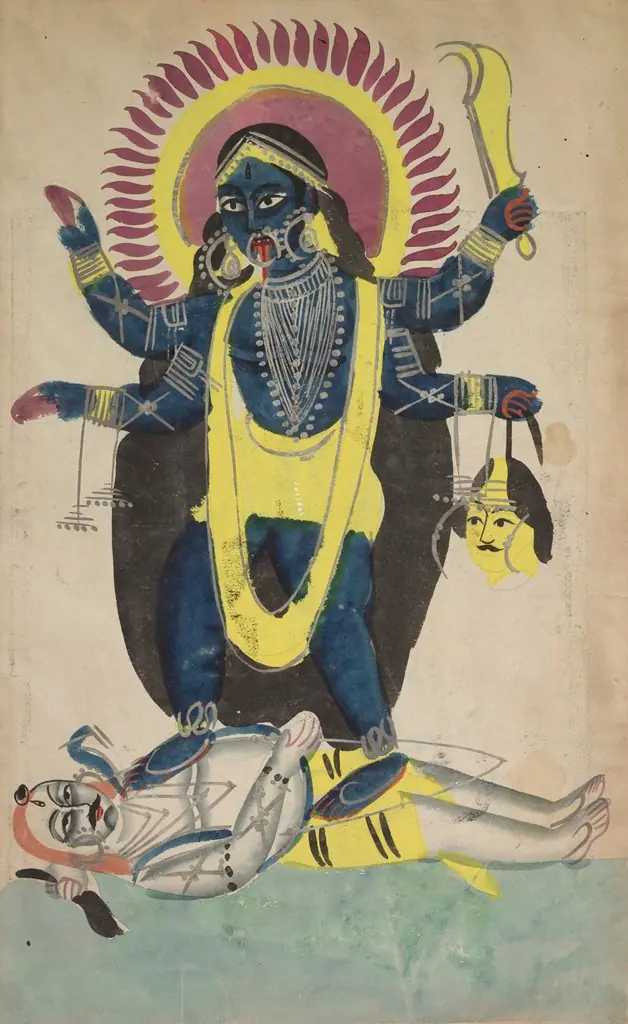
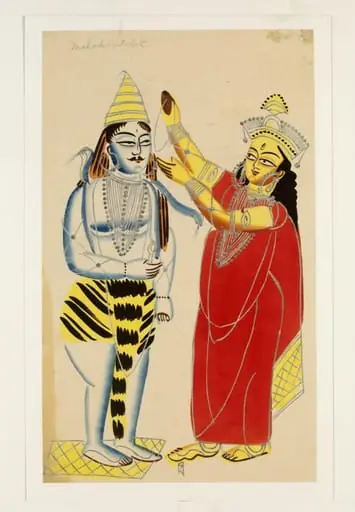
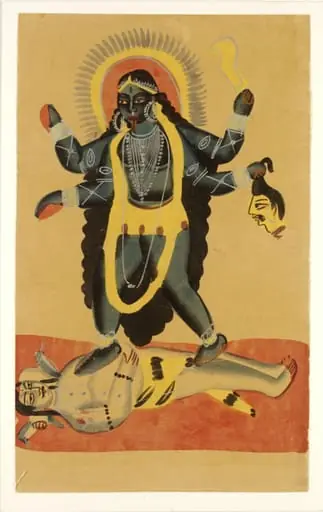
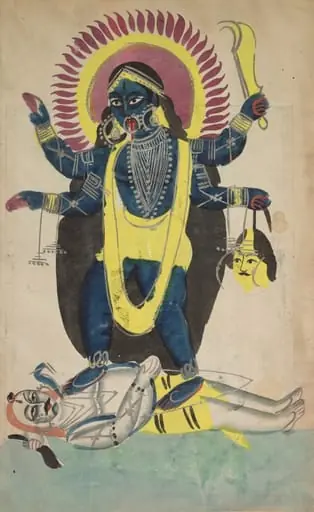
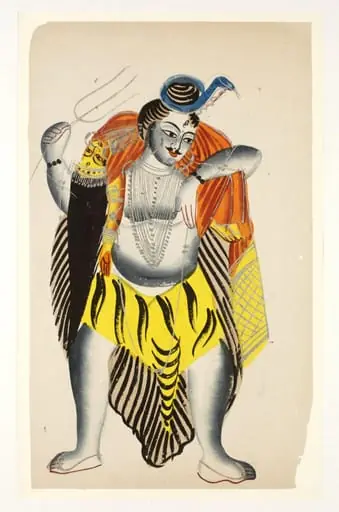
The work depicts a male figure clad in a yellow loincloth patterned with black stripes, hoisting the corpse of a woman dressed in red and crowned. A dark, partially obscured figure appears at the right, extending its left arm upward. The composition rests against a light‑brown ground marked with subtle tonal variations.
Technique & Style
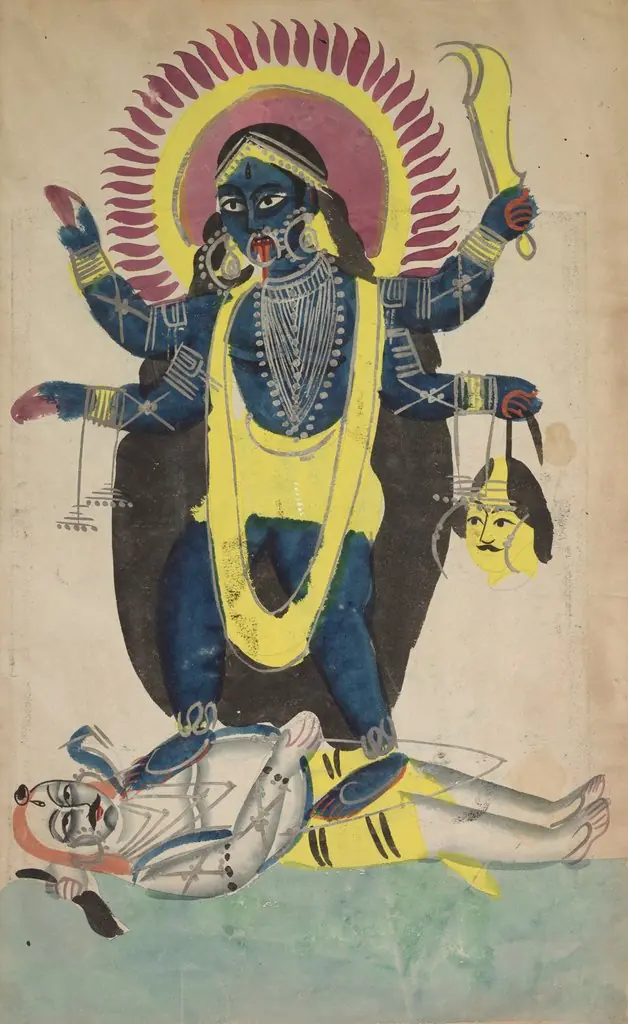
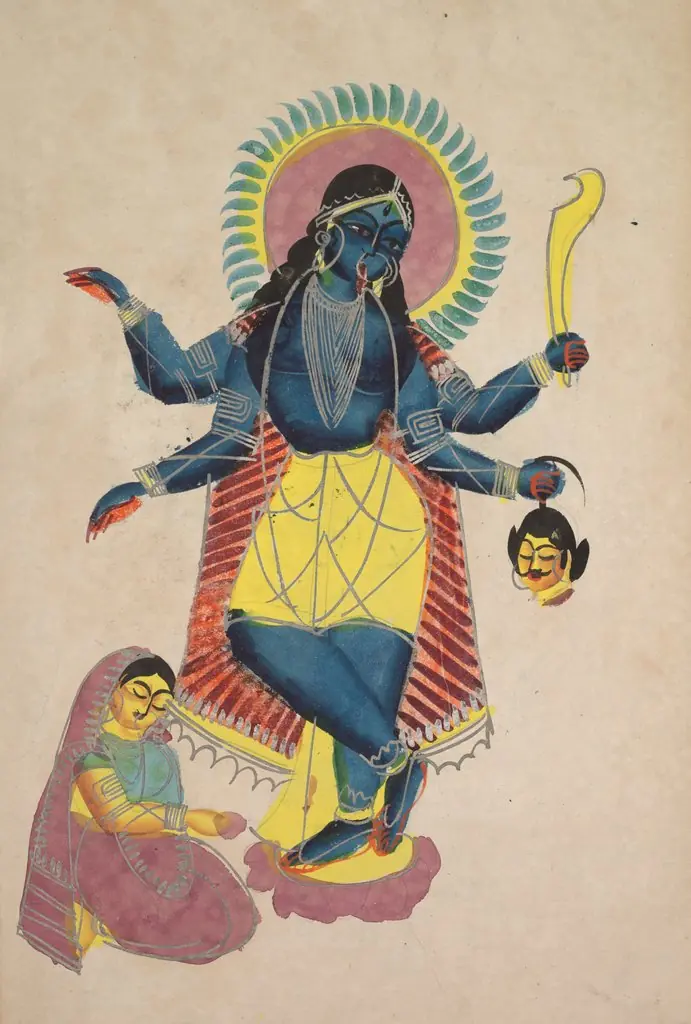
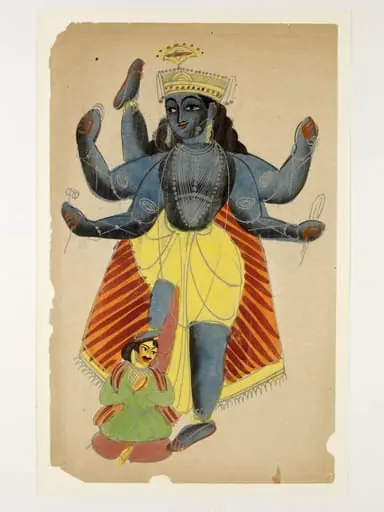
Rendered in the characteristic flatness of Kalighat painting, the piece employs bold outlines and a limited palette of vivid yellows, reds, and blacks. The figures are stylized rather than naturalistic, and the background’s faint markings provide a minimal spatial context, focusing attention on the dramatic gesture.
Artist & collection