Artwork
Studies of a Lion Killing Prey
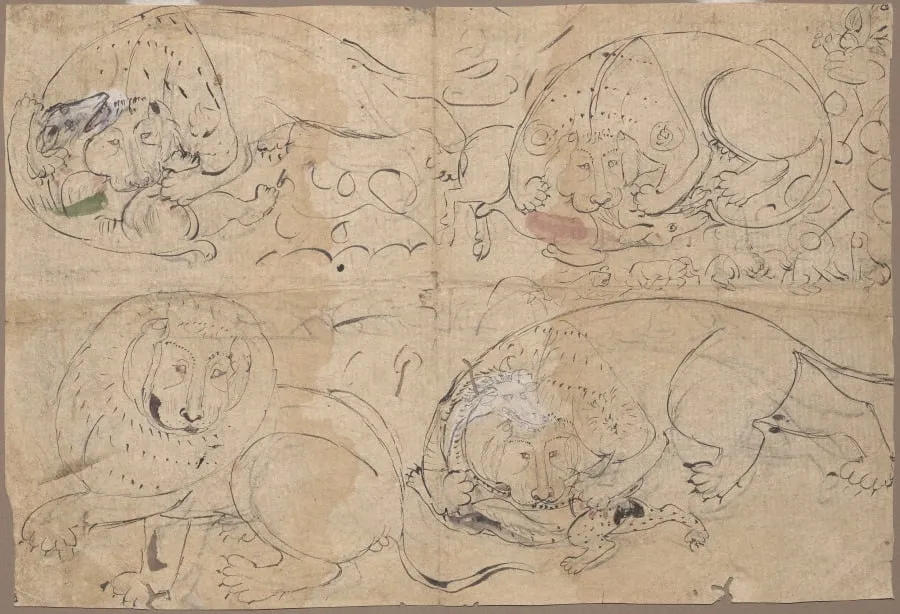
Studies of a Lion Killing Prey is a drawing by the Romanticist artist Unknown. It dates from 1804 and is held in the collection of the Cleveland Museum of Art. This ink drawing captures four lions in dynamic motion, rendered with rapid, unrefined strokes on faded paper.
- Accession no.
- 1983.114
- Credit line
- Gift of Mr. and Mrs. William E. Ward
About this work
Overview
The composition emphasizes kinetic energy over detail, with minimal background elements, only faint dots suggesting terrain.
This ink drawing captures four lions in dynamic motion, rendered with rapid, unrefined strokes on faded paper. The composition emphasizes kinetic energy over detail, with minimal background elements, only faint dots suggesting terrain. Shading is sparse, applied in muted browns and grays, allowing the fluidity of the lines to dominate.
The absence of finish reinforces a sense of immediacy, as if the scene was observed and recorded in real time.
Subject & Meaning
The scene depicts lions engaged in the act of hunting, two mid-pounce with jaws agape, others poised or stalking. There is no indication of prey, heightening the focus on the predators’ raw intensity. The work conveys nature’s violence not as a narrative moment but as a primal force, stripped of symbolism or moral framing. The lions appear untamed, their movements unmediated by human interpretation.
Technique & Style
The artist employed loose, gestural ink lines to suggest form rather than define it, prioritizing motion over anatomical precision. Areas of light wash add subtle volume, but most of the drawing remains unshaded, relying on line weight and direction for expression. The paper’s faded state enhances the sketch’s ephemeral quality, aligning with a method that values spontaneity and emotional immediacy over polish.
History & Provenance
The drawing’s origin is undocumented, but its style and subject align with early 19th-century European artistic interests in wild animals, particularly among those influenced by Romantic ideals. It likely stems from a series of observational sketches made from live specimens or preserved models, common in studios of naturalists and painters seeking authentic animal behavior.
Context
Created during a period when European artists increasingly turned to nature’s untamed aspects for inspiration, this work reflects a broader fascination with the sublime in the animal kingdom. While not part of a known larger series, its emphasis on movement and raw power echoes contemporary studies by artists exploring the boundaries between observation and emotional expression.
Legacy
Though unsigned and unattributed, the drawing contributes to a wider body of 19th-century animal studies that shifted focus from idealized representations to visceral, unembellished depictions of wildlife. Its unfinished quality anticipates later modernist approaches that valued process and energy over finish, influencing how movement and instinct were visually articulated in art.
Artist & collection









- Untitled
 Untitled
 Portrait of the Heavenly Master
 Untitled
 天部諸尊図像抄|Scroll 9 of Collected Iconography (Zuzōshō): Ten (Devas)
 舞楽図屏風 ・唐獅子図屏風|Bugaku Dances (front); Chinese Lions (reverse)
 Album of Daoist and Buddhist Themes: Search the Mountain: Leaf 44
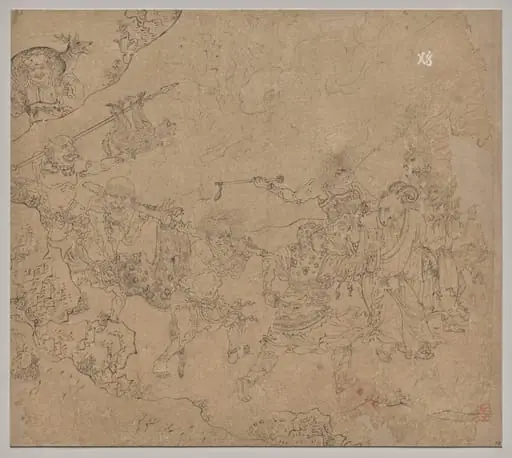 Album of Daoist and Buddhist Themes: Search the Mountain: Leaf 45
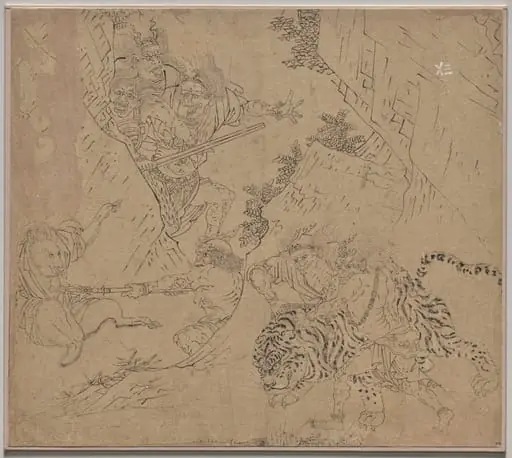 Album of Daoist and Buddhist Themes: Search the Mountain: Leaf 43
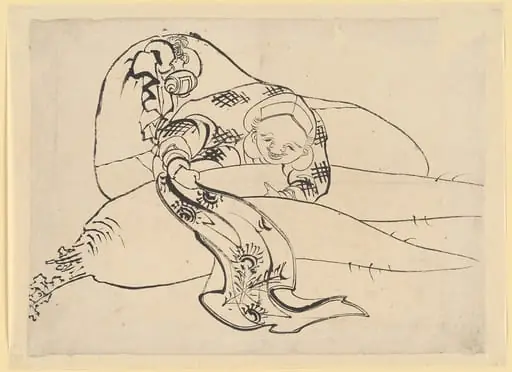 Untitled
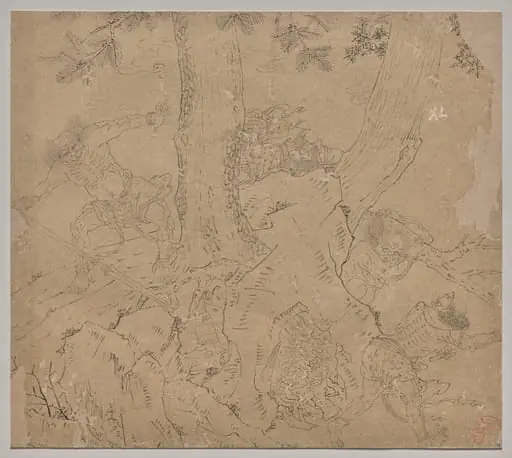 Album of Daoist and Buddhist Themes: Search the Mountain: Leaf 46
![Man Playing Piano; Two Sheep [verso], by Paul Gauguin](https://artifactworldgallery.com/img/paul-gauguin--man-playing-piano-two-sheep-verso--80f685776a7d92dd-w320.webp) Man Playing Piano; Two Sheep [verso]
Man Playing Piano; Two Sheep [verso]