Artwork
Untitled
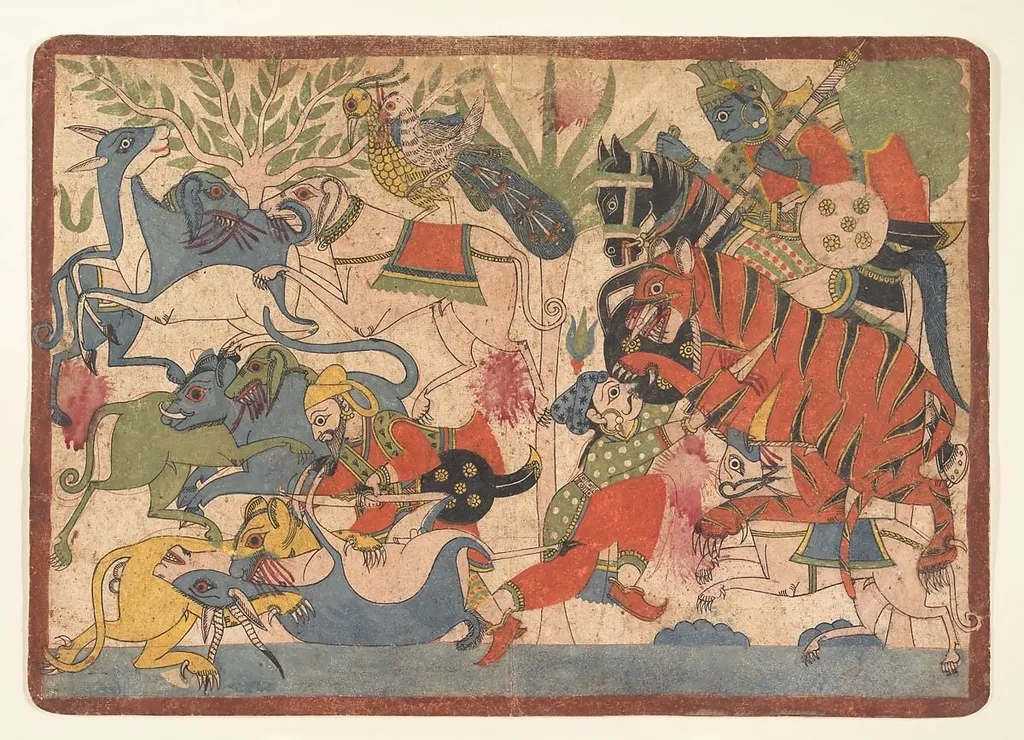
Untitled is a watercolor painting. It dates from 1825 and is held in the collection of the Metropolitan Museum of Art.
- Accession no.
- 1980.527.3
- Credit line
- Gift of Daniel Slott, 1980
About this work
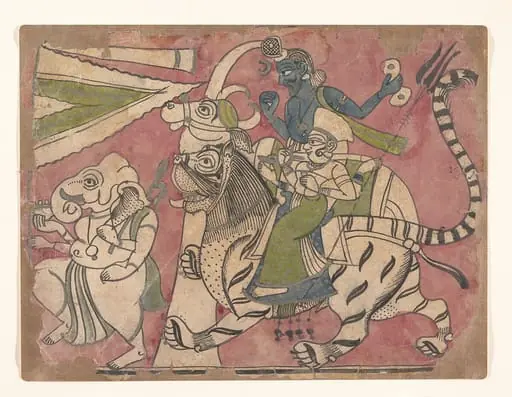
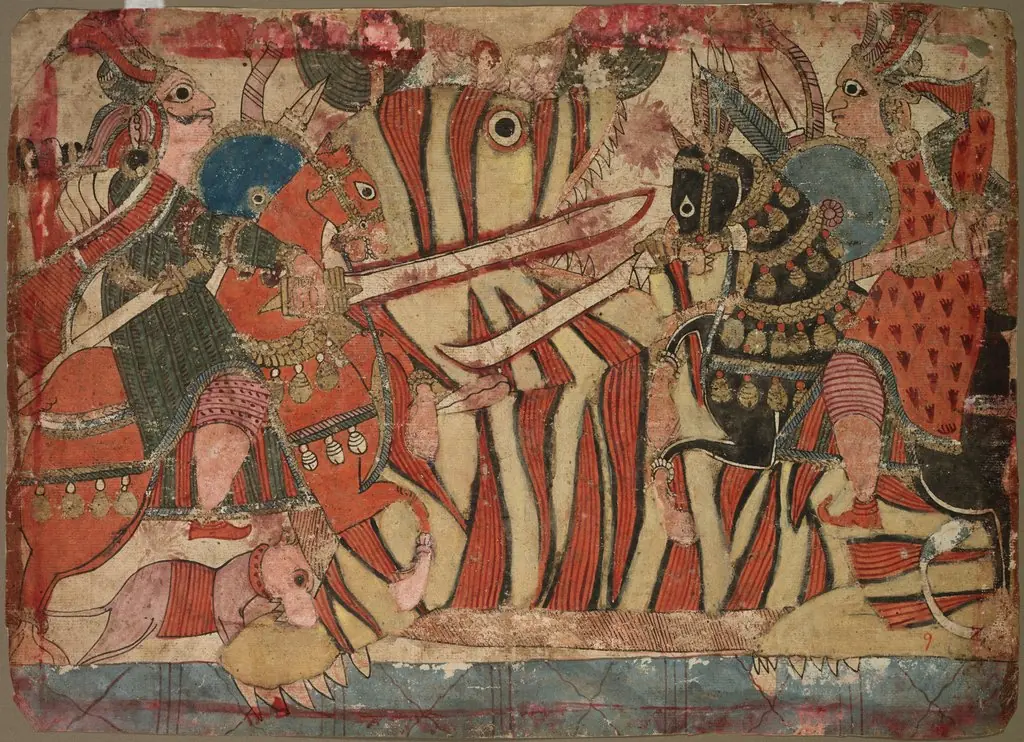
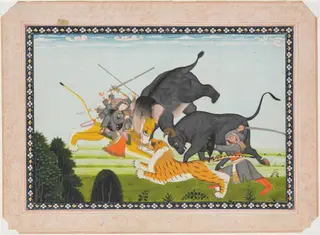
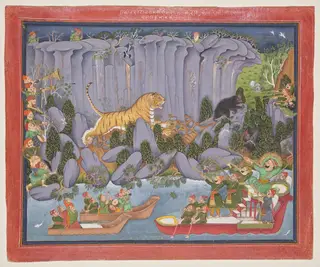
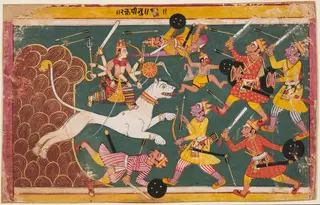
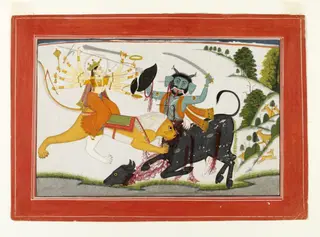
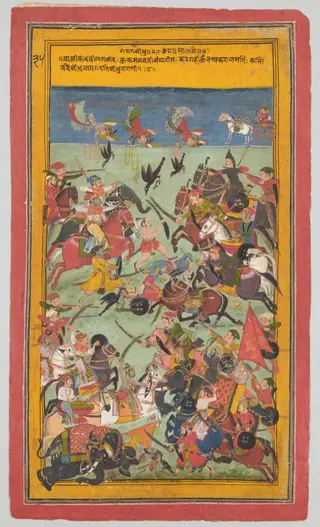
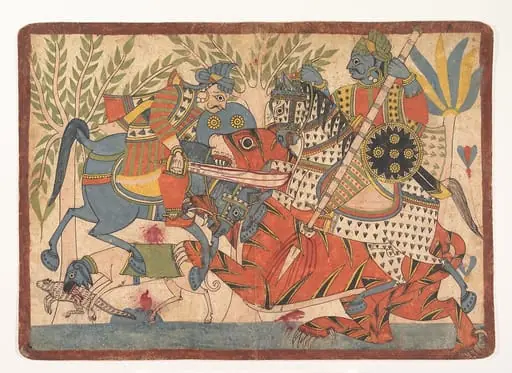
A royal hunt unfolds across a Paithan folio made for the wandering Chitrakathi bards of the western Deccan. Painted in ink and opaque watercolor on paper in the early nineteenth century, the Mahabharata scene was held up before village audiences as a storyteller sang of hero-warriors. The Met acquired it in 1980 as a gift from Daniel Slott.
Subject & Meaning
The scene reflects an Indian tradition of royal hunts, in which such imagery served to glorify the patron's prowess and connection to both nature and authority.
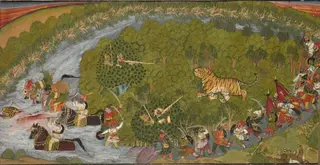
The work depicts a dynamic hunting scene set in a natural landscape, featuring a male equestrian figure in pursuit of wildlife. Iconographically, the composition centers on the interaction between predator and prey: a tiger attacks a peafowl while a mounted hunter observes or participates in the chase. The horse, rendered with energetic motion, underscores the theme of equestrianism and the aristocratic tradition of sport hunting.
Symbolically, the juxtaposition of the tiger, often associated with power and ferocity, and the peafowl, a bird linked to beauty and nobility, may evoke broader cultural narratives of dominance and the natural order. The scene reflects an Indian tradition of royal hunts, in which such imagery served to glorify the patron's prowess and connection to both nature and authority.
Technique & Style
The work is executed in ink with opaque watercolor washes on paper, a support typical for delicate 19th-century Indian illustration. The paper sheet measures roughly 31.1 × 43.5 cm and dates to 1825, by an unidentified painter. Ink line defines a dynamic equestrian figure engaged in hunting, while accompanying motifs of a man, peafowl and a tiger introduce a narrative of sport and exotic fauna.
The composition balances precise linear detail with soft, layered color, producing a vivid yet restrained visual rhythm. The work is held by the Metropolitan Museum of Art.
History & Provenance
The work, an anonymous painting dated to 1825, entered the collection of the Metropolitan Museum of Art, where it remains housed. No commissioning patron or earlier ownership records are documented in the available sources. Created using ink and opaque watercolor on paper, the painting's precise origins and initial provenance prior to its acquisition by the museum remain unestablished, with its anonymous attribution and lack of inscribed context limiting further historical reconstruction. Its dimensions are recorded as 31.1 cm in height by 43.5 cm in width.
Overview
This untitled painting, rendered in ink and opaque watercolor, exemplifies the Chitrakathi narrative tradition from Maharashtra. Created between 1800 and 1850 in the distinctive Paithan style, it illustrates a royal hunt scene derived from the ancient epic, the Mahabharata. These folios were integral to oral storytelling performances across the western Deccan, serving as visual aids for bards entertaining small village audiences.
Context
This painting is part of the Chitrakathi tradition, a form of narrative art produced by the Chitrakarthi caste in Maharashtra for oral performances. These individual folios were originally bound into loose-leaf sets called pothi. Storytellers would present them to intimate village gatherings, often numbering ten to thirty listeners, holding them up as they recounted epic tales.
The frequent handling often led to wear and tear, particularly at the top center, which was sometimes subsequently repaired.
Artist & collection