Artwork
Wall painting from the west wall of Room L of the Villa of P. Fannius Synistor at Boscoreale
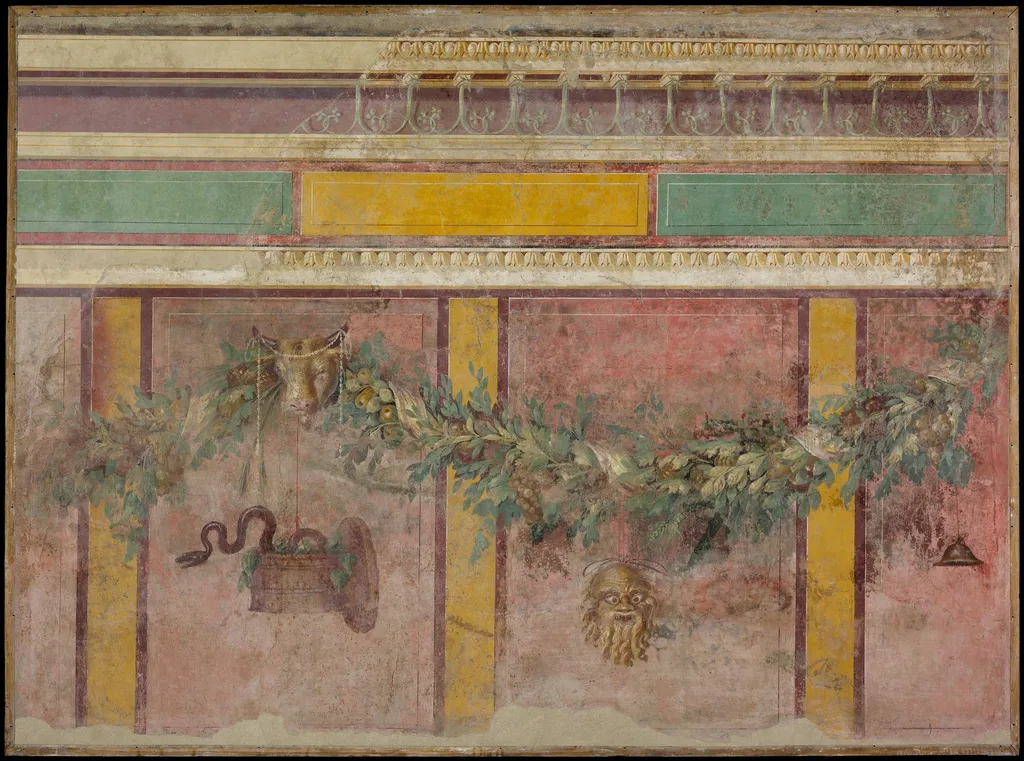
Wall painting from the west wall of Room L of the Villa of P. Fannius Synistor at Boscoreale is an unspecified painting. It dates from -45 and is held in the collection of the Metropolitan Museum of Art. This wall painting fragment originates from the Villa of P.
About this work
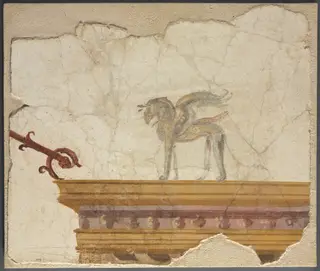
Painted around 50 to 40 BCE in the Second Style, the fragment shows a boukranion with garlands of fruit, grape leaves, and pinecones spilling to either side.
A sacrificial bull's head once anchored a fresco from the exedra of a Roman villa just north of Pompeii. Painted around 50 to 40 BCE in the Second Style, the fragment shows a boukranion with garlands of fruit, grape leaves, and pinecones spilling to either side. A cista mystica hangs from the bull's mouth, open to reveal a snake coiled in ivy, with a satyr mask and bronze cymbal on red cords. The Met acquired it in 1903.
Subject & Meaning
The west‑wall painting from Room L of the Villa of P. Fannius Synistor at Boscoreale is a trompe‑l'œil still life dated to 45 BCE. It depicts a bull, garlands of fruit and leaves, a snake, Hedera (ivy), a cornice and a theatrical mask, all rendered in the Roman illusionistic style. The bull and ivy suggest strength and enduring life, while the garland, fruit and mask evoke abundance, festivity and Dionysian associations; the snake may symbolize rebirth or protective power.
Together these elements convey the owner’s wealth, cultured taste and the Roman elite’s fascination with illusionistic decoration that celebrated prosperity and mythological themes.
Technique & Style
The wall painting, dated to 45 BCE, is a Roman trompe‑l'œil work now in the Metropolitan Museum of Art, measuring approximately 195.6 cm high by 271.8 cm wide. The sources record its genre as trompe‑l'œil and place it within Roman art, but they do not provide details of the painting’s technique, materials, medium, support, handling, or current condition. Consequently, only its stylistic illusionism, chronological placement, and dimensions are substantiated by the available information.
History & Provenance
Created circa 45 BCE, this trompe-l'œil wall painting originally adorned the west wall of Room L within the Villa of P. Fannius Synistor at Boscoreale. The work dates to the late Roman Republican period, reflecting the artistic movements of that era. While the specific individual who commissioned the piece is not explicitly named in the available records beyond the villa's owner, the painting's inception is firmly established at the middle of the first century BCE.
Following its excavation, the artwork entered the collection of the Metropolitan Museum of Art, where it is currently housed and displayed. The museum attributes the piece to the broader category of Roman art, noting its detailed depiction of naturalistic elements such as bulls, garlands, and masks within an architectural framework.
Overview
This wall painting fragment originates from the Villa of P. Fannius Synistor in Boscoreale, a Roman estate near Pompeii. Created around 50–40 BCE, it exemplifies the late Second Pompeian Style, characterized by architectural illusionism. The fresco centers on a sacrificial bull's head, or boukranion, adorned with abundant garlands. It was acquired by the Metropolitan Museum of Art in 1903.
Artist & collection