Artwork
The Seconda Macchina for the Chinea of 1773: The Preparation of Theriac in Venice
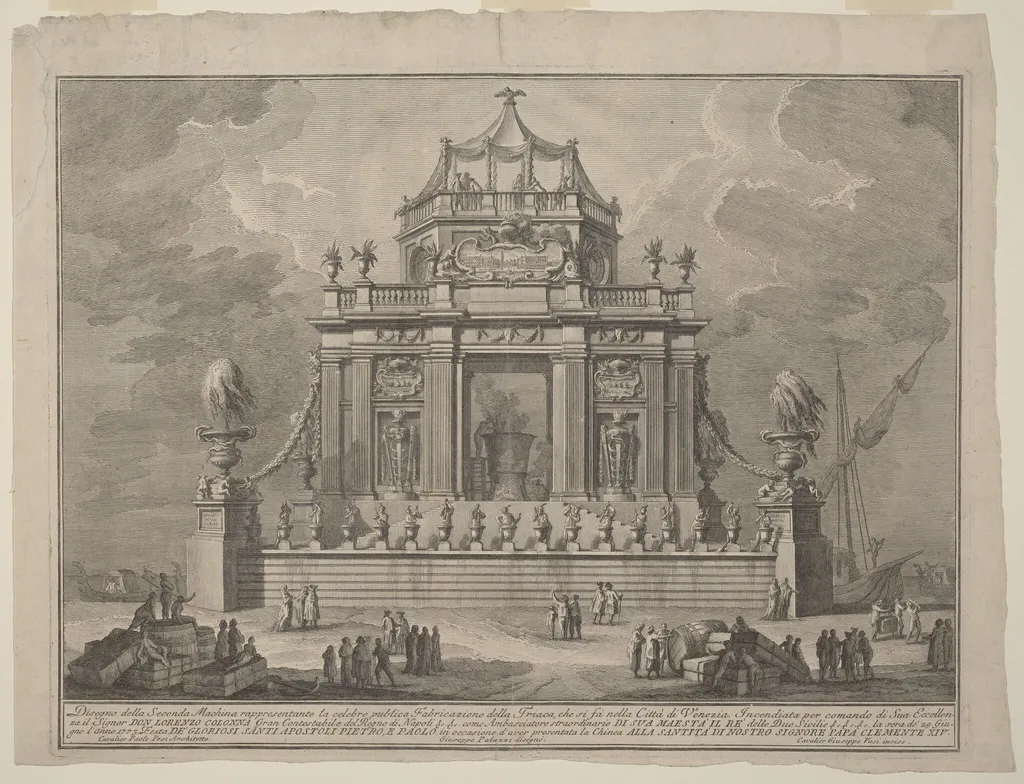
The Seconda Macchina for the Chinea of 1773: The Preparation of Theriac in Venice is an ink print by the Romanticist artist Giuseppe Vasi. It dates from 1773 and is held in the collection of the National Gallery of Art.
- Inscription
- Inscribed:across bottom in plate: Disegno della Seconda Machina rappresentante la celebre publica Fabricazione della Triaca, che si fà nella Città di Venezia. Incendiata per comando di Sua Eccellen- / za il Signor DON LORENZO COLONNA Gran Contestabile del Regno di Napoli &c. &c. come Ambasciatore straordinario DI SUA MAESTA IL RE delle Due Sicilie &c. &c. &c. la sera de' 29. Giu / gno l'anno 1773. Festa DE GLORIOSI SANTI APOSTOLI PIETRO, E PAOLO in occasione d'aver presentata la Chinea ALLA SANTITA DI NOSTRO SIGNORE PAPA CLEMENTE XIV. / Cavalier Paolo Posi Architetto. / Giuseppe Palazzi disegnò. / Cavalier Giuseppe Vasi incise.
About this work
People in old clothes stand around it, some watching, some working.
This drawing shows a big, fancy stage setup in Venice. It has tall columns, statues, and a small roof on top. People in old clothes stand around it, some watching, some working. The stage looks like a temple, with steps and a crowd below.
The text at the bottom says this was for a special event in 1773. It was part of a big show to celebrate something important.
Check out how this was made using etching.
Overview
Created in 1773 by Giuseppe Vasi, this etching documents a temporary architectural spectacle erected in Venice for the annual Chinea ceremony. Rendered in fine linear detail on laid paper, the print captures a ceremonial structure designed as a temple-like stage, complete with columns, statuary, and a modest canopy. The scene includes figures in period dress, both observers and participants, suggesting a public ritual tied to civic or religious tradition.
Subject & Meaning
The image depicts the preparation of theriac, a complex medicinal compound historically believed to counteract poison. The staged setting transforms a pharmacological process into a public spectacle, reflecting Venice’s fusion of science, ceremony, and civic pride. The temple architecture elevates the act to a ritual, aligning medical tradition with symbolic grandeur during a festival honoring the Pope.
Technique & Style
Vasi employed etching to achieve precise, delicate lines that define architectural elements and human figures with clarity. The composition emphasizes verticality through tall columns and receding steps, guiding the viewer’s eye upward. Atmospheric depth is suggested by varying line density, while the absence of tone keeps focus on structure and arrangement, characteristic of topographical printmaking of the period.
History & Provenance
The print was produced as part of Vasi’s series documenting Venetian festivities, commissioned to record the Chinea, a tribute paid by Venice to the Papacy. It was likely distributed to dignitaries and collectors, serving both as a record and a commemorative object. The work survives in several institutional collections, attesting to its role in preserving ephemeral civic events.
Context
The Chinea ceremony, held annually on June 29, involved the presentation of a symbolic gift to the Pope, often accompanied by elaborate public displays. In 1773, Venice’s display centered on theriac, a substance with medieval origins still revered for its curative properties. Such events reinforced Venice’s cultural authority and its ties to broader European traditions of learned ritual.
Legacy
Vasi’s etching contributes to a broader archive of 18th-century Venetian civic life, preserving transient performances that otherwise vanished without documentation. As a record of public spectacle and medical practice, it offers insight into how science and ceremony intersected in early modern urban culture, influencing later topographical and historical printmaking.
Own this work as a print
Artist & collection

 The Seconda Macchina for the Chinea of 1766: A Theater for Athletic Games
 The Prima Macchina for the Chinea of 1765: The Garden of the Hesperides
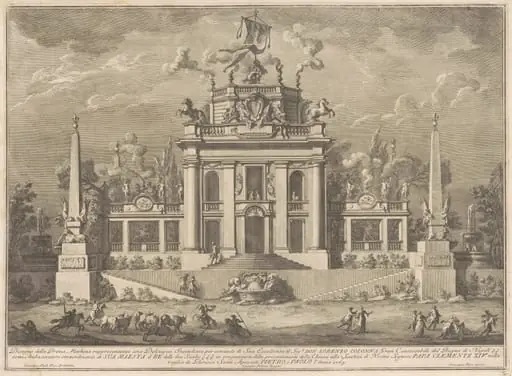 The Prima Macchina for the Chinea of 1769: A "Deliziosa"
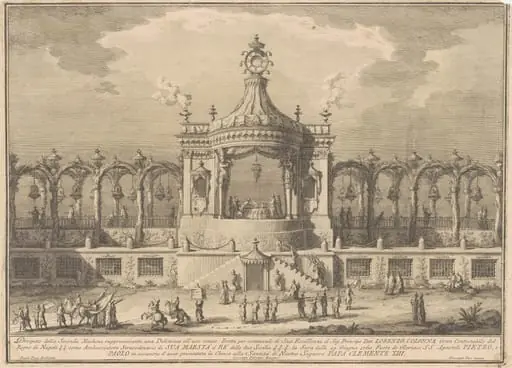 The Seconda Macchina for the Chinea of 1760: A Chinoiserie Pavilion
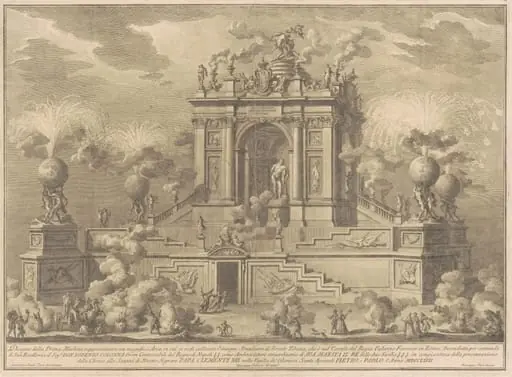 The Prima Macchina for the Chinea of 1767: A Triumphal Arch with the Farnese Hercules
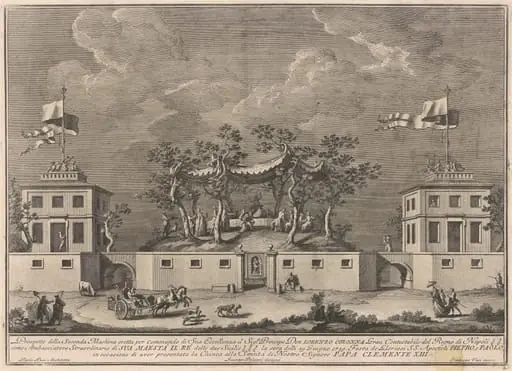 The Seconda Macchina for the Chinea of 1759: A "Deliziosa" with a Bacchanal
 The Seconda Macchina for the Chinea of 1762: A Kiosk, or Pleasure-House in Ottoman Style
 The Seconda Macchina for the Chinea of 1763: The Grape Harvest
- The Seconda Macchina for the Chinea of 1773: The Preparation of Theriac in Venice
 The Prima Macchina for the Chinea of 1771: The Temple of Asclepius
 The Prima Macchina for the Chinea of 1771: The Temple of Asclepius
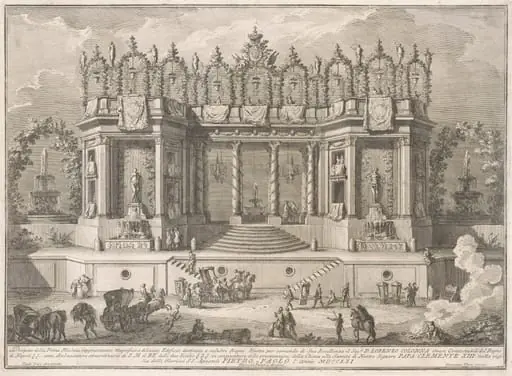 The Prima Macchina for the Chinea of 1761: The Salubrious Baths
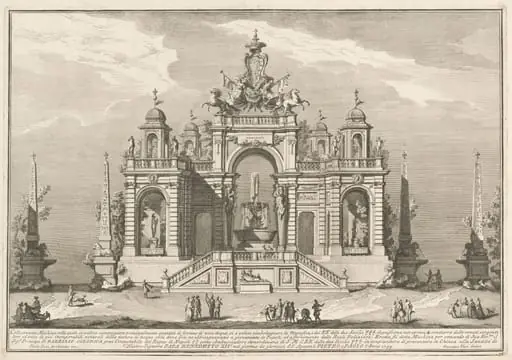 The Seconda Macchina for the Chinea of 1754: An Allegory of Waterworks
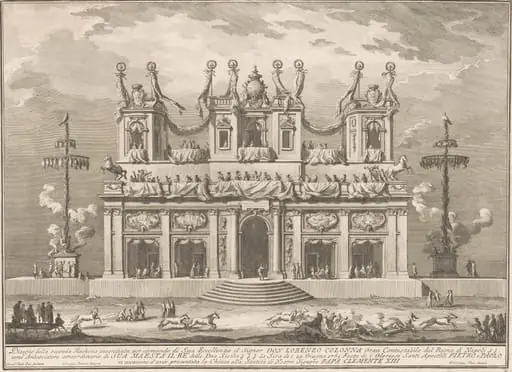 The Seconda Macchina for the Chinea of 1765: A Decorated Building with Cockaigne Poles
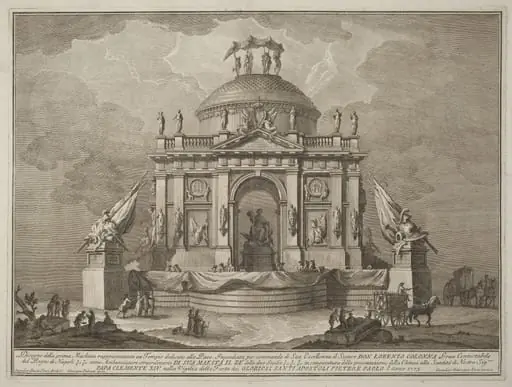 The Prima Macchina for the Chinea of 1773: The Temple of Peace
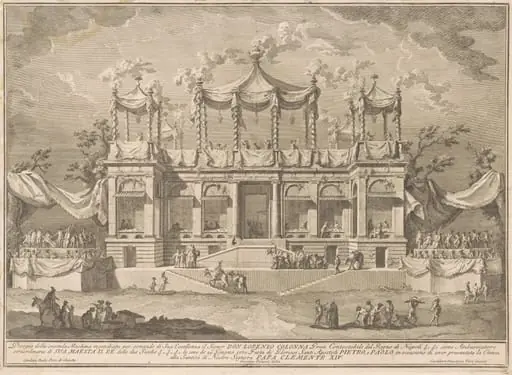 The Seconda Macchina for the Chinea of 1770: The Fish Market Portico
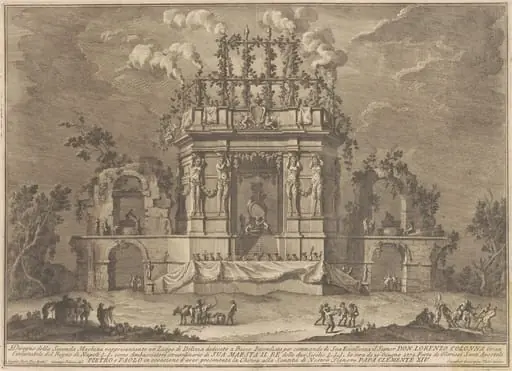 The Seconda Macchina for the Chinea of 1771: A Pleasure Palace Dedicated to Bacchus
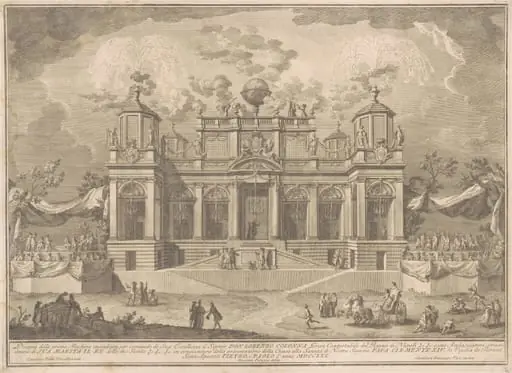 The Prima Macchina for the Chinea of 1770: An Roman Building for Commerce