Artwork
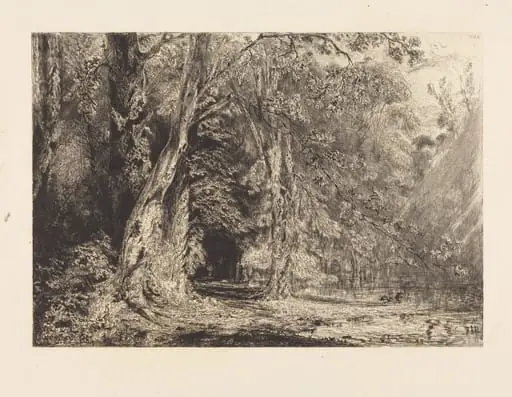
Landscape with Fallen Tree
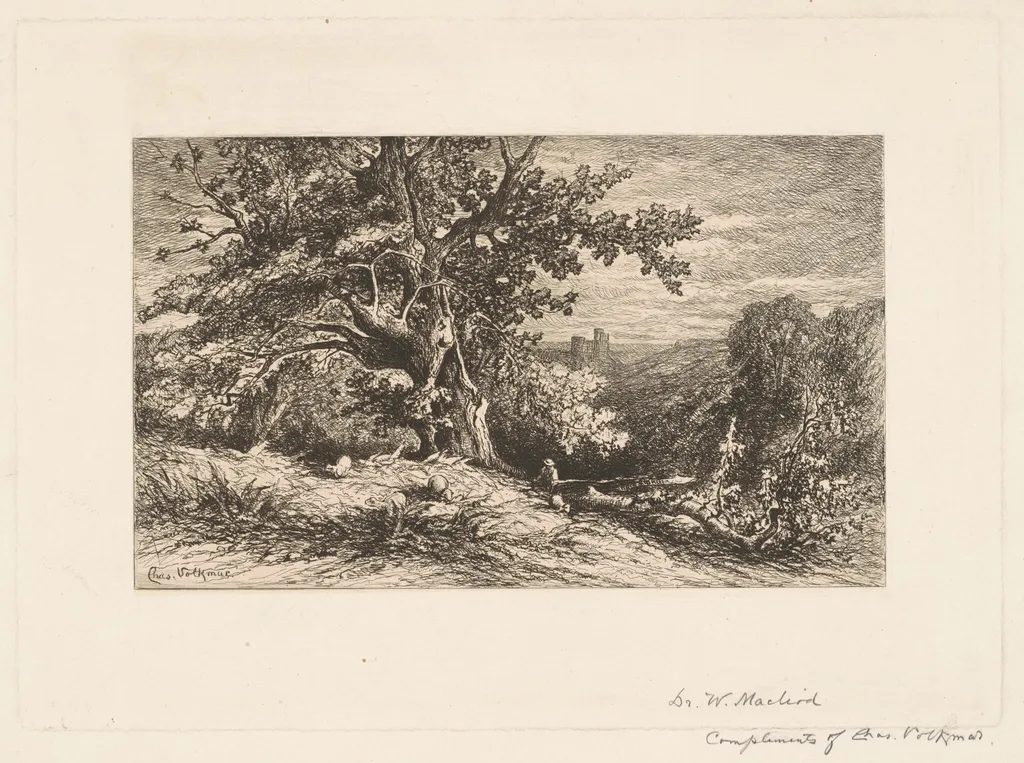
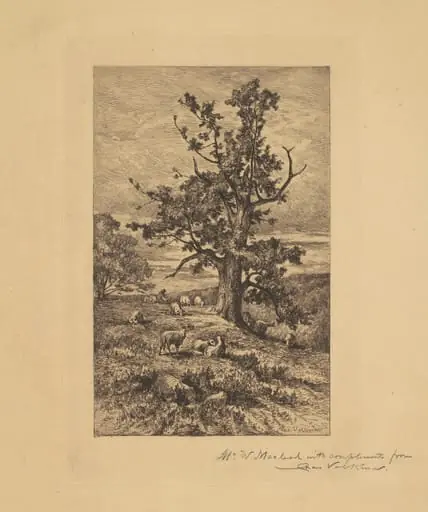
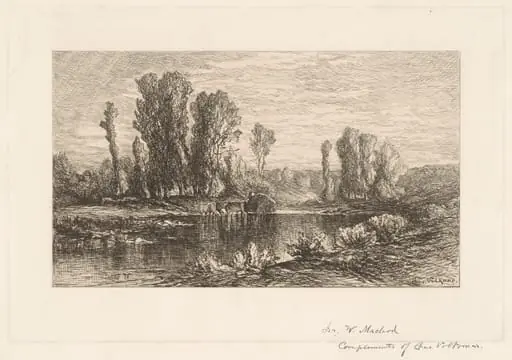
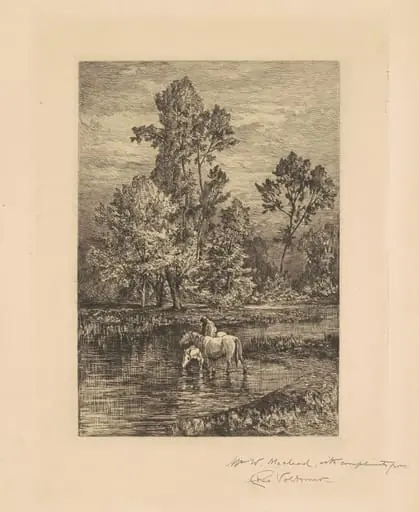
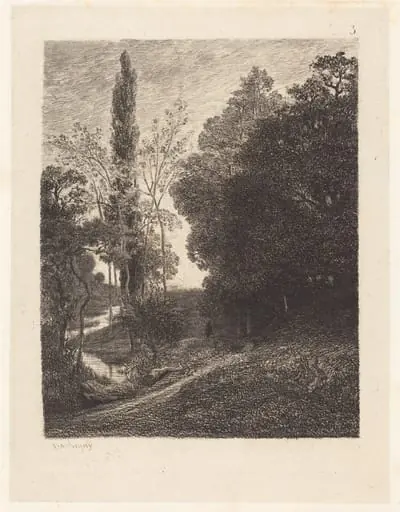
Landscape with Fallen Tree is an ink print by the Impressionist artist Charles Volkmar. It dates from 1875 and is held in the collection of the National Gallery of Art.
- Inscription
- Inscribed:lower left in plate: Chas. Volkmar.; lower left edge in graphite: Accepted in the Salon of 1875.; lower right edge in graphite: Dr. W. Macleod / Compliments of Chas. Volkmar.
About this work
Overview
In the background, a small architectural structure, possibly a tower or cottage, emerges subtly through the foliage, adding depth to the forest setting.
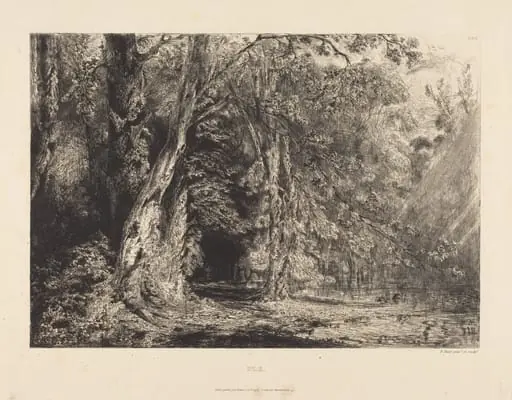
Charles Volkmar's 'Landscape with Fallen Tree,' created in 1875, is an etching in black on wove paper that captures a dense, wooded scene dominated by a massive uprooted tree spanning a stream. The composition centers on the fallen trunk, whose thick, gnarled branches create a complex network of lines against the sky, while the water below is rendered with fine strokes to suggest shallow currents rushing around the exposed roots. In the background, a small architectural structure, possibly a tower or cottage, emerges subtly through the foliage, adding depth to the forest setting.
Two diminutive figures stand near the water's edge, providing a sense of scale and emphasizing the grandeur of the natural elements. This work reflects Volkmar's engagement with the American landscape tradition during the late 19th century, showcasing his skill in translating the textures of nature into the linear medium of etching. The piece exemplifies the artist's focus on detailed observation and atmospheric rendering, contributing to his reputation as a significant printmaker of his era.
Subject & Meaning
The work captures a moment of natural disruption, the overturned trunk suggesting both the passage of time and the impact of environmental forces. The presence of human figures and a distant building introduces a subtle dialogue between humanity and the untamed forest.
Technique & Style
Executed entirely in black on wove paper, the image relies on intricate line work to convey texture, rough bark, tangled foliage, and rippling water. Volkmar employed the etching process, incising the design onto a metal plate and then printing the reversed image, achieving a range of tonal values without color.
History & Provenance
Created in 1875, the print reflects the 19th‑century European interest in detailed landscape studies. While specific ownership records are limited, the piece is documented as part of Volkmar’s printed oeuvre, illustrating his engagement with the etching medium during that period.
Own this work as a print
Artist & collection