Artwork
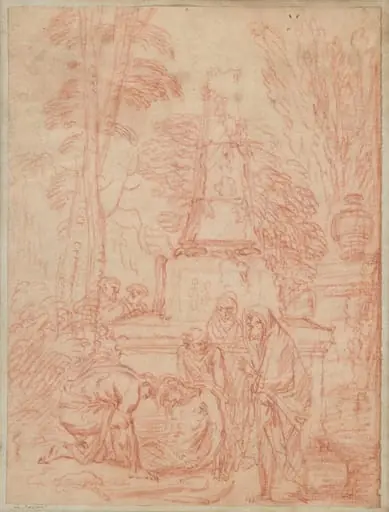
Children Parodying a Triumph of Bacchus
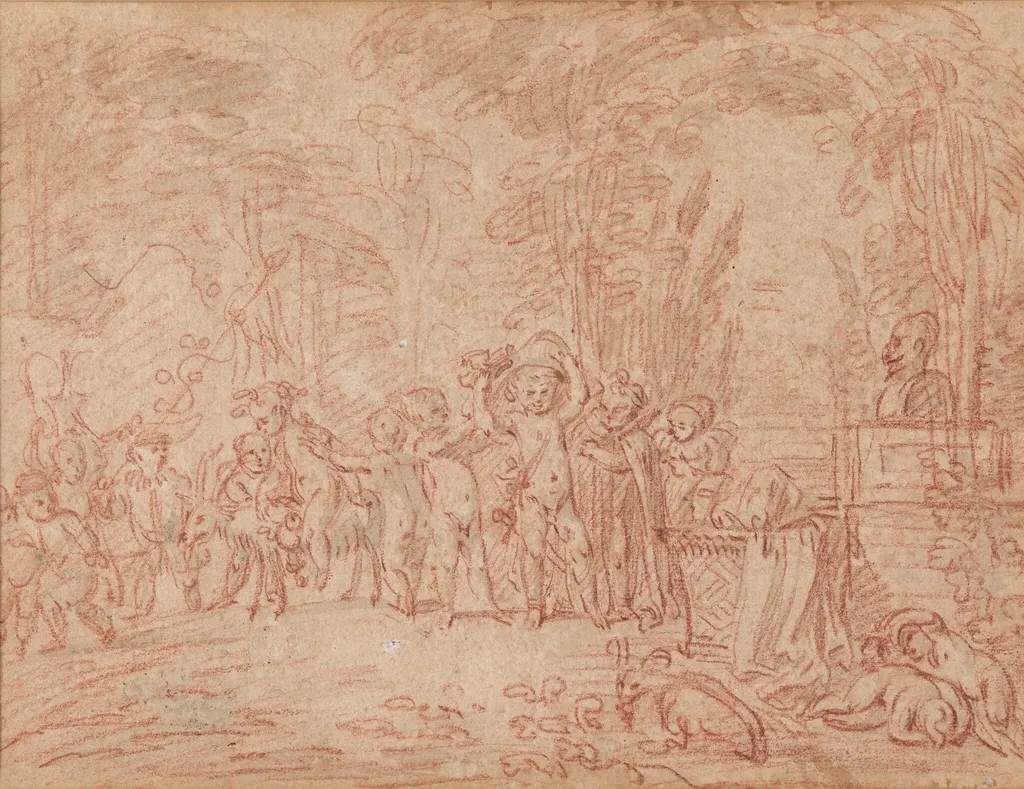
Children Parodying a Triumph of Bacchus is a chalk drawing by the Baroque artist Jean Antoine Watteau. It dates from 1708 and is held in the collection of the National Gallery of Art.
- Inscription
- Inscribed:by later hand, verso in brown ink: près Paris en 1721
About this work
Overview
The work depicts a group of children enacting a playful, miniature version of a classical triumphal procession associated with Bacchus, the Roman god of wine.
Created in 1708, Children Parodying a Triumph of Bacchus is a red chalk drawing with gray wash on laid paper by Antoine Watteau. The work depicts a group of children enacting a playful, miniature version of a classical triumphal procession associated with Bacchus, the Roman god of wine. Rather than a formal mythological narrative, the composition focuses on the spontaneous energy and theatricality of the children, who assume various poses and interact with one another while holding symbolic objects.
Watteau employs his characteristic fluid line and subtle tonal modeling to suggest movement and volume without detailed backgrounds, allowing the figures to dominate the visual field. This early work demonstrates Watteau's emerging interest in the fusion of classical themes with contemporary, genre-like observations of human behavior. It serves as a precursor to his later, more famous fêtes galantes, where aristocratic figures often engage in similar playful, theatrical scenarios in pastoral settings.
The drawing highlights the artist's mastery of the red chalk medium, a technique he would refine throughout his brief but influential career, bridging the rigid formalism of the French Academy with a more naturalistic and expressive approach to figure drawing.
Subject & Meaning
The composition gathers a group of youngsters engaged in a light‑hearted imitation of a Bacchic procession. Each child assumes a distinct pose, some clutching makeshift props, while others interact in a spontaneous, almost theatrical manner, suggesting a playful reinterpretation of the classical triumph of the wine god.
Technique & Style
Watteau employs a delicate red chalk line that defines the figures, overlaid with a subtle gray wash to model volume and suggest atmospheric depth. The contrast between the warm chalk and cool wash creates a modest chiaroscuro effect, while the minimal background hints at an outdoor setting without distracting detail.
History & Provenance
The drawing emerged in the early eighteenth century, a period when Watteau frequently explored mythological themes in informal sketches. It entered the National Gallery of Art’s holdings through a 20th‑century acquisition, though earlier ownership records remain sparse.
Context
Watteau’s oeuvre often juxtaposes aristocratic subjects with scenes of everyday merriment. This drawing reflects his interest in merging classical iconography with the innocence of childhood, a motif that resonated with contemporary French tastes for elegant yet whimsical representations.
Legacy
Although not as widely reproduced as his oil paintings, the sketch illustrates Watteau’s skill in drawing and his capacity to infuse mythic subjects with a sense of immediacy. It continues to be cited in studies of his preparatory works and his approach to narrative drawing.
Own this work as a print
Artist & collection
Artist
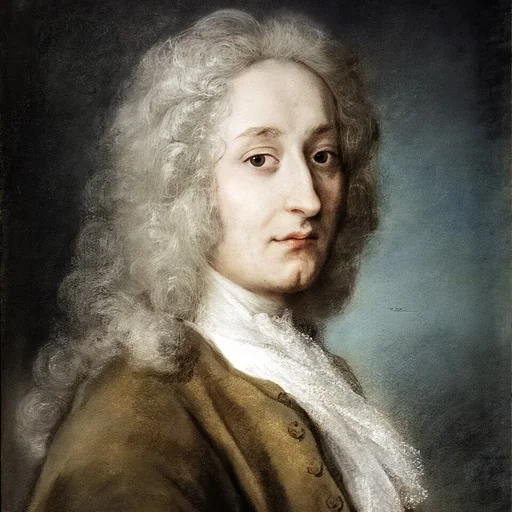
Jean-Antoine Watteau was a French painter and draughtsman whose brief career spurred the revival of interest in colour and movement, as seen in the tradition of Correggio and Rubens.

 The Adoration of the Magi
 Landscape with Elisha Mocked
![The Adoration of the Magi [recto], by Donato Creti](https://artifactworldgallery.com/img/donato-creti--the-adoration-of-the-magi-recto--2cfd5d76b55e821e-w320.webp) The Adoration of the Magi [recto]
The Adoration of the Magi [recto] Crucifixion of Saint Peter
 A Fête Galante with Falconers
 A Bishop Blessing a King
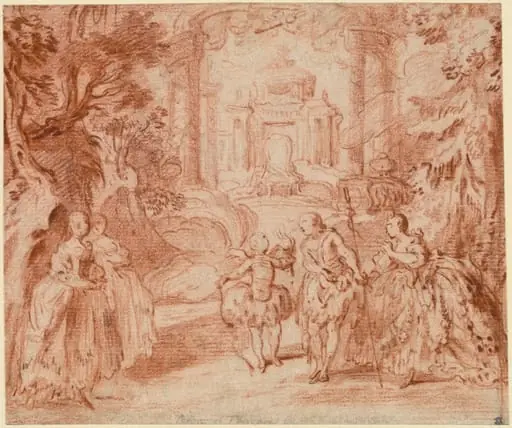 The Divertissement from Voltaire's "La princesse de Navarre"
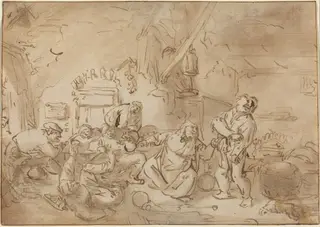 Brawl in an Inn
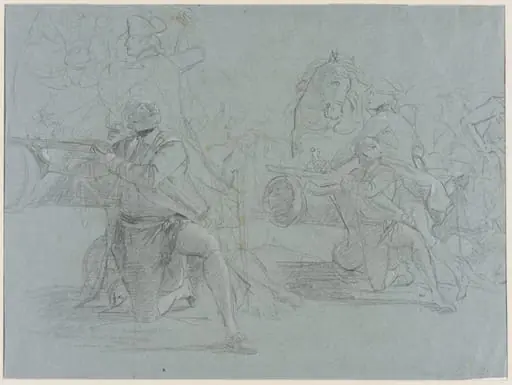 Study for 'The Siege of Gibraltar'
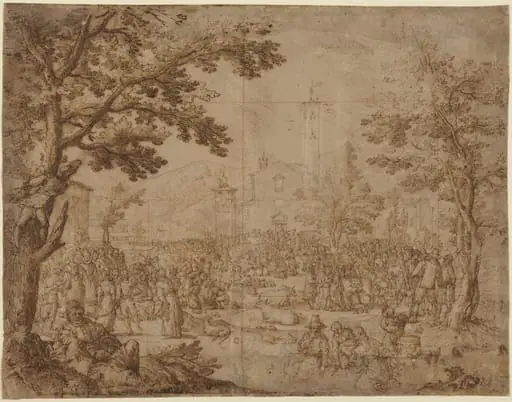 The Fair at Impruneta
- Bacchanal with Children and Chariot
 Tobit Burying the Dead