Artwork
A scholar in his study
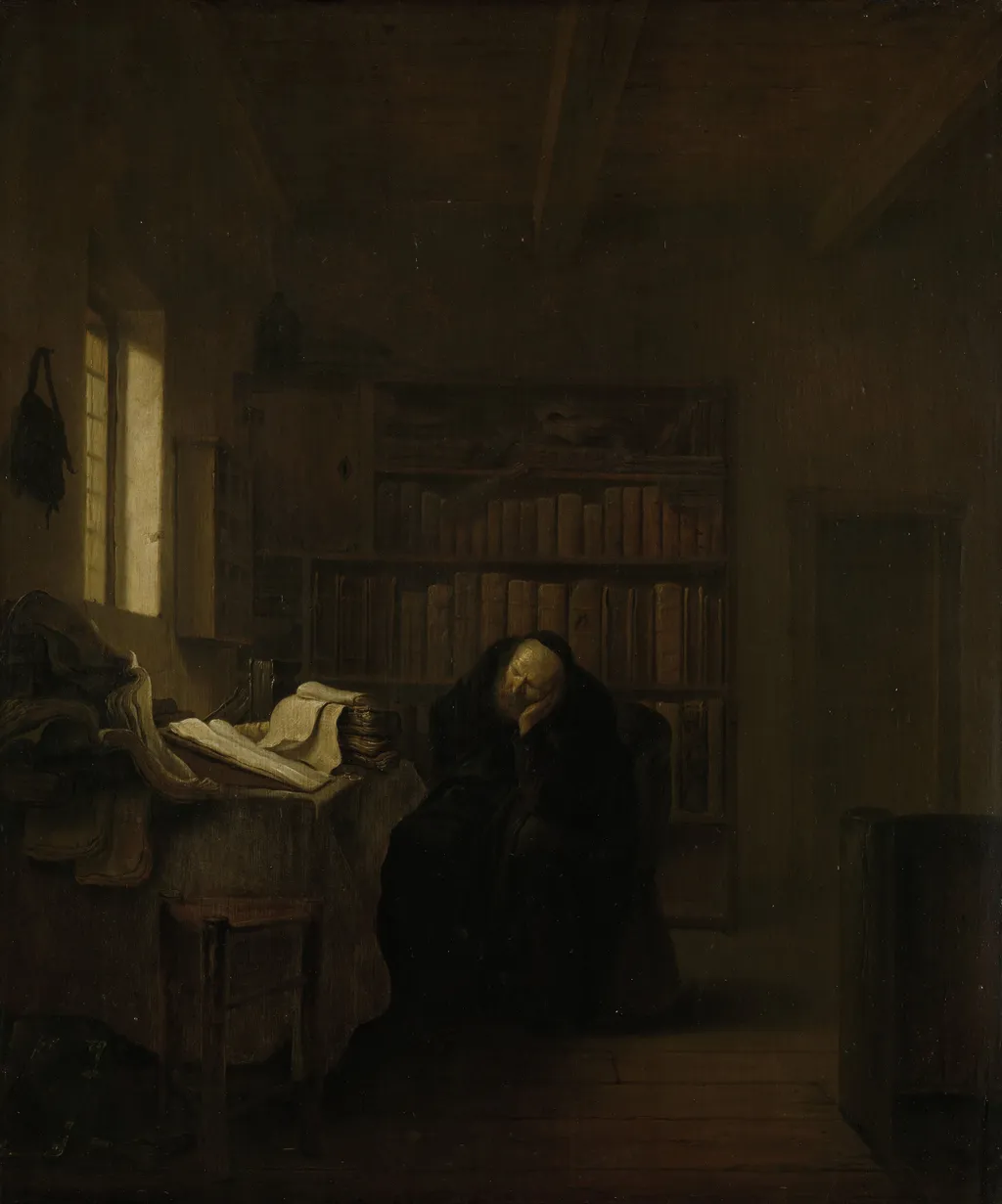
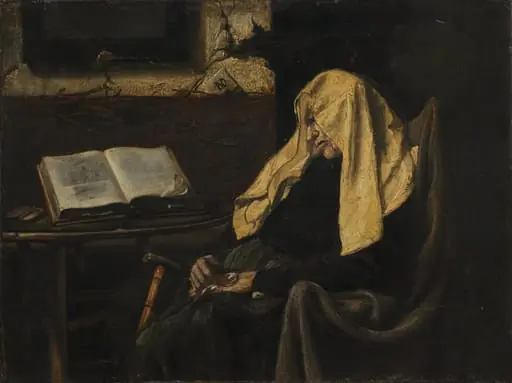
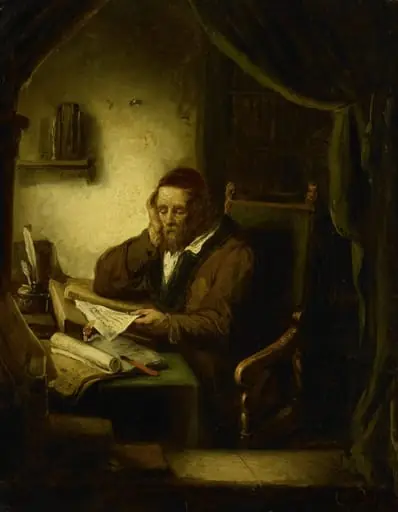
A scholar in his study is an oil painting by the Dutch Golden Age artist Willem de Poorter. It dates from 1645 and is held in the collection of the Rijksmuseum.
About this work
Subject & Meaning
The work was initially attributed to Cornelis Bega in 1808, later reassigned to Salomon Koninck in 1887, and finally to Hendrick Martensz.
The painting portrays an elderly scholar in a black tabbaard and kalotje, garments typical of 17th-century academic dress. He rests his head on his left arm with eyes closed, surrounded by books, papers, and a magnifying glass on the table. A bookcase filled with volumes stands against the wall, and a staircase leads downward in the lower right. The subject embodies scholarly contemplation and the pursuit of knowledge, symbolized by the books and reading tools.
The work was initially attributed to Cornelis Bega in 1808, later reassigned to Salomon Koninck in 1887, and finally to Hendrick Martensz. Sorgh in 1999 based on stylistic analysis. Art historian Werner Sumowski supported this attribution to Willem de Poorter, which the Rijksmuseum endorses. The subject reflects the intellectual archetype common in Dutch Golden Age art, emphasizing learning and introspection.
Technique & Style
Created in 1645, this work is executed in oil paint on a panel support, measuring 41 cm in height and 34 cm in width. The painting depicts an elderly scholar wearing a black robe and cap, seated with his head resting on his left arm. The composition includes a table laden with numerous books and papers, a pair of pince-nez spectacles, and a bookcase against the wall.
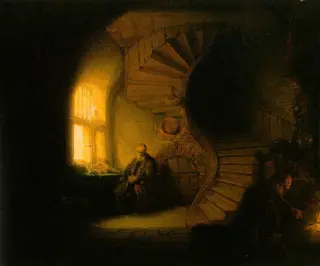
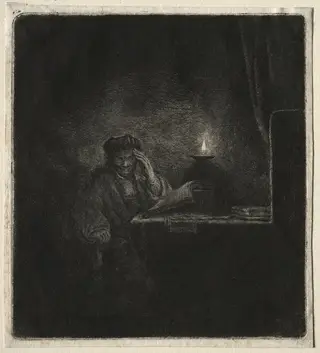
Stylistically, the work is characterized by a brown interior palette reminiscent of the style of Rembrandt. The handling of the scene draws comparisons to Rembrandt's Meditating Philosopher and the Parable of the Rich Fool, particularly in the arrangement of open books. While the attribution has shifted historically from Cornelis Bega to Salomon Koninck and Hendrick Martensz. Sorgh, the Rijksmuseum currently accepts the attribution to Willem de Poorter.
History & Provenance
Painted in 1645, this work originated from the collection of the Rotterdam collector Gerrit van der Pot. The Rijksmuseum acquired the painting on June 6, 1808, purchasing it at the estate auction of Van der Pot held in Rotterdam. Upon its acquisition, the piece was attributed to Cornelis Bega.
Subsequent art historical analysis led to reattributions; in 1887 it was assigned to Salomon Koninck, and in 1999 Fred Meijer suggested Hendrick Martensz. Sorgh as the creator. The Rijksmuseum currently recognizes the attribution to Willem de Poorter, a view supported by Werner Sumowski. Between 2004 and 2008, the painting was loaned to the Rembrandthuis during renovations at the Rijksmuseum.
The painting is held in the collection of the Rijksmuseum in Amsterdam. It entered the museum's holdings on June 6, 1808, purchased at the estate auction of the Rotterdam collector Gerrit van der Pot. At the time of acquisition, the work was attributed to Cornelis Bega, though later scholarship reattributed it first to Salomon Koninck in 1887, then to Hendrick Martensz. Sorgh in 1999, and finally to Willem de Poorter, which is the current accepted attribution.
Due to renovations at the Rijksmuseum, the artwork was on loan to the Rembrandthuis from 2004 until 2008.
Context
Acquired by the Rijksmuseum in 1808 from the collection of Gerrit van der Pot, the painting was initially attributed to Cornelis Bega due to its brown interior tones. Scholars later noted its stylistic affinity with Rembrandt, specifically comparing the composition to the Meditating Philosopher in the Louvre and the Parable of the Rich Fool in Berlin. In 1887, the work was re-attributed to Salomon Koninck, a known follower of Rembrandt who frequently depicted scholars.
Attribution shifted again in 1999 when Fred Meijer assigned it to Hendrick Martenszoon Sorgh. Currently, the museum accepts the assessment of Werner Sumowski, who identified Willem de Poorter as the creator. Between 2004 and 2008, the panel was loaned to the Rembrandthuis during museum renovations.
Overview
A Scholar in His Study is a 1645 oil painting by Willem de Poorter, depicting a contemplative scene of a learned individual immersed in his surroundings. Now part of the Rijksmuseum's collection, the work exemplifies the Dutch Golden Age's penchant for intimate, everyday genre scenes.
Legacy
While specific influences or direct artistic descendants of 'A Scholar in His Study' are not highlighted in the provided information, the painting contributes to the broader legacy of Dutch genre painting, influencing subsequent depictions of everyday life and intellectual themes in art.
Own this work as a print
Artist & collection