Artwork
Carriages Waiting
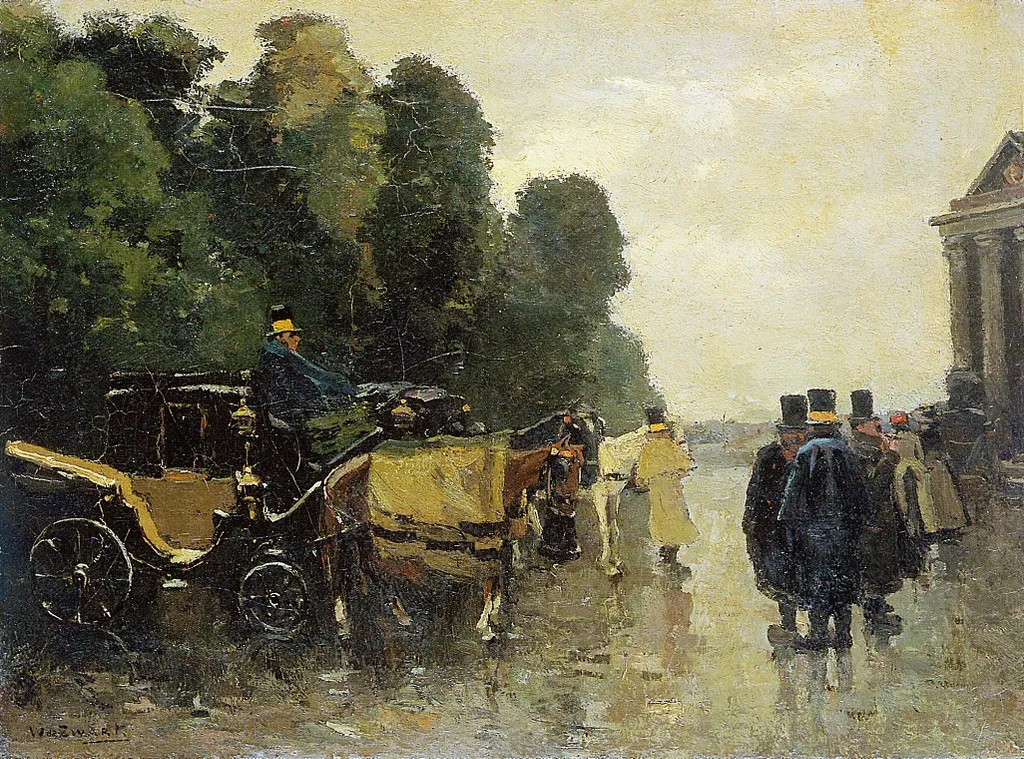
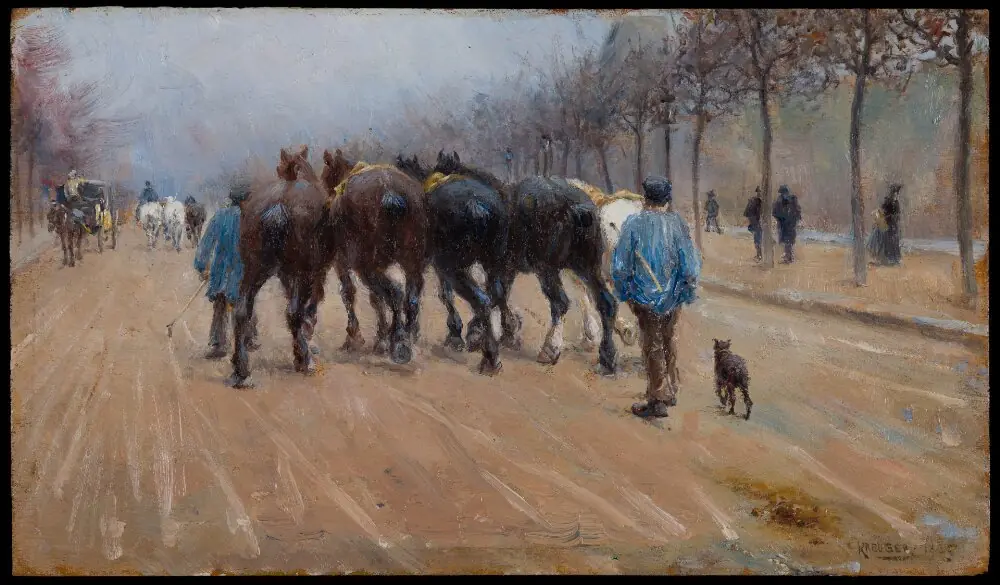
Carriages Waiting is an oil painting by the Amsterdam Impressionist artist Willem de Zwart. It dates from 1896 and is held in the collection of the Rijksmuseum.
About this work
Subject & Meaning
Recent analysis identifies the specific location as the Bosbrug near the Malieveld, rather than previously assumed sites like the State Railway station.
The painting depicts a group of coachmen waiting for passengers on a rainy day in The Hague, set against a backdrop of tall trees. While coachmen typically wore colorful attire that earned them the nickname 'monkeys' in Amsterdam, here their garments are obscured by black rain capes, contributing to a somber and quiet urban atmosphere. The wet square reflects the figures and carriages, emphasizing the impressionistic technique and thick application of paint.
Recent analysis identifies the specific location as the Bosbrug near the Malieveld, rather than previously assumed sites like the State Railway station. The building visible on the right is 'het Wachtje,' a nineteenth-century guardhouse that served as a northern entrance to the city before its destruction during World War II. The work captures a distinctly Dutch sense of melancholy, contrasting with the bustling street scenes painted by contemporaries.
Technique & Style
Carriages Waiting is an oil painting executed on canvas, measuring 31.5 by 43 centimeters. Willem de Zwart applied oil paint in a loose impressionistic manner, using thickly laid pigment to convey a damp, tranquil urban scene. The work depicts several carriage drivers in raincoats beneath trees, their figures rendered with muted tones and a sense of melancholy typical of De Zwart’s style.
Contemporary analysis notes the location as the Bosbrug near the Malieveld, identified through the presence of the historic Wachtje shelter, and emphasizes the artist’s careful preparatory studies, including a more detailed watercolor version that accentuates the falling rain.
The painting belongs to the Amsterdam Impressionism movement and reflects De Zwart’s focus on everyday moments, distinguishing his approach from contemporaries such as George Hendrik Breitner, who favored more dynamic street scenes.
History & Provenance
Willem de Zwart created the oil painting Carriages Waiting (also known as Rijtuigen met wachtende koetsiers) on canvas between approximately 1890 and 1894. The work was produced during the artist's residency at Beeklaan in Loosduinen, near The Hague, a period where he focused extensively on scenes of stationary carriages. While earlier assumptions placed the depicted scene at the State Station or near the theater, recent scholarship identifies the location as the Bosbrug bridge near the Malieveld, featuring a now-demolished guardhouse known as 'het Wachtje'.
The composition was meticulously prepared through earlier studies, including an 1889 watercolor titled Halte de voitures and a subsequent watercolor focusing on wet pavement reflections. The painting currently resides in the collection of the Rijksmuseum in Amsterdam.
The painting Carriages Waiting is held in the collection of the Rijksmuseum in Amsterdam. Also known by the Dutch titles Rijtuigen met wachtende koetsiers, Regendag, or Stationerende rijtuigen, the work measures 31.5 by 43 centimeters and depicts a rainy street scene. While the artist produced related watercolors of this subject as early as 1889, including one exhibited at the 1889 World's Fair in Paris, the provided sources do not list specific exhibition history for this particular oil version beyond its current museum residence.
Context
Carriages Waiting (1890) is an oil painting on canvas measuring 31.5 by 43 centimeters, created by Willem de Zwart during his residence at the Beeklaan in Loosduinen, part of the 'Loosduinse School' of artists. The work depicts horse-drawn carriages and waiting coachmen in rainy weather, reflecting the Amsterdam Impressionist movement and the artist's focus on everyday urban scenes. De Zwart's interest in station wagons was influenced by his father, a coach painter, and contemporaries such as Willem Witsen, and was shaped by his exposure to etching practices in The Hague.
The painting's location was identified as the Bosbrug near the Malieveld, once home to 'the Wachtje,' a 19th-century guardhouse that was demolished during World War II. A related watercolor study shows De Zwart's meticulous compositional preparation, emphasizing rain effects and atmospheric reflection. Scholarship highlights the piece as emblematic of De Zwart's melancholic, distinctly Dutch interpretation of impressionistic urban genre scenes, distinct from contemporaries like George Hendrik Breitner.
Overview
Created in 1896, Carriages Waiting is an oil on canvas by Dutch artist Willem de Zwart. The work portrays a city street after rain, populated by horse‑drawn carriages, pedestrians in coats and hats, and a line of trees beneath a pale sky. It belongs to the Rijksmuseum’s collection and exemplifies de Zwart’s transition from the Hague School toward the brighter palette of Amsterdam Impressionism.
Artist & collection
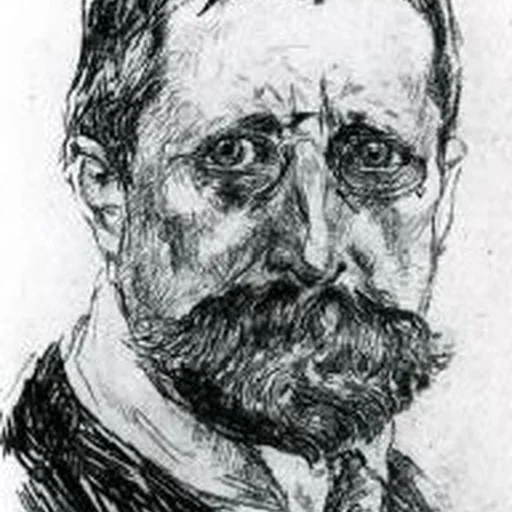
Artist
Wilhelmus "Willem" Hendrikus Petrus Johannes de Zwart (16 May 1862 – 11 December 1931) was a Dutch painter, engraver, and watercolorist with many connections to the Hague School and later associated with the Amsterdam Impressionism…