Movement
Cezannian cubism
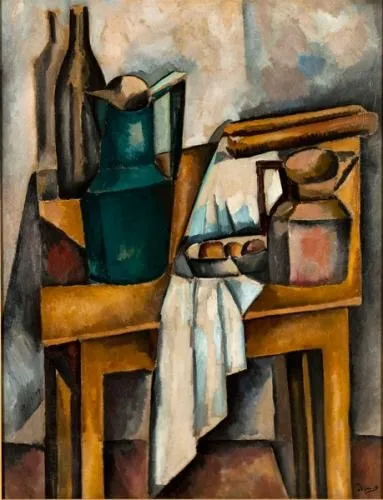
Cezannian cubism is an art movement of the 1900–1910 period. The gallery holds 2 works in this movement. Browse Cezannian cubism paintings, portraits, pictures and artworks from the world's public-domain museum collections.
Cézannian Cubism—also called early or "pre-" Cubism—designates the formative phase of the Cubist revolution, roughly 1907 to 1909, before the movement crystallised into its later Analytic and Synthetic stages. Its catalyst was the great Paul Cézanne memorial retrospective at the 1907 Salon d'Automne in Paris, which exposed a generation of young painters to the late master's vision shortly after his death in 1906. Equally galvanising was Cézanne's much-quoted advice, set down in a 1904 letter to Émile Bernard, to "treat nature by means of the cylinder, the sphere and the cone." Together with Picasso's brutal Les Demoiselles d'Avignon (1907), these stimuli pushed art away from Impressionist atmosphere toward a hard architecture of form.
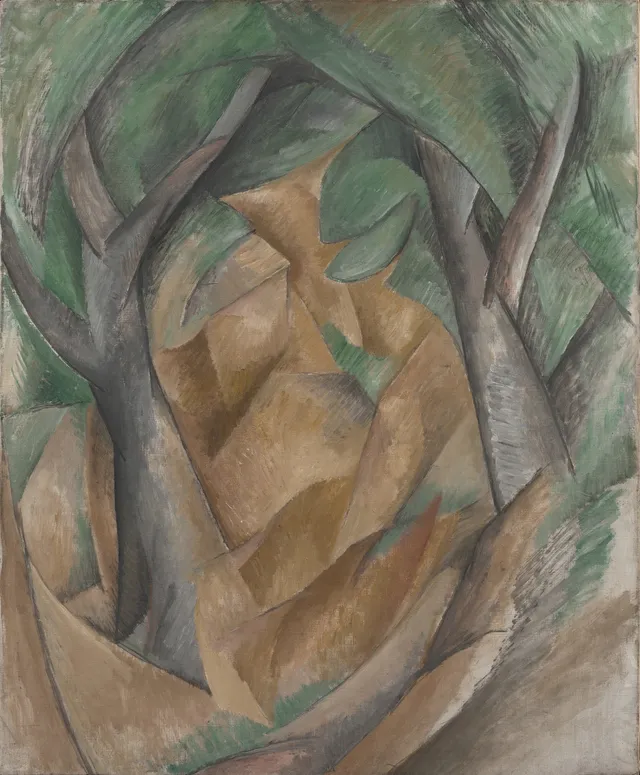
The phase is defined visually by the reduction of landscape, figure and still life to faceted geometric volumes—houses and trees rendered as shaded cubes, cylinders and pyramids—and by Cézanne's technique of passage, in which planes bleed into one another to flatten and compress pictorial depth. Palettes are deliberately austere, dominated by ochres, tans, muted greens and slate greys, subordinating colour to structure. Modelling gives way to the angled "constructive" brushstroke borrowed directly from Cézanne, so that a canvas reads as an interlocking scaffold of tilted facets rather than an illusionistic window.
The principal figures are Georges Braque and Pablo Picasso, who met through Guillaume Apollinaire in 1907 and entered an intense dialogue of mutual influence from 1908. Braque's landscapes painted at L'Estaque that summer—above all Houses at L'Estaque (1908)—are widely regarded as the first Cubist paintings; it was before such work that the critic Louis Vauxcelles, prompted by Matisse, sneered at Braque's "little cubes," inadvertently naming the movement. André Derain, briefly abandoning Fauvism for Cézanne's constructivism around 1908, contributed proto-Cubist landscapes and still lifes. Our catalogue holds two characteristic examples of this moment: Braque's Trees at l'Estaque and Derain's Nature morte à la table.
Cézannian Cubism proved a brief but decisive overture. By 1909 Braque and Picasso had tightened its faceting into the fractured, monochrome grammar of Analytic Cubism, and ultimately Synthetic Cubism and collage. As the bridge between Post-Impressionism and full Cubism, it remains the indispensable first chapter of twentieth-century abstraction.
Works
Frequently asked questions
What is Cezannian cubism?
Cezannian cubism is an art movement. The transitional phase (roughly 1907–1909) in which Picasso and Braque moved toward Cubism under the direct influence of Cézanne's late faceted planes and multiple viewpoints.
When did Cezannian cubism take place?
Cezannian cubism dates from 1900–1910.
Where can I see Cezannian cubism works?
Cezannian cubism works in the collection are held by Musée d'art moderne de Paris and Statens Museum for Kunst.