Movement
Proto-Cubism
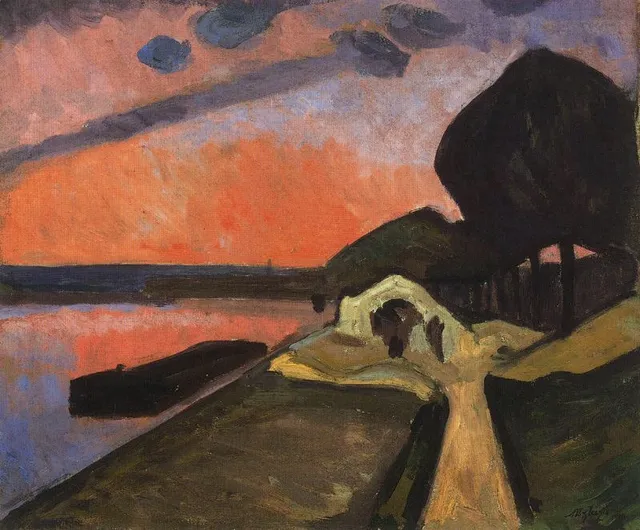
Proto-Cubism is an art movement of the 1906–1910 period. The gallery holds 1 work in this movement. Browse Proto-Cubism paintings, portraits, pictures and artworks from the world's public-domain museum collections.
Proto-Cubism — also called Précubisme, pre-Cubism, or early Cubism — names the transitional phase, roughly 1906 to 1910, during which a loose circle of Parisian painters moved away from the bright, expressive surfaces of Post-Impressionism and Fauvism toward a radical geometrization of form. It was less a coherent program than a shared search for structure, and its single most important catalyst was Paul Cézanne. Retrospectives of his work at the Salon d'Automne in 1904, 1905 and 1906, followed by two memorial exhibitions after his death in 1907, broadcast his conviction that nature should be treated in terms of the cylinder, the sphere and the cone. That lesson — that a painting could expose the underlying architecture of things rather than merely their appearance — became the seed of everything that followed.
The style is recognizable by its faceting of objects into angular, blocky planes, its compression of classical perspective, and its deliberately muted palette, a calculated retreat from Fauvist colour. Two further sources sharpened the break: the stylized, almond-eyed severity of ancient Iberian sculpture, and the abstracted geometry of African masks, which Picasso encountered in Paris around 1906. The decisive monument is Picasso's Les Demoiselles d'Avignon (1907), whose splintered bodies and mask-like faces shattered Renaissance space; Georges Braque pursued a parallel path in landscapes such as those painted at L'Estaque.
The term embraces a wide cast. Beyond Picasso and Braque, it includes Jean Metzinger, Albert Gleizes, Henri Le Fauconnier, Robert Delaunay, Fernand Léger and Juan Gris — figures who would soon form the public 'Salon Cubist' wing. Gleizes, drawing on Cézanne, Symbolism and the Pont-Aven painters, produced characteristic early works such as The Banks of the Marne (Bords de la Marne, 1909, now in the Museum of Fine Arts of Lyon, and held in this catalogue), in which riverside motifs are reduced to simplified, clearly constructed masses.
Proto-Cubism's significance is essentially generative: it was the laboratory in which the vocabulary of fracture, multiple viewpoints and structural analysis was first tested. From it emerged full Cubism, conventionally dated to spring 1911, which split into the dense Analytic phase and the later Synthetic phase, and which in turn seeded Orphism, Futurism, and much of the geometric abstraction that defined twentieth-century art.
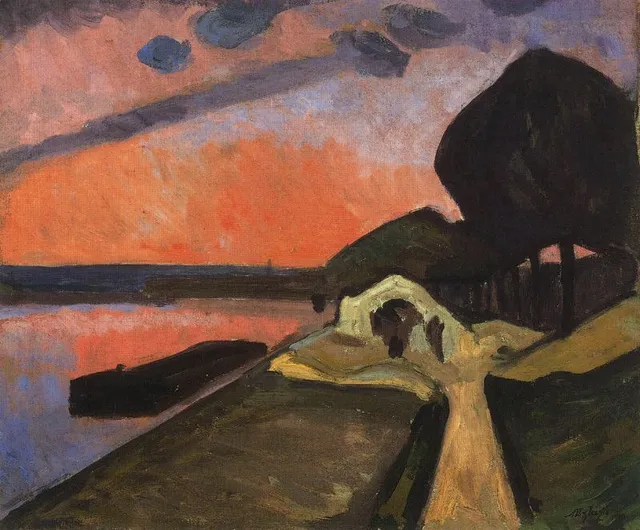
Works
Frequently asked questions
What is Proto-Cubism?
Proto-Cubism is an art movement. The transitional moment in Picasso's and Braque's work (roughly 1906–1909) that moved from Post-Impressionist influence — above all Cézanne — toward the fractured planes of Analytic Cubism.
When did Proto-Cubism take place?
Proto-Cubism dates from 1906–1910.
Where can I see Proto-Cubism works?
Proto-Cubism works in the collection are held by Museum of Fine Arts of Lyon.