
Movement
Art Nouveau
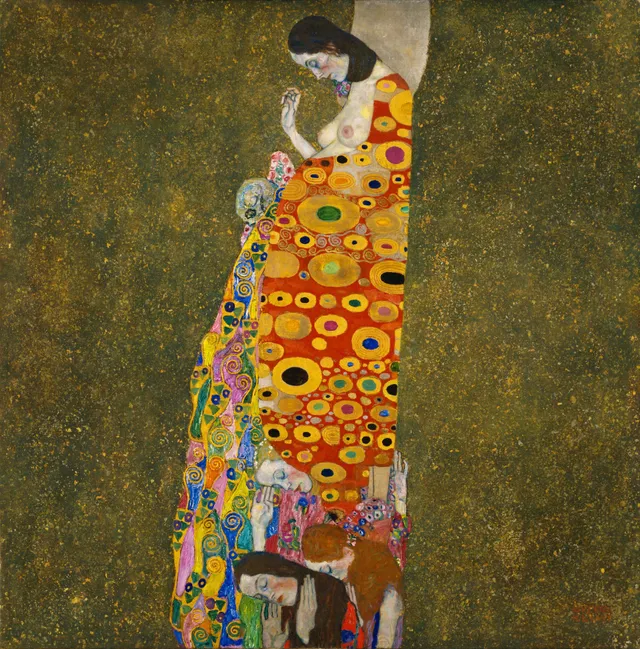
Art Nouveau is an art movement of the 1880–1910 period. The gallery holds 1 work in this movement, including works by Alphonse Mucha, John White Alexander and Félix Vallotton. Browse Art Nouveau paintings, portraits, pictures and artworks from the world's public-domain museum collections.
Art Nouveau was an international philosophy and style of art, architecture and applied art that flourished from roughly the early 1890s to the outbreak of the First World War. It arose as a deliberate revolt against nineteenth-century academic historicism and the cheapened products of industrial mass manufacture. Its intellectual roots lay in the English Arts and Crafts movement, whose champion William Morris insisted on artisanal quality and stylised organic ornament; on the Continent these ideals fused with the expressive line of Paul Gauguin and Henri de Toulouse-Lautrec and the flattened, asymmetrical compositions of Japanese ukiyo-e prints. The movement took its name from the Maison de l'Art Nouveau, the Paris gallery Siegfried Bing opened at 22 rue de Provence on 26 December 1895, though the term had circulated in the Belgian journal L'Art Moderne as early as 1884.
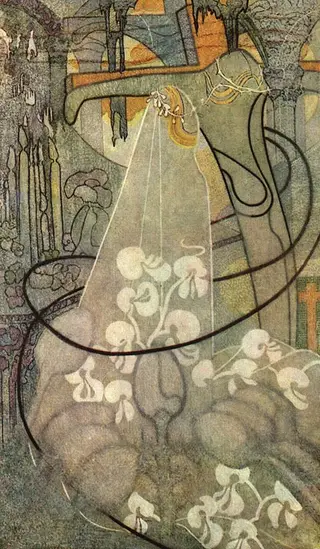
The style is instantly recognisable by its undulating, asymmetrical "whiplash" line, drawn from flower stalks, vine tendrils, insect wings and flowing hair. Practitioners rejected the hierarchy that ranked painting and sculpture above the decorative arts, pursuing instead a Gesamtkunstwerk in which architecture, furniture, glass, metalwork and graphics formed a unified whole. Victor Horta's Hôtel Tassel in Brussels (1893), with its exposed iron, light-flooded interior and vegetal wrought-iron columns, is widely regarded as the first true Art Nouveau building.
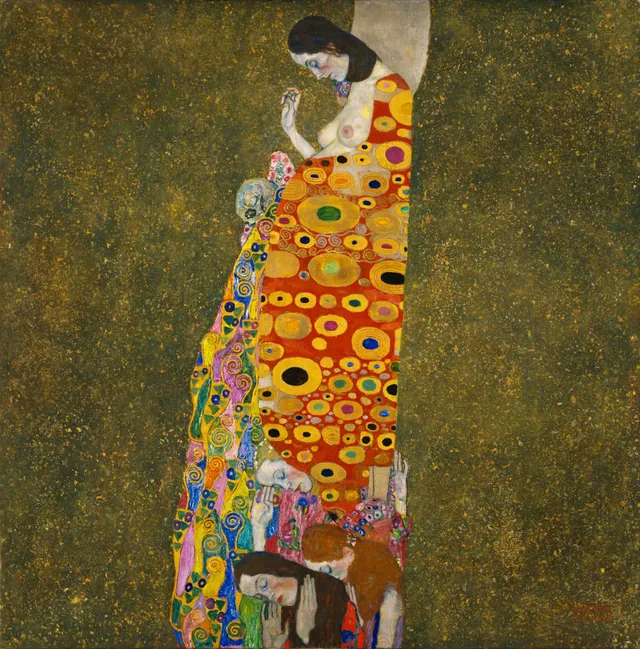
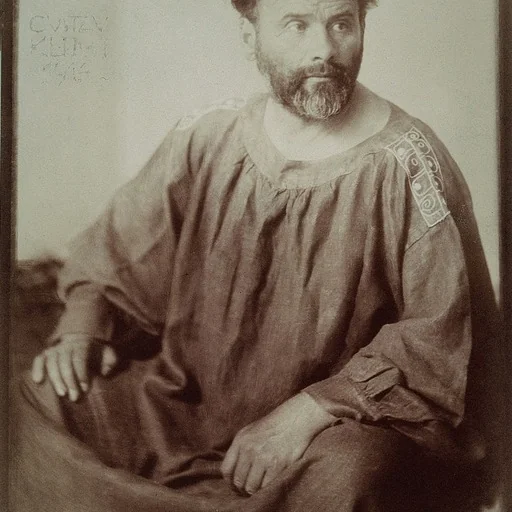
The movement was at once cosmopolitan and intensely regional, acquiring different names: Jugendstil in Germany, Secessionsstil in Austria, Modernisme in Catalonia, Stile Liberty in Italy and the "Tiffany style" in the United States. Its canonical figures span disciplines and nations — Hector Guimard, whose sinuous cast-iron Paris Métro entrances became civic emblems; Antoni Gaudí in Barcelona; the Glasgow designer Charles Rennie Mackintosh; the Czech poster-maker Alphonse Mucha, whose 1895 Gismonda for Sarah Bernhardt launched the decorative "Mucha style"; Louis Comfort Tiffany, whose iridescent Favrile glass (trademarked 1894) defined American taste; and Gustav Klimt, leader of the Vienna Secession, represented in this collection by Hope II (1907–08).
By 1914 the style's labour-intensive ornament had fallen from fashion, eclipsed by the geometric rationalism that led toward Art Deco and modernism. Yet Art Nouveau's insistence on total design, its dignifying of the applied arts, and its embrace of new materials left a lasting imprint on twentieth-century design and graphic art.
Key artists


Works
Groups & collectives
Frequently asked questions
What is Art Nouveau?
Art Nouveau is an art movement. The German-speaking countries' variant of Art Nouveau, named after the Munich magazine Jugend ('Youth') founded in 1896.
Who are the key Art Nouveau artists?
Key Art Nouveau artists in the collection include Alphonse Mucha, John White Alexander and Félix Vallotton.
When did Art Nouveau take place?
Art Nouveau dates from 1880–1910.
Where can I see Art Nouveau works?
Art Nouveau works in the collection are held by Museum of Modern Art.