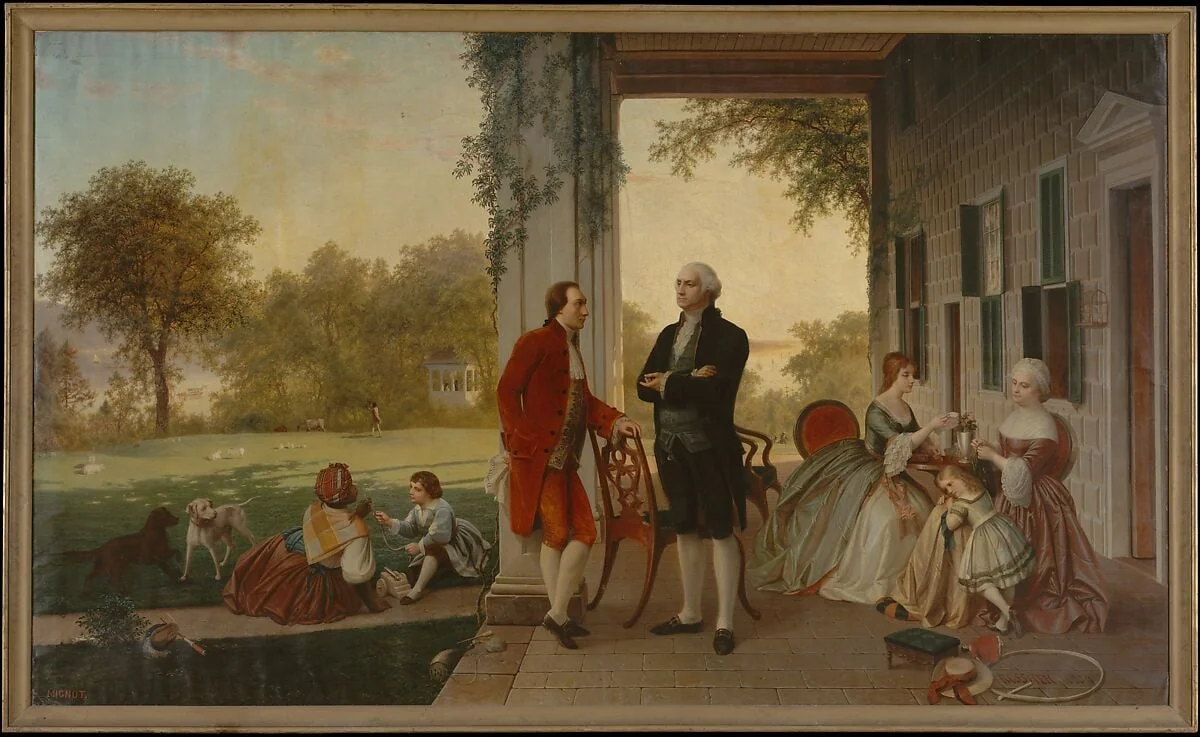
History painting was never a neutral record of the past. It was an argument made in oil, addressed to viewers who could read its signs the way we read a road. A raised arm, a Roman fold of cloth, a broken column, a particular sword held a particular way: each carried a fixed meaning that the first audience decoded in seconds and that we now have to reconstruct like a dead grammar. The thesis of this essay is simple and, I think, easy to lose under the genre's reputation for grandeur. These pictures were instruction before they were decoration. Their power lived not in their size or their subject but in a shared vocabulary of gesture, attribute, and reference that bound painter and public into one act of recognition.
Strip that vocabulary away and the grand machines go quiet. We stand in front of a man drinking from a cup and see a sad old philosopher; the first viewers saw an entire ethics of the citizen, a model for how to die when the state has wronged you. That gap is the subject here. I want to argue that the meaning of a history painting was a transaction completed in the viewer, not a property fixed in the canvas, and that the genre's whole apparatus of pose and emblem existed to make that transaction reliable. When the code was working, a painting could do the work of a sermon or a statute. When painters started bending the code, as Benjamin West did in 1770, the change registered as a small public scandal, which tells you exactly how seriously the first viewers took the rules.
A grammar the first audience could read
Begin with the word. The term was introduced by the French Royal Academy in the seventeenth century, and the French histoire carried the older sense of story rather than our narrower idea of documented chronology (Tate). A history painting told a story with a moral charge: scripture, myth, the lives of saints, the deeds of the ancient republics. What made it the supreme exercise of the art was its demand for many figures arranged in significant action, each legible, each contributing to a single argument. The idea predates the Academy by two centuries. Leon Battista Alberti, writing in the 1430s, called the multi-figure narrative the istoria and held it to be the greatest work of the painter, because composing it well required mastery of every lesser skill at once (Wikipedia).
Legibility was the whole game. A figure became readable through attributes: keys for Peter, a wheel for Catherine, an eagle for Jupiter, scales for Justice. Gesture carried tone. An arm flung outward in a diagonal meant alarm or command; a hand laid flat on the breast meant fidelity or grief; a downturned torch at the edge of a scene meant a life going out. These were not the painter's private inventions. They were public property, taught in academies, repeated across thousands of prints, fixed in handbooks that told an artist precisely how to render terror, supplication, or resolve. A buyer in 1750 who knew none of the Latin behind a Roman subject could still parse the scene from its choreography, because the choreography was standardized. The first viewers were not passive admirers of skill. They were practiced readers, and the painter wrote for them.
Why it sat at the top of the ladder
By the time the Académie Royale de Peinture et de Sculpture was founded in 1648, the ranking of the genres was settled across Europe. History painting stood highest, then portraiture, then scenes of daily life, then landscape, then still life at the bottom. The logic was openly stated: the higher you climbed, the more the work depended on invention and the less on mere copying of what sat in front of you. Still life ranked low because it asked only for accurate observation; history ranked high because it asked the painter to stage an event no eye had witnessed and make a crowd believe it (Metropolitan Museum of Art). This was a hierarchy of difficulty dressed as a hierarchy of dignity, and it set the terms of ambition for two hundred years.
In Britain the case was made most loudly by Joshua Reynolds, whose Discourses to the Royal Academy laid out a "grand style" in which the painter generalized away the accidental and the particular to reach a noble, permanent idea of the human form (Internet Archive). The irony is sharp. Reynolds preached history painting and earned his fortune painting portraits, because the British market wanted faces, not the death of Germanicus. The hierarchy was an article of faith that the economy quietly contradicted, and that tension is the hinge on which the genre turned in the eighteenth century. The grand machines carried the most prestige and sold the worst. Something had to give.
Modern dress and the breaking of the code
What gave was the convention that great subjects required ancient costume. In 1770 Benjamin West exhibited The Death of General Wolfe, showing the British commander dying at Quebec in 1759, eleven years earlier, and he put his figures in the red coats and gorgets they had actually worn (Smarthistory). Reynolds reportedly warned him off it. The grand style demanded the timeless toga; modern buttons would drag the scene down into reportage. West kept the buttons and kept the grandeur, and he did it by smuggling the old code in under the new clothes. Wolfe sinks back into the arms of his officers in the exact pose of a Christian Deposition, the lifeless body of a martyr lowered from the cross. The first viewers read the borrowed composition instantly. A general becomes a saint of empire; a colonial skirmish becomes a sacrifice.
This is the crucial point about iconography and its first audience. West did not abandon the language. He proved how portable it was. By transplanting the visual grammar of religious painting onto a contemporary battlefield, he showed that the sacred connotations lived in the arrangement of bodies, not in the nominal subject, and that a painter could move those connotations onto whatever a nation wished to sanctify. The picture was a sensation, endlessly engraved, and West rode it to the presidency of the Royal Academy, which he held from 1792 until his death (National Gallery of Art). The lesson was not lost on the next century of painters, least of all the Americans, who had a new republic to furnish with scripture and no ancient past to borrow it from.
An American scripture in modern coats
A young United States needed founding images, and it built them on West's discovery. The most famous is Emanuel Leutze's Washington Crossing the Delaware, painted in Düsseldorf in 1851 for a German audience as much as an American one. Almost nothing in it is factually accurate. The boat is the wrong type, the flag had not yet been adopted, the river ice looks Rhenish, and no commander stands upright in a small craft in a December current. Leutze knew all of this. He was not reporting a crossing. He was building an icon, and every wrong detail is a correct symbol. Washington stands because standing means resolve; the light breaks ahead of the boat because dawn means the new order; the men at the oars are a deliberate cross-section of the young nation, so that the viewer reads not a raid but a people. The first audiences wept in front of it. They were reading the argument, and the argument was that the republic was born of disciplined courage against long odds.
The same impulse runs through smaller, stranger works. Thomas Chambers's The Constitution and the Guerriere turns a War of 1812 naval duel into a heraldic emblem of national arrival, the American frigate riding high and intact while the British ship founders, the sea itself stylized into decorative scrolls so that the eye reads triumph before it reads weather. A.A. Lamb's Emancipation Proclamation goes further into open allegory, marshaling angels, a triumphal chariot, and the figure of Liberty around the document, so that a piece of executive paper is staged as a sacred event in the manner of a baroque apotheosis. To a modern eye the picture can look naive. To its first viewers the abundance of emblems was the message: this was history being elevated to scripture in real time, and the visual excess was the marker of importance.
Looking hard at Mount Vernon
Consider the picture at the head of this essay, Thomas Pritchard Rossiter's Washington and Lafayette at Mount Vernon, 1784, painted in the 1850s and subtitled The Home of Washington after the War. Look at where Rossiter put everyone. The great columned portico of Mount Vernon runs across the upper register, and the figures cluster on the lawn below it, small against the architecture. Washington is not at the geometric center and not on a horse. He stands at ease on his own porch in civilian dress, turned toward Lafayette and a knot of children, one hand loose at his side. The composition deliberately drains away the diagonal energy that Leutze would later pour into the Delaware. Nothing lunges. The lines are horizontal, settled, domestic.
That calm is the argument, and a viewer in 1859 read it at once against a specific ancient model. The retired general who lays down his command and returns to his fields is Cincinnatus, the Roman dictator who took up the plough again, and Washington had been called the American Cincinnatus for decades. Rossiter builds the whole picture to say it without a caption. The white house stands in for the farm; the children and the visiting Frenchman stand in for a private life resumed; the absence of any weapon or uniform is the entire point. The light is even and golden across the lawn, the kind of late-afternoon glow that signals an ending rather than a beginning. Set this beside the upright hero of the Delaware and you see the two halves of the founding myth the genre was built to carry: the man who dares, and the man who, having won, gives the power back. Both meanings are encoded in posture and setting. Neither needs a word.
Works discussed in this article
Reading Socrates
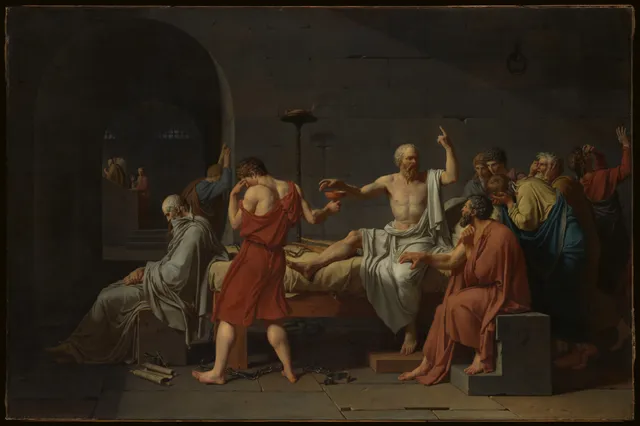
For the purest case of iconography aimed at a knowing audience, turn to Jacques-Louis David's The Death of Socrates of 1787. Look at the philosopher's two hands and you have the whole picture. One reaches up and out for the cup of hemlock, fingers closing on it without the slightest tremble, while Socrates does not even glance at the poison. The other hand is raised with a finger pointing upward, frozen in the middle of an argument. He is still teaching as he takes the cup. The body is a wall of pale, controlled muscle, lit hard from the left, set against a bare cell of cold gray stone. Around him the followers crumple. One clutches his own face, one grips the wall, one at the foot of the bed bows his head into his hand. The contrast is total and deliberate: the dying man is the only calm body in the room.
Every element is a sign a Parisian of 1787 could read. The pointing finger is reason itself, undisturbed by death. The untrembling reach for the cup is the free man choosing the law over his own life. The seated figure at the head of the bed, lost in thought rather than grief, is Plato, set apart to mark him as the witness who will carry the teaching forward. David has arranged a lecture on civic virtue and self-mastery, staged two years before the Revolution for an audience already arguing about tyranny and conscience. The picture was understood as such immediately. This is what the grand style was for: not to illustrate a Greek anecdote but to hand a contemporary public a model of how a citizen should stand when the state turns unjust. The toga here is not nostalgia. It is the costume that gives the lesson the authority of the ancients.
What the archive shows
The genre's reach is easy to underestimate from the handful of famous machines that fill the textbooks. Across our own holdings, Artifact World Gallery keeps 2,044 history paintings spread over 114 venues, the work of 903 different artists, running from roughly 1150 to 2013. Two figures in that line matter. The first is the spread of nearly nine centuries, which tells you the category outlived the Academy that named it and kept absorbing new subjects, from medieval chronicle to nineteenth-century nationhood. The second is the count of 903 hands. This was never the preserve of a few masters. It was a vast, working tradition with shared rules, which is exactly why the iconography stayed legible: a vocabulary used by hundreds of painters for hundreds of viewers becomes a language, and a language can be read.
The deep end of that range reaches objects that were never meant for a gallery wall at all. Apollonio di Giovanni's Cassone with the Conquest of Trebizond is a fifteenth-century Florentine marriage chest, its long front panel crowded with a historical campaign rendered as a glittering procession. A chest like this stood in a bride's chamber and carried her linens. Its painted history was a daily moral furnishing, a story of valor and order meant to shape a household, read every morning by the woman who opened it. That is iconography at work in the most domestic register imaginable, and it makes the same point the David makes at the grand end. The picture exists to instruct the person standing in front of it, and the person standing in front of it knew how to take the instruction.
What survived the code
Rembrandt had shown, more than a century before West, how much pressure the grammar could take. His Night Watch of 1642 took a static militia group portrait and pushed it toward history painting by setting the figures in motion, a rare group portrait that showed the men actually doing something rather than posing in rows. The lesson there is the lesson everywhere in this genre. Drama, light, and arrangement carry meaning that the bare subject does not. A row of armed citizens is a record. The same men caught mid-stride, half in shadow, become an event.
The grand style as Reynolds defined it did not survive the nineteenth century intact. Photography took the work of recording, the academies lost their authority, and the modern public stopped reading attributes the way it once read them. What survived is the deeper habit the genre trained: the assumption that an image of the past is always an argument about who we are now. Every national monument, every founding mural, every carefully composed news photograph of a leader still runs on the grammar these painters built, the pointing hand, the breaking light, the unarmed hero on the porch. The pictures meant a great deal to their first viewers because those viewers were taught to read them. We can learn the language back. When we do, a man drinking from a cup stops being a quiet old philosopher and becomes, again, the most dangerous figure in the room: a citizen who would rather die by the law than live against it.
Sources & further reading
- History painting (art term) — Tate
- Genre Painting in Northern Europe (Heilbrunn Timeline of Art History) — The Metropolitan Museum of Art
- History painting — Wikipedia
- Benjamin West's The Death of General Wolfe — Smarthistory
- Benjamin West — National Gallery of Art
- Sir Joshua Reynolds's Discourses on Art — Internet Archive