The hardest exam a painter could sit
Mythology painting was never really about the gods. To stage a mythological subject, a painter had to invent a scene no living person had witnessed, build convincing bodies in motion and often undressed, organize a story that might fold several moments of a narrative into one frame, and then finish the surface to a pitch that announced large ambition. The subject was a pretext. The real content was method. That is the claim this essay defends: the recognizable look of mythological painting was manufactured, on purpose, by a training system and a working procedure that treated myth as the most demanding test a painter could face. Ask how the style was made and you are really asking about the source text on the desk, the campaign of drawings, the workshop replica, and the handling of the nude.
The hierarchy made this official. The French Royal Academy introduced the term history painting in the seventeenth century to cover subjects taken from classical history, classical mythology, and the Bible, according to the Tate's glossary of art terms. In 1667 the theorist André Félibien fixed the ranking that would govern European ambition for the next century, placing the multi-figure history painting, with mythology inside it, above portraiture, above scenes of daily life, above landscape and still life. The order was not snobbery dressed as theory. It described a ladder of difficulty. You climbed it by mastering the lower rungs and then combining them. Mythology sat at the summit because it asked for everything the lower genres asked for, at once, and added invention on top.
Our own holdings show how broad and how durable that ambition was. Artifact World Gallery keeps 3,199 Mythology works, made by 1,166 different artists and held across 123 venues, spanning roughly 1100 to 2023. That is nearly a millennium of painters returning to the same handful of stories about love, punishment, and transformation. The spread matters more than the count. When eleven centuries of artists keep choosing Venus, Pandora, and the Sphinx, they are not chasing novelty of subject. They are using a fixed repertoire as a common ground on which to compete on craft. The story is the constant. The method is the variable, and the variable is where the style lives.
The source on the desk
Before a brush touched anything, the mythological painter was a reader. The single most mined book in the European studio was Ovid's Metamorphoses, a long poem of bodies changing into laurels, stags, stars, and stone. It survives today in editions like Frank Justus Miller's facing-page Latin and English Loeb, published in London in 1916 and now free to read on the Internet Archive. Ovid gave painters something a single anecdote could not: a plot with a before and an after. The flower that springs from spilled blood, the woman who becomes a tree at the moment of capture, the hunter gored at the height of his beauty. Each episode hands the artist a hinge between two states, and the whole problem of mythological composition is how to paint a hinge.
This is the first material fact of the genre, and it is a literary one. The painter is illustrating a text most of the audience knows by heart, which frees him from explaining and forces him to interpret. He cannot simply report the moment. He has to choose which instant carries the whole arc, then load that instant with the parts the viewer already remembers. A reader who knows Ovid sees the death inside the embrace, the curse inside the gift. The method, in other words, begins as a reading strategy. The poem is the brief, and the painter's first act of invention is deciding where in the poem to stop time.
The drawn campaign
Between the reading and the painting came a wall of paper. A finished mythological canvas is the visible tip of a buried mass of drawings: studies of single figures from a posed model, sheets that test the whole arrangement, drawings of a single hand or a falling drapery worked until it behaved. The J. Paul Getty Museum built an entire exhibition around this hidden labor, Gods and Heroes: European Drawings of Classical Mythology, which gathered close to forty sheets running from the Renaissance into the nineteenth century, all of them devoted to working out how to picture myth (Getty). The drawings are where the style is actually engineered. The oil only records the decisions.
Why so much paper for mythology in particular? Because the body is exposed and the body is doing something hard. A clothed sitter in a portrait forgives errors of anatomy that a leaping nude will not. The mythological figure runs, recoils, twists to look back, lifts a weight, dies. Each of those verbs is an anatomical claim the painter has to be able to back up, and the only way to back it up is to have drawn it from a model, repeatedly, until the muscle and the foreshortening read as true. The drawn campaign is the engineering phase. By the time the canvas is begun, the difficult thinking is done, and what remains is the matter of paint.
The nude as engine
Mythology carried the nude back into respectable painting, and that single permission shaped the whole genre's method. A church altarpiece had little room for a life-size pagan body. A poem about Venus had room for nothing else. Smarthistory describes Botticelli's Birth of Venus as among the first almost life-size representations of a fully mythological female nude in Western art since antiquity (Smarthistory). Once that door opened, the nude became the genre's central technical problem and its central pleasure. The painter who could model living flesh in oil, with its blush and its weight and its soft transitions, owned the most prestigious skill in the studio.
Flesh in oil is built, not laid down in a stroke. The Venetian method, which set the standard the rest of Europe chased, worked the body up in layers: a solid underpainting that fixed the light and shade, then a sequence of thin translucent glazes that let one tone glow through another, so that skin seemed lit from inside rather than colored on the surface. A cheek is not pink paint. It is white and earth under a film of warm lake, the warmth pooling where blood would pool. This is why mythology and the nude advanced together. The subject demanded bodies, the bodies demanded glazing, and glazing became the signature handling of the genre's most ambitious practitioners.
The workshop and the replica
Demand turned method into industry. Titian, whom our archive represents more deeply than any other mythological painter, ran his studio as a repeatable system. His Venus and Adonis, a subject lifted straight from Ovid, was not a single picture but a template. The National Gallery of Art notes that at least thirty versions of the composition came out of Titian and his workshop (National Gallery of Art). That number tells you something the individual masterpiece hides. A successful mythological invention was an asset to be reproduced, varied, and sold again, with assistants laying in the repeatable parts and the master reserving the passages that announced his hand. Our own holdings carry the genre's reach across that economy, including a Venus and Adonis by Joost de Pape, one more painter taking up a composition the Venetians had made into common property.
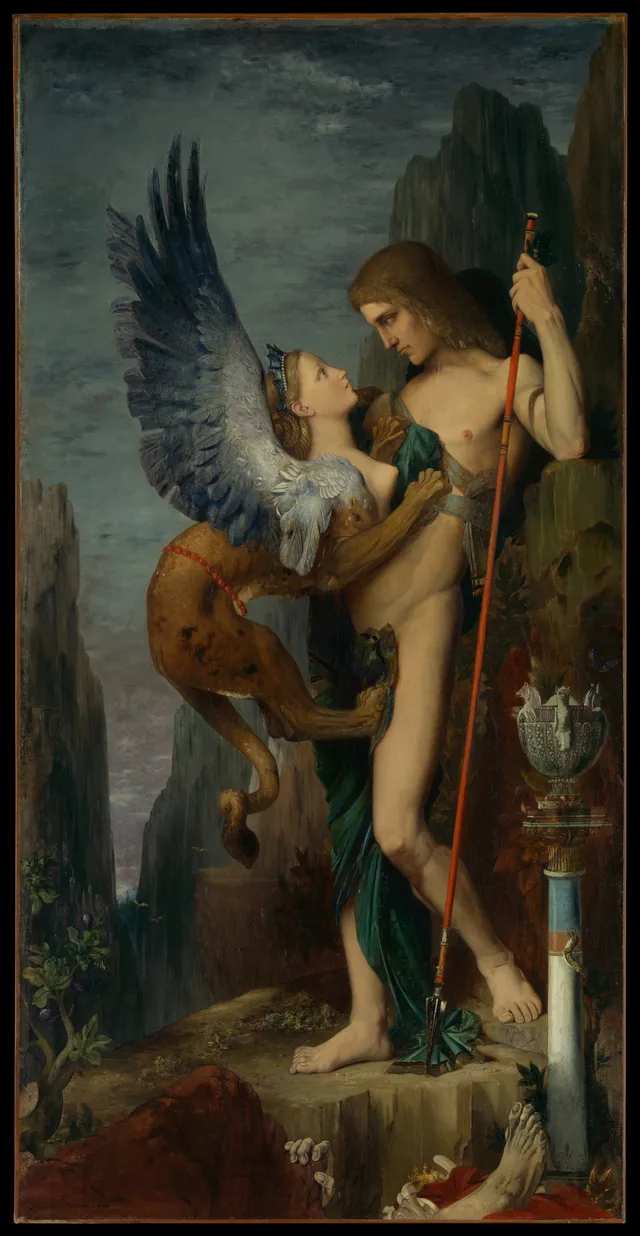
Look closely at how a later master inherits and bends this machinery in Oedipus and the Sphinx by Gustave Moreau. The canvas stands tall and narrow, and Moreau jams the two protagonists into a single vertical column of contact. The Sphinx does not crouch at a distance and pose a question. She has sprung onto Oedipus, claws hooked into his chest and thigh, her woman's face lifted to within inches of his. He does not flinch. He holds his spear and returns her stare with a stillness that is almost rude. At the lower edge, easy to miss, the genre's older brutality is kept in reserve: a pale foot and a dead hand belonging to a suitor who answered wrong, fingers still gripping the rock above the ravine. A column rises, an urn sits to one side, the sky behind goes thin and cold.
Everything that earlier centuries built is here, repurposed. The drawn anatomy is impeccable, the surface enameled to a hard polish that recalls the glaze tradition without its warmth, and the body of Oedipus is the academic nude doing the academic thing, holding a difficult contrapposto under pressure. But Moreau has frozen the hinge so completely that the picture refuses to resolve. The story's whole tension is the question and its answer, and he paints the half-second before either, two faces locked, the riddle suspended in the air between them. The method is conservative. The result is strange. That gap is exactly what the late genre learned to exploit.
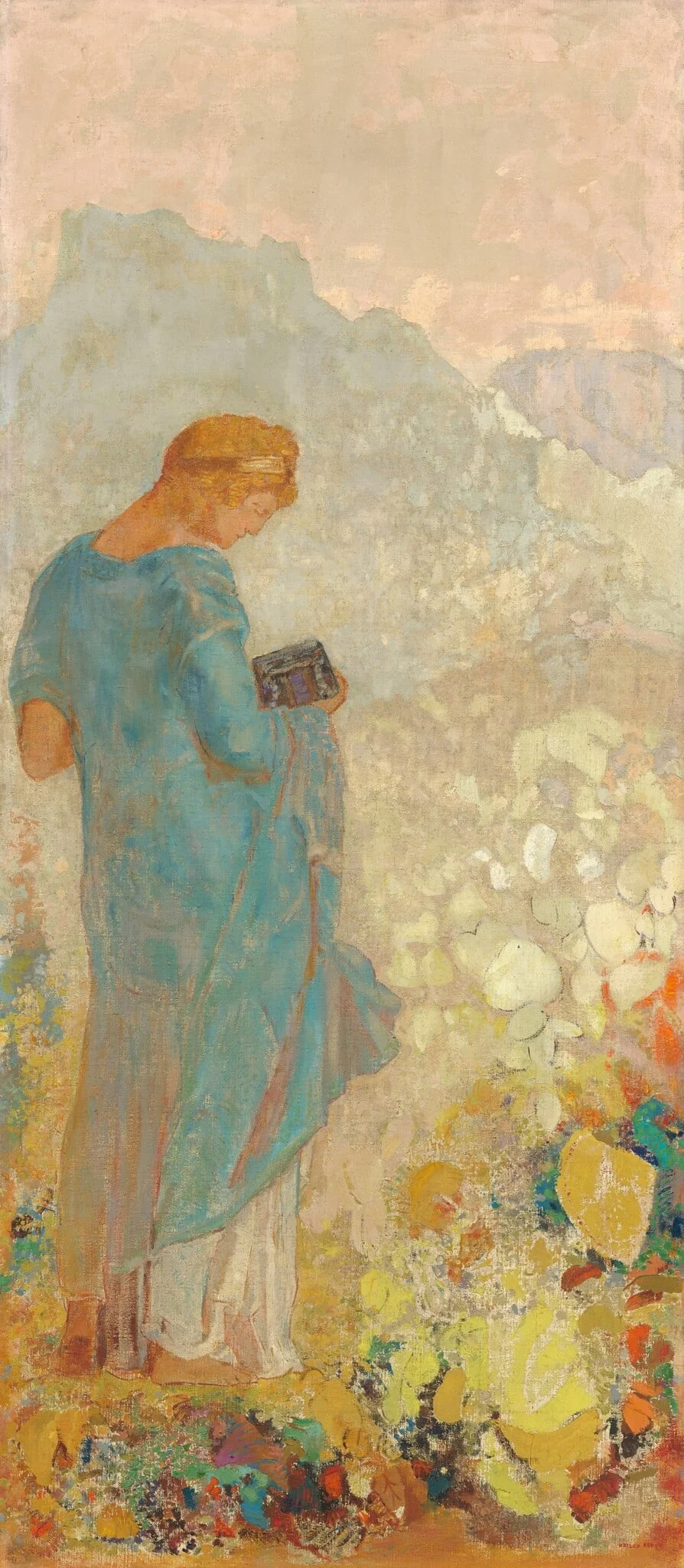
Odilon Redon pushes the same inheritance further into dream. His Pandora keeps the obligatory body, a pale standing nude holding the fatal vessel, but dissolves everything the academy prized around it. There is almost no narrative instant to read. The figure rises out of a haze of flower-color, blues and golds and greens worked so loosely that the meadow seems to be condensing into a woman rather than surrounding one. The first evils of the world are about to escape from the jar in her hands, and Redon paints none of that event. He paints the hush before it, a body made of the same colored mist as the garden, beautiful and about to be the cause of everything. The literary hinge has been internalized until it is mood rather than scene.
Works discussed in this article
Paint as the real subject
Some painters used myth less as a story than as a license to handle paint with freedom. Rembrandt's Flora barely needs the goddess. A young woman in heavy floral costume holds blossoms, and the whole reason for the picture is the matter she is made of. The fabric is built in thick, loaded strokes you can read as ridges of pigment, the petals dabbed and dragged so that the flowers seem to have been grown out of the brush. Calling her Flora gives Rembrandt permission to dress an ordinary face in extraordinary stuff and to let paint behave like silk, like leaf, like skin, in the same square foot. The mythological label here is almost a courtesy. The information is in the impasto.
His Philemon and Baucis makes the case from the opposite direction, through light. The Ovidian tale is gentle for once: an old couple unknowingly feed two travelers who turn out to be gods, and are spared the flood that drowns their unkind neighbors. Rembrandt sets it in a dim interior and lets a single warm source carve the figures out of brown shadow, the disguised gods glowing at the humble table while the corners of the room fall away into dark. The technical content is the management of that fall-off, the way the eye is led to the lit faces and allowed to lose everything else. Myth gave him a reason to paint hospitality as a small miracle of illumination.
The method, revisited and exported
By the eighteenth century the procedure had hardened into a curriculum that could be taught, carried abroad, and adapted. Angelica Kauffmann worked the literary end of the genre with a Neoclassical clarity, choosing episodes like Telemachus and the Nymphs of Calypso, a subject drawn from the same well of classical narrative, and staging it with the legible, frieze-like calm the age wanted. The method she applied was the inherited one: a known text, a drawn arrangement, idealized bodies, a finish that flatters the figure. What changed was the temperature, cooler, more sculptural, the warm Venetian glow swapped for daylight and edges.
The Met's account of the genre's later life reminds us how flexible the inherited vocabulary became. In Italian allegorical programs of the seventeenth and eighteenth centuries, mythology turned into a usable sign system, with Hercules deployed as shorthand for virtuous strength inside larger decorative schemes (The Metropolitan Museum of Art). A god was no longer only a character in a story. He was a word in a visual language, ready to be set into a ceiling or a print to mean something about a patron. The method here is semantic as much as technical, the painter assembling meaning from a stock of figures the educated viewer could read on sight.
And then the system that built the genre began, slowly, to let it dissolve. Jean Baptiste Camille Corot painted nymphs into his silvery woods, but the woods are the point and the nymphs are nearly weather. Lorenzo Lotto, a generation behind the Venetian giants, had already shown how a single restless temperament could bend the shared repertoire toward private feeling. The repertoire stayed fixed while the handling around it kept moving, which is precisely why the genre lasted across the eleven centuries our archive records. The stories were stable enough to carry any method a painter wanted to test against them.
Here is the judgment I will stand behind. The myths themselves are not what make these paintings worth our attention now. We can read Ovid for the stories. What the canvases hold, and what no text can give us, is the visible record of a craft being pushed to its limit under the highest stakes the art world of the time could set. A mythological painting is a painter's argument that he can do the hardest thing. Read it that way and the apparently dusty subject becomes the most honest evidence we have of how ambitious painting was actually made.
Walk the genre in our collection and you can watch the method change hands. The same Sphinx, the same Venus, the same girl with flowers, passed from a Venetian workshop turning out thirty replicas to a Dutchman loading silk in paint to a Frenchman freezing a riddle to a Symbolist letting the figure melt into a meadow. The story holds still on purpose. Everything around it, the glaze, the light, the edge, the loaded stroke, keeps moving, and that movement is the history of painting itself, told through one fixed set of gods who agreed to sit for all of it.
Sources & further reading
- History painting (art term) — Tate
- Venus and Adonis — National Gallery of Art
- Sandro Botticelli, The Birth of Venus — Smarthistory
- The Greek Hero in Italian Renaissance and Baroque Art — The Metropolitan Museum of Art
- Drawings Exhibition Features Gods and Heroes of Classical Mythology — The J. Paul Getty Museum
- Metamorphoses (Loeb edition, trans. Frank Justus Miller, 1916) — Internet Archive
- Hierarchy of genres — Wikipedia
- History painting — Wikipedia